
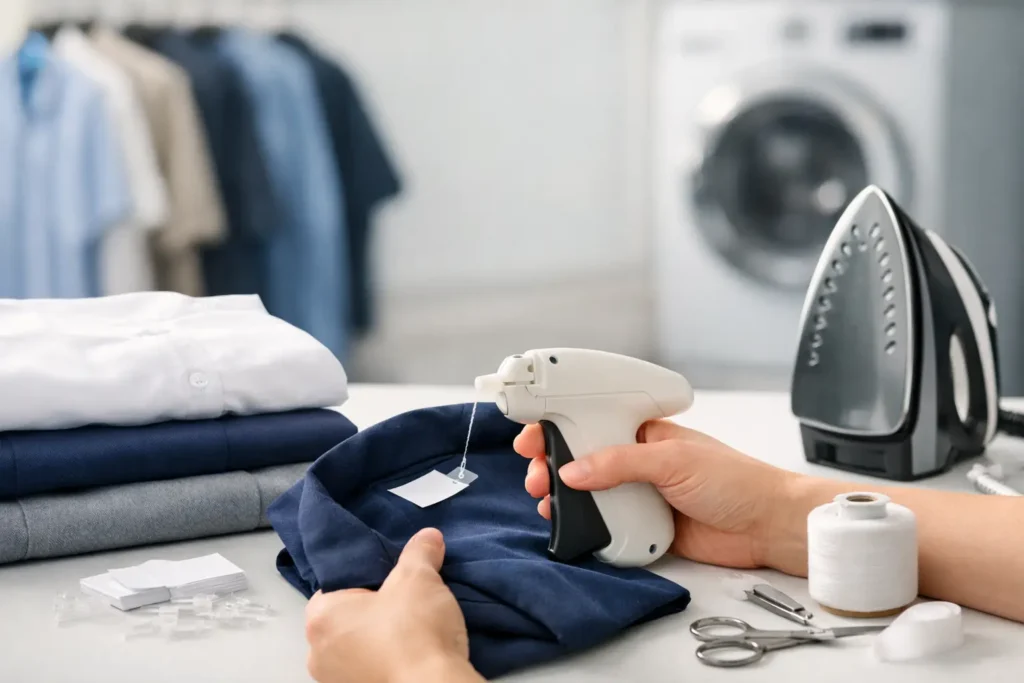
Uniform loss usually does not start with theft or poor staff behavior. It starts in the wash process – when names fade, tags peel, or garments come back to the wrong department. That is why the best laundry labeling methods for uniform programs matter far beyond identification. They affect turnaround time, replacement cost, employee satisfaction, and how much manual correction your team does every week.
For commercial laundries, hotels, healthcare facilities, dry cleaners, and institutional operations, labeling is not a small accessory decision. It is part of process control. A weak label system creates avoidable rewash, sorting delays, and garment mix-ups. A reliable one supports accountability and keeps the uniform program moving at production speed.
What makes a labeling method work in a uniform program
The right label has to survive your real conditions, not ideal ones. That includes repeated washing, chemical exposure, heat, extraction force, finishing, and daily handling. It also has to stay readable by the people actually touching the garment at each stage – soil sort, wash, finishing, packing, and return.
That is where many operations make the wrong call. They choose the lowest-cost marking method without checking whether it matches the fabric, wash temperature, or replacement cycle of the garments. A cotton housekeeping uniform, a polyester-blend front desk shirt, and a healthcare scrub top may all need different labeling logic even if they are processed in the same plant.
A good system usually balances four things: durability, readability, application speed, and replacement cost. If one of those is off, the label program starts creating work instead of removing it.
Best laundry labeling methods for uniform programs
There is no single best option for every facility. The strongest method depends on garment type, wash intensity, and how your team tracks inventory.
Sew-in name tapes
Sew-in name tapes remain one of the most dependable options for uniform programs with heavy wash frequency. They handle repeated commercial laundering better than most temporary solutions, and they are less likely to detach during extraction or drying when properly applied.
This method works especially well for long-life garments assigned to individual employees. Hospitality uniforms, industrial workwear, and healthcare apparel often fit this model. A sewn label gives consistent placement, supports visual identification, and holds up under finishing.
The trade-off is labor. Application takes more time, whether done in-house or outsourced, and replacement requires a repair step. But for programs where garments stay in circulation for months or years, the longer service life often justifies the extra effort.
Heat-seal labels
Heat-seal labels are popular because they are faster to apply and can look clean and professional. For some uniform programs, they offer a good middle ground between durability and speed. They are especially useful when operations need to label large garment batches quickly.
That said, performance depends heavily on label quality, adhesive quality, fabric type, and application accuracy. If temperature, pressure, or dwell time are off, labels can lift at the edges or fail early. Heat-seal labels also tend to be less forgiving on heavily flexed areas or garments exposed to aggressive wash chemistry.
For moderate-duty programs, they can be effective. For high-temperature, high-turn environments, testing first is the smart move.
Direct marking with laundry pens
Laundry pens are simple, low-cost, and useful for temporary marking or short-cycle garments. They can work for quick identification during onboarding, repairs, or stopgap inventory control. For emergency use, they are hard to beat because they require no machinery and almost no setup.
But they are rarely the best long-term answer for a structured uniform program. Ink can fade, writing can become hard to read, and consistency depends on the person doing the marking. If your operation runs high volume, handwritten identification usually creates more exceptions over time.
Use this method when speed matters more than longevity, or when the garment life is short enough that permanent labeling is unnecessary.
Barcoded and serialized labels
For operations managing higher garment counts, serialized labels can improve control significantly. A visible code tied to an employee, department, issue date, or replacement history helps reduce manual guesswork and supports better recordkeeping.
This approach is especially useful when uniform loss has become a measurable cost. Instead of relying only on visual name recognition, staff can match garments to system records. That improves accuracy in plants handling multiple customers or departments.
The limitation is that the label alone is not the whole system. You need scanning discipline, database accuracy, and label placement that remains accessible after repeated use. Without process follow-through, a serialized label becomes just another tag.
RFID-enabled labeling
RFID is the advanced option for uniform programs that need stronger asset visibility and less manual tracking. It can support bulk reading, inventory audits, and movement tracking across wash, storage, and issue points. In large healthcare, hospitality, or industrial programs, that can save labor and expose shrinkage patterns faster.
It is not the automatic best choice for every operator. RFID adds cost at the label level and usually requires infrastructure investment, software integration, and process training. For smaller operations, the return may not justify the setup. For larger systems with chronic losses or strict compliance requirements, it often does.
The decision comes down to scale. If you are managing thousands of pieces and spending too much labor on tracking, RFID deserves a serious look.
How to choose the best method for your operation
Start with garment life. If uniforms are issued for long-term use, sewn labels or durable heat-seal labels usually make more sense than direct pen marking. If garments are temporary, seasonal, or frequently replaced, a simpler method may be enough.
Next, look at wash conditions. High heat, strong chemistry, and repeated extraction put real stress on labels. A method that performs well in light-duty laundering may fail quickly in a commercial plant. This is where operators should think like production managers, not office buyers.
Then consider how garments are returned. If your process relies on visual sorting, readability matters most. If you run inventory software or track assignment history, serialized labels or RFID may create more value.
Finally, calculate labor honestly. A cheaper label that takes longer to apply, reapply, or verify can cost more over the life of the program than a premium label with faster handling.
Placement matters as much as label type
Even the best laundry labeling methods for uniform programs can fail if labels are placed badly. A label sewn into a high-friction area may curl, fray, or irritate the wearer. A code hidden in a seam or under a fold slows identification at finishing and packing.
Most operations do best with standardized placement across garment categories. That gives staff a repeatable visual cue and reduces search time. Consistency also matters when training new employees or working across multiple departments.
Comfort matters too. If employees dislike the label placement, they may cut tags out or report uniforms as defective. The practical answer is to choose a location that protects the label without creating wearer complaints.
Common mistakes that cause relabeling and loss
The biggest mistake is mixing labeling methods without a clear policy. One garment has a sewn tape, another has faded pen marking, another has a partial heat-seal tag. That inconsistency slows every touchpoint and makes exceptions harder to resolve.
Another common problem is choosing labels without testing them in actual operating conditions. A sample may look fine on day one and fail after ten wash cycles. Short trials save money here.
Some facilities also overlook the supply side. Needles, fasteners, tapes, and marking accessories are small items, but if they are not available when needed, relabeling gets delayed and garments re-enter circulation incorrectly marked. Specialized suppliers such as ABELCO EQUIPMENT TRADING LLC understand that these consumables are part of uptime, not an afterthought.
A practical recommendation for most uniform programs
For many commercial uniform programs, the most reliable starting point is a durable sew-in or high-quality heat-seal label with standardized placement and clear employee or garment identification. If the operation is large enough to need better traceability, add serialization. If losses are high and scale supports the investment, move toward RFID.
That is the practical path – start with what survives your wash environment, then add technology only when it solves a real operational problem. Not every plant needs the most advanced system. Every plant does need a labeling method that holds up, stays readable, and fits the way garments move through production.
The best laundry labeling methods for uniform programs share one trait: they hold up under real wash conditions. The right label should disappear into the workflow. When nobody is stopping to guess who owns a garment, where it goes, or whether the mark will survive the next wash, your uniform program is working the way it should.
For teams standardizing their wider operation, our guide to commercial washers for laundry buyers pairs well with a solid labeling plan. For durability standards behind textile care symbols, the GINETEX care labelling system is a useful external reference.