
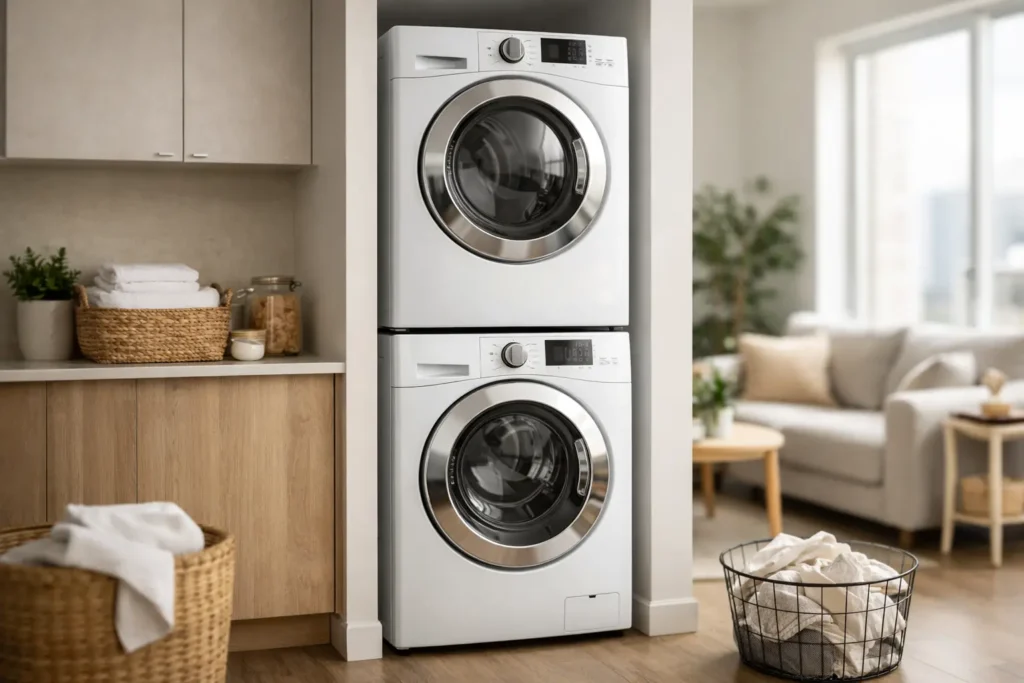
Apartment laundry projects usually look simple on paper until the first site measurement is wrong, the drain location is off, or the machine capacity does not match resident demand. That is why knowing how to choose stacked washer dryer for apartments is less about picking a compact unit and more about protecting uptime, tenant satisfaction, and operating cost.
For apartment owners, property managers, and on-premise laundry buyers learning how to choose stacked washer dryer for apartments, the right stack setup has to fit the room, match the utility infrastructure, and hold up under repeated daily use. Checking ENERGY STAR clothes washer ratings early helps control long-term utility cost. A residential-style decision process often leads to short equipment life, more service calls, and resident complaints. When weighing how to choose stacked washer dryer for apartments, a commercial buying approach is better. It starts with the room, then the load profile, then the machine specifications.
How to choose stacked washer dryer for apartments starts with the room
When you map out how to choose stacked washer dryer for apartments, the first decision is physical fit. Not just whether the machine fits through the door, but whether the full installation works in real conditions. Measure width, depth, height, doorway clearance, turning radius, and the service space required around the unit. If the laundry room is tight, even a small mismatch can delay installation or limit future maintenance access.
Stacked systems make sense in apartments because they save floor space, but vertical space matters just as much. Check ceiling height, sprinkler locations, vent routing, and whether the top dryer section will be accessible for routine servicing. If residents or staff need to load the upper dryer frequently, ergonomics matter too. A unit that technically fits but is awkward to use will create complaints over time.
Drain position, water supply, electrical service, and gas availability should be confirmed before equipment is shortlisted. Too many buyers choose the machine first and then discover the utility conversion adds cost they did not budget for. If the site already supports electric dryers, changing to gas may not make sense. If venting is difficult, that may narrow your options immediately.
Capacity should match the apartment demand profile
One of the most common mistakes in apartment laundry rooms is choosing based on footprint alone. Capacity has to reflect the number of units served, resident turnover, and typical peak laundry periods. A machine that is too small may save space upfront but will lose money through extended cycle queues, poor resident experience, and faster wear.
Think in terms of throughput, not just drum size. A stacked washer dryer system should move laundry efficiently during peak hours, especially in multifamily properties where weekends can put heavy pressure on shared equipment. If your property has family-heavy occupancy, pet-friendly leasing, or longer resident stays, expect larger and more frequent loads.
For in-unit apartment applications, capacity should suit the likely user without oversizing the utility draw. For shared laundry rooms, commercial-grade stack systems are usually the better choice because they are designed for repeated cycles and faster turnaround. It depends on whether the machine serves one apartment, a small cluster of units, or a full common laundry room.
Residential-style and commercial-style stacks are not the same
This is where procurement discipline matters. Residential stack units can work in light-duty settings, but they are rarely the right answer for apartment common areas with frequent use. Commercial stack washer/dryer systems are built with stronger components, serviceable parts, and operating cycles that support higher turnover.
The lower purchase price of a residential unit can look attractive, but downtime changes that math quickly. If a property manager has to replace equipment earlier than expected or deal with recurring repairs, the initial savings disappear. Buyers focused on long-term occupancy and operating continuity should look hard at build quality, parts availability, and serviceability.
Utilities will narrow the right choice fast
When evaluating how to choose stacked washer dryer for apartments, utility compatibility should move near the top of the checklist. Washer voltage, dryer power source, water pressure, drain capacity, and venting requirements all affect installation cost and long-term reliability.
Gas dryers often offer faster dry times and can reduce operating costs in the right setting, but only when gas service is already practical and compliant. Electric dryers may be easier to install in many apartment buildings, especially in retrofit situations. The right answer depends on the site. There is no value in choosing a high-performance unit if the building cannot support it efficiently.
Water extraction also matters. A washer with stronger extraction leaves less moisture in the load, which shortens dryer time and improves throughput. In apartment settings, that can reduce resident wait times and energy consumption. This is one of the specifications that gets overlooked because buyers focus on capacity and dimensions first.
Venting, heat, and noise deserve more attention
Apartment environments bring resident sensitivity that industrial sites do not always face. Noise and heat output can become leasing issues if the laundry room is adjacent to occupied spaces. Check decibel expectations, airflow requirements, and room ventilation. A poorly planned laundry room can become hot, loud, and expensive to operate.
If the machine is installed inside an apartment unit rather than a common area, this becomes even more important. Residents expect quieter operation and manageable cycle times. In that case, balancing compact size with performance and noise control becomes a more nuanced decision.
Durability and serviceability matter more than appearance
A clean exterior and modern control panel may help at first glance, but apartment equipment should be evaluated like operating infrastructure. Ask practical questions. Are core components built for repeat use? Are wear parts readily available? Can the machine be serviced without major disassembly? Is the control system straightforward enough for staff to manage?
The best stacked systems for apartments are not simply the smallest or cheapest units. They are the ones that stay in service, maintain consistent cycle quality, and can be repaired quickly when needed. Knowing how to choose stacked washer dryer for apartments is where recognized commercial brands usually justify their position. Buyers are not just purchasing a machine. They are purchasing predictability.
In how to choose stacked washer dryer for apartments, a machine with limited parts support is a risk, especially for property groups trying to standardize maintenance across multiple sites. Commonality of parts, known service procedures, and supplier support can make a major difference over the life of the equipment. For venting and electrical fit, the U.S. Department of Energy laundry guide is a helpful neutral reference.
Controls, payment setup, and user experience
For shared apartment laundry rooms, controls should be easy for residents to understand and easy for management to monitor. Complicated interfaces lead to misuse, abandoned cycles, and unnecessary service complaints, and NFPA fire-safety guidance on dryer venting is worth reviewing for shared rooms. Straightforward cycle selection is usually better than excessive programmability unless the site has a specific operational reason.
If the laundry room is revenue-generating, payment compatibility matters as well. Buyers should confirm whether the equipment supports the payment model they want today and whether it can adapt later. Coin, card, app-based, or centralized payment systems each have operational trade-offs. The wrong setup can create accounting friction or resident dissatisfaction.
For in-unit apartment installations, the user experience is simpler, but reliability remains the real selling point. Residents care less about advanced features than consistent wash quality, reasonable cycle times, and quiet operation.
Cost should be measured across the equipment life
Purchase price is only one part of the decision. A lower-cost stacked washer dryer can become the more expensive option if it uses more utilities, needs frequent repairs, or creates long resident wait times. Total operating cost includes water, power or gas, maintenance, downtime, and replacement cycle.
That is why commercial buyers should compare expected lifespan and service structure, not just unit pricing. In many apartment applications, the best value comes from equipment that costs more upfront but delivers steadier performance and fewer interruptions. That is a procurement decision, not just a product decision.
How to compare final options before you buy
Once you narrow the shortlist, compare each model against the same criteria: actual installed footprint, capacity, utility match, extraction performance, dryer efficiency, expected duty cycle, service access, parts support, and resident usability. If one machine wins only on price and loses on three or four operating points, it is usually not the right machine.
It also helps to think beyond opening day. Can your team get parts quickly? Can the supplier support future replacements or expansion? If you operate across multiple properties, can the same equipment platform be standardized? Specialized suppliers understand these questions because they are tied directly to uptime.
A good apartment laundry installation should feel predictable after it is commissioned. Residents should know how to use it. Staff should know how to maintain it. Ownership should know what it costs to run.
If you are evaluating stacked systems for apartment use, the right choice is the one that fits the site, handles the real load, and stays serviceable over time. Get that part right, and the laundry room stops being a recurring problem and starts performing like it should.