
A missing name tape does not look like a big problem until linen starts circulating through multiple loads, multiple departments, and multiple shifts. In a busy plant, commercial laundry marking accessories are not a minor add-on. These commercial laundry marking accessories are part of control, traceability, and turnaround.
If you run a hotel laundry, healthcare linen room, dry-cleaning operation, or on-premise facility, the right marking setup helps prevent mix-ups, reduces replacement loss, and keeps customer-owned items identifiable after repeated washing and finishing, supporting the traceability that CDC laundry handling guidance expects in healthcare settings. The wrong setup does the opposite. Marks fade. Fasteners fail. Tapes fray. Staff spend time rechecking pieces that should have been easy to sort the first time.
What commercial laundry marking accessories actually do
In practical terms, these products support one job – keeping each item identified throughout the wash process and during handling after wash. That sounds simple, but commercial environments create stress that ordinary labeling methods do not survive. High temperatures, moisture, chemicals, extraction speed, ironing pressure, and repeated handling all expose weak accessories very quickly.
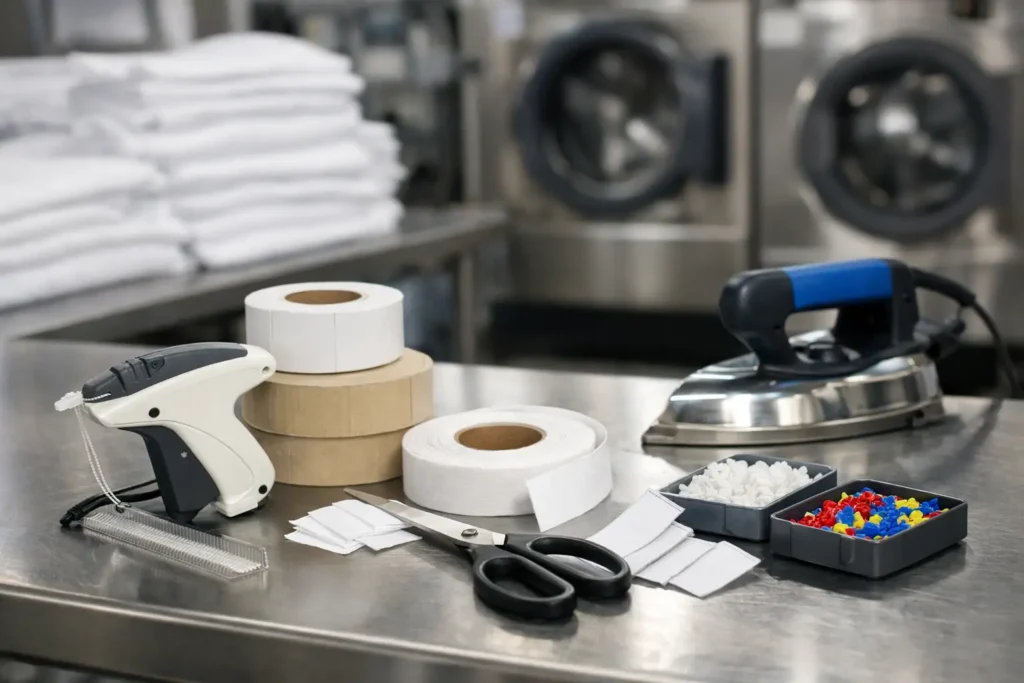
That is why professional operations typically rely on a small but essential category of supplies: marking tapes, fasteners, marking needles, and laundry pens. Each one plays a specific role. Tapes carry the identifier. Needles and fasteners help attach the mark securely. Pens are used for temporary or supplemental identification, especially where a stitched or fixed mark is not practical.
For many operators, this category gets attention only when something goes wrong. A better approach is to treat marking supplies the same way you treat belts, valves, or routine consumables. They are part of continuity. If the accessories are inconsistent, the process becomes inconsistent.
The core types of commercial laundry marking accessories
Marking tapes are usually the foundation of a durable identification system. They are used where a permanent or semi-permanent label is needed on garments, uniforms, linens, or resident-owned pieces. The quality difference matters. A tape that looks fine at receiving may not hold shape after repeated wash cycles, especially if it is exposed to aggressive chemicals or high-heat finishing.
Fasteners matter just as much. In some operations, they are used for quick application or to support specific tagging methods. The main concern is not just attachment at the point of use, but attachment after wash, extraction, and finishing. A low-grade fastener may save a little on purchase cost and create a larger loss later in labor, rework, and missing-item claims.
Needles are a smaller purchase, but not a small decision. In high-volume environments, compatibility between needle type, fabric type, and application method affects both speed and durability. If staff struggle to apply labels consistently, the process slows down. If the needle choice damages delicate fabric or creates weak stitching, the mark will not last.
Laundry pens are useful, but they should be viewed realistically. They are best for temporary notation, backup marking, or cases where the item does not justify a sewn tape. They are not always the right answer for long-term identification. Ink performance depends on fabric, wash chemistry, and frequency of reprocessing, much like the durability tests behind ASTM textile care labeling standards.
Why durability matters more than unit price
Procurement teams often compare commercial laundry marking accessories by piece cost because they are recurring items. That is fair, but it is only part of the picture. The real cost is tied to failure rate.
A cheaper tape that curls, fades, or detaches creates hidden cost in sorting delays, relabeling, replacement linen, and customer complaints. The same logic applies to fasteners, pens, and other commercial laundry marking accessories. In commercial laundry, low-value components can create high-value disruption, a point echoed in Drycleaning & Laundry Institute best practices.
This is why experienced operators tend to buy commercial laundry marking accessories for repeat performance rather than the lowest line item. Dependable commercial laundry marking accessories protect workflow. That is the value.
How to choose the right marking setup for your operation
The best commercial laundry marking accessories combination depends on what you process and how you process it. A hotel laundry handling sheets, towels, and F&B linen has different marking needs than a dry cleaner handling customer garments. A healthcare laundry faces another level of demand because item identification may tie directly to resident ownership, room allocation, or compliance-driven handling.
Start with the item type. Flat linen, uniforms, personal garments, and specialty textiles do not all respond the same way to the same marking method. Thick items may accept one fastening method easily, while delicate items may require a softer, lower-impact approach.
Then look at your wash conditions. Heat level, chemical dosing, moisture retention, and finishing method all influence accessory performance. If your operation uses intense wash formulas or high-temperature drying, choose products built for that exposure. If your volume is lower and handling is gentler, you may have more flexibility.
Application method also matters. If your team applies labels manually, speed and ease of use are important. If the process takes too long or requires too much correction, staff will create workarounds, and those workarounds usually reduce consistency.
Questions worth asking before you reorder
Before buying on autopilot, it helps to ask a few direct questions. Are marks staying readable after repeated cycles? Are attachments surviving normal wash and finish conditions? Are staff applying them quickly and correctly? Are you replacing too many labeled items because identification fails before the textile does?
If the answer to any of those questions is no, the issue may not be your process alone. It may be the accessory quality, the accessory choice, or a mismatch between the accessory and the textile.
Common mistakes with commercial laundry marking accessories
One common mistake is treating all fabrics as if they need the same marking method. They do not. Heavy-duty workwear, hospitality linen, and resident garments each place different demands on the accessory.
Another mistake is relying on pens where sewn or fixed identification is the better long-term option. Pens are useful, but they can fade, transfer, or become hard to read over time depending on the application. They work best when their limitations are understood.
Some operations also underestimate compatibility. A good tape with the wrong needle, or a durable fastener applied poorly, can still fail in service. The accessory set needs to work together.
The last mistake is supply inconsistency. When operations switch brands or specifications frequently based only on price or temporary availability, staff have to adjust repeatedly. That creates variation in application and results. A stable supply source reduces that problem.
Building a more dependable labeling process
The simplest way to improve results is to standardize. Choose a marking method for each major item category, train staff on one correct application method, and keep the same accessory specifications in stock. Consistency reduces relabeling and helps supervisors spot problems early.
It also helps to review marking performance as part of normal operational checks. If labels are failing after a specific number of cycles, or only on certain textiles, that pattern tells you something useful. You may need a stronger tape, a different attachment method, or a pen better suited to the fabric.
For facilities buying both equipment and consumables, there is also a practical advantage in working with a specialized supplier that understands the full laundry environment. Marking accessories are not separate from production reality. They have to fit the pace, heat, chemistry, and handling standards of a commercial plant. That is where a specialist supplier adds value – not by overcomplicating the purchase, but by helping you avoid preventable mismatch.
Commercial laundry marking accessories and operational control
Good identification supports more than sorting. It supports accountability. When items are marked properly, losses are easier to track, customer orders are easier to separate, and staff can move faster with fewer judgment calls.
That matters most in operations where throughput is high and margins are tight. The accessory itself may be small, but the operational effect is not. Reliable marking reduces friction in daily work. It supports cleaner handoffs between receiving, washing, finishing, packing, and delivery.
For growing facilities, this becomes even more important. Manual knowledge does not scale well. Clear labeling does. If your business is adding volume, adding accounts, or expanding service lines, a dependable marking system helps maintain control without adding unnecessary complexity.
A strong setup usually comes down to a few straightforward decisions: choose accessories that match your textiles, choose durability over short-term savings, and buy from a source that understands commercial use conditions. That is how a simple category does its job properly.
If your identification process is creating delays, relabeling, or preventable losses, it is worth reviewing the accessories before blaming the workflow. Often, the fix is simpler than it looks – and it starts with using marking supplies built for commercial laundry, not just for attachment on day one.