
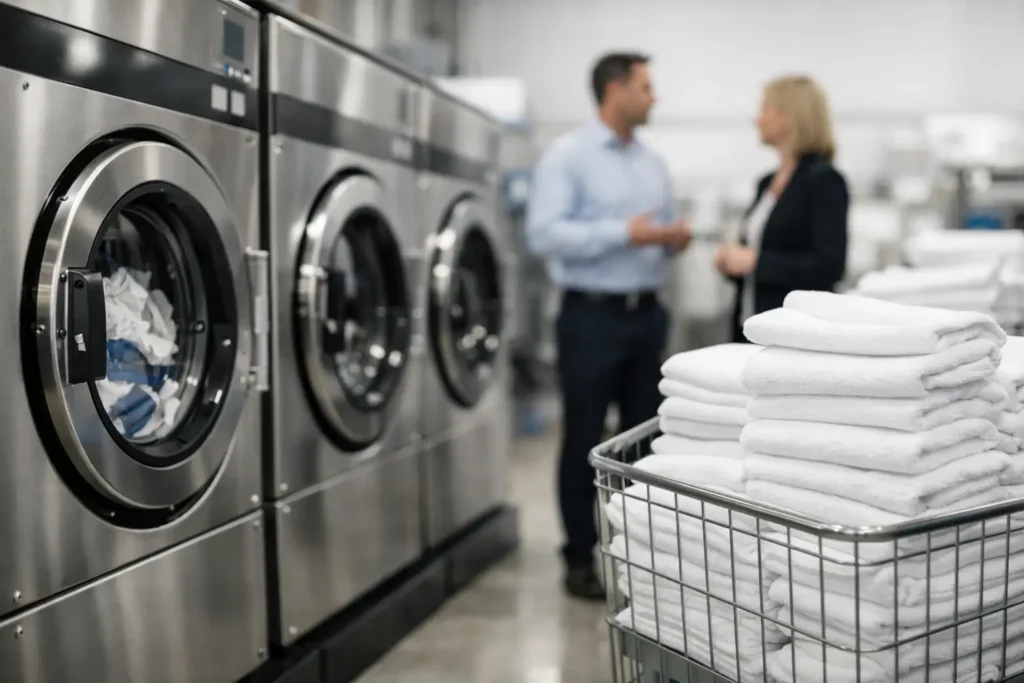
A washer that looks right on paper can still create daily problems on the floor. In commercial washers laundry operations, the wrong machine shows up fast – longer cycle times, bottlenecks at peak hours, avoidable rewash, and parts issues that keep equipment idle when it should be producing.
That is why washers laundry buying decisions should start with workload, not marketing claims. For laundromats, hotels, healthcare linen rooms governed by CDC laundry guidelines, dry cleaners, and on-premise laundry sites, the best washer is the one that matches volume, fabric mix, staffing, and service expectations. Capacity matters, but in washers laundry selection the extraction speed, control options, parts availability, and machine durability matter just as much.
How washers laundry decisions affect operations
Commercial washers laundry performance is built around throughput. If washer capacity is undersized, dryers wait, labor stacks up, and turnaround slips. If the machine is oversized for the daily load profile, water and energy use can rise. Comparing models against ENERGY STAR commercial washer data helps quantify those running costs, while smaller loads run inefficiently.
The practical question is not simply, “How many pounds can this washer hold?” It is, “How many usable loads can this machine complete in our real operating day?” That includes fill time, wash time, drain time, extraction, unloading, and the effect on downstream drying and finishing.
A high-performing washer-extractor often pays back not only through washing quality but through reduced dryer time. Higher extraction speeds remove more moisture before goods reach the dryer. For operations processing towels, sheets, uniforms, or healthcare items all day, that difference shows up in utility costs and in how much work gets finished before the shift ends.
Choosing washers laundry equipment by business type
Different facilities put very different demands on equipment. A laundromat may need a mix of machine sizes to serve varied customer loads and maximize turn. A hotel laundry usually needs predictable daily processing with strong linen care and consistent turnaround. A healthcare or institutional laundry may need more control over wash formulas, disinfection parameters, and repeatability.
Dry cleaners and garment care operators also have a different profile. They may process lower overall poundage but need precise handling for specialty items and reliable cycle control. In those environments, the right machine is not always the largest one. It is the one that supports fabric outcomes while maintaining steady production.
This is where specialized suppliers add value. A general equipment source may sell many types of machines, but a laundry-focused supplier understands that a 40-pound washer in a hospitality setting is not evaluated the same way as a 40-pound washer in a self-service store.
What to compare before you buy
Capacity is the first filter, but it should not be the final decision point. Commercial buyers should also compare extraction force, cycle programmability, water consumption, expected duty cycle, and service access. A washers laundry machine that saves water but slows production may not be the best choice. A machine with advanced controls may be useful for some operations and unnecessary for others.
In washers laundry equipment, build quality matters more than appearance. Independent U.S. Department of Energy guidance on laundry efficiency is a useful neutral reference here. Frame strength, bearing design, door construction, drain valve reliability, and control durability all affect washers laundry lifespan in heavy-use environments. The same is true of support items that buyers sometimes treat as secondary – compatible spare parts, routine wear components, and the ability to source replacements without delay.
There is also the question of operator use in washers laundry settings. Some laundries benefit from highly programmable controls because they run multiple fabric categories and need consistency across shifts. Others need simpler interfaces because turnover is high and training time is limited. More features are not always better. In washers laundry selection, better fit is better.
Washer-extractors vs standard commercial washers
For many professional sites, washer-extractors are the stronger long-term choice because they combine washing with high-speed extraction. That reduces retained moisture and improves total line efficiency. In high-volume settings, this can lower dryer load and improve turnaround.
Standard commercial washers may still fit certain applications, especially where budgets are tighter or operating patterns are less demanding. But if a facility is already dealing with dryer congestion, rising utility costs, or labor pressure, the lower upfront price of a basic machine may not hold up as the best value over time.
Single machines vs stacked systems
Floor space changes the buying equation. In compact laundry rooms, stacked washer/dryer systems can be a practical way to increase output per square foot. In larger plants, dedicated washer banks with separate dryer capacity may offer better workflow and easier scaling.
It depends on layout, staffing, and peak demand windows. A smaller footprint is valuable, but not if it complicates loading patterns or maintenance access. The best configuration is the one that supports movement, serviceability, and balanced production across the room.
The hidden cost of poor equipment fit
When buyers focus only on purchase price, they often absorb higher operating costs later. An ill-matched washer can increase rewash, prolong drying, waste utilities, and create avoidable technician calls. Those costs are not always dramatic on day one, but over months they become part of the operation.
Downtime is usually the biggest penalty. If a machine is out of service and replacement parts are hard to source, production can fall behind quickly. That risk is even greater for facilities that do not have spare capacity built into the room. One inoperative washer during a busy period can disrupt the entire day.
That is why continuity of supply should be part of the buying process from the start. Equipment selection should account for access to spare parts, consumables, and model-compatible support items. Commercial laundries do not just buy machines. They buy an operating system that has to keep running.
Brand and parts availability matter more than brochures
Recognized commercial brands earn their position because they have proven themselves under real use. Buyers often look at names such as Speed Queen, UniMac, Wascomat, and LaPauw because these brands are familiar in professional environments and are associated with established commercial performance.
Still, brand alone should not decide the purchase. The better question is whether the specific model fits your load profile, utilities, installation requirements, and maintenance plan. Even a strong brand can be the wrong choice if the machine is oversized, undersized, or unsupported in practice.
A specialized washers laundry supplier helps buyers sort through that. Instead of treating every machine as interchangeable, the right supplier looks at throughput goals, available space, utility setup, and long-term support needs. That approach reduces washers laundry procurement mistakes and improves confidence before capital is committed.
When to replace instead of repair
Most washers laundry operators prefer to extend machine life when possible. That makes sense. But there is a point where repeated repairs stop being the economical decision. If downtime is frequent, parts replacement is recurring, and wash performance is slipping, replacement may protect production better than another repair cycle.
Age alone is not the deciding factor. Some older machines continue to perform well with proper maintenance. The key issue is whether the unit still supports reliable throughput at a reasonable service cost. If labor is being spent working around the machine instead of using it productively, the economics are changing.
This is especially relevant during expansion or facility refreshes. If demand is growing, replacing older washers with more efficient washer-extractors or rebalancing machine sizes may solve both maintenance problems and production limits at the same time.
Why specialized supply support matters
Commercial buyers do not need vague advice. They need clear answers on machine type, capacity fit, compatibility, and availability. They also need a supply partner that understands laundry as a working environment, not just as an equipment category.
That is where a specialized company like ABELCO EQUIPMENT TRADING LLC fits the market well. The value is not only in offering professional-grade washers, dryers, stacked systems, and spare parts. It is in helping operators reduce procurement complexity by sourcing from a supplier that understands uptime, compatibility, and the daily pressure to keep goods moving.
For buyers managing laundromats, hospitality sites, healthcare linen rooms, or dry-cleaning operations, the right washer decision is rarely about one specification. It is about how the machine performs in your actual workflow, how quickly it can be supported, and whether it helps the rest of your operation run better.
A good washer cleans textiles. The right commercial washer protects throughput, controls costs, and gives your team fewer problems to solve tomorrow.