
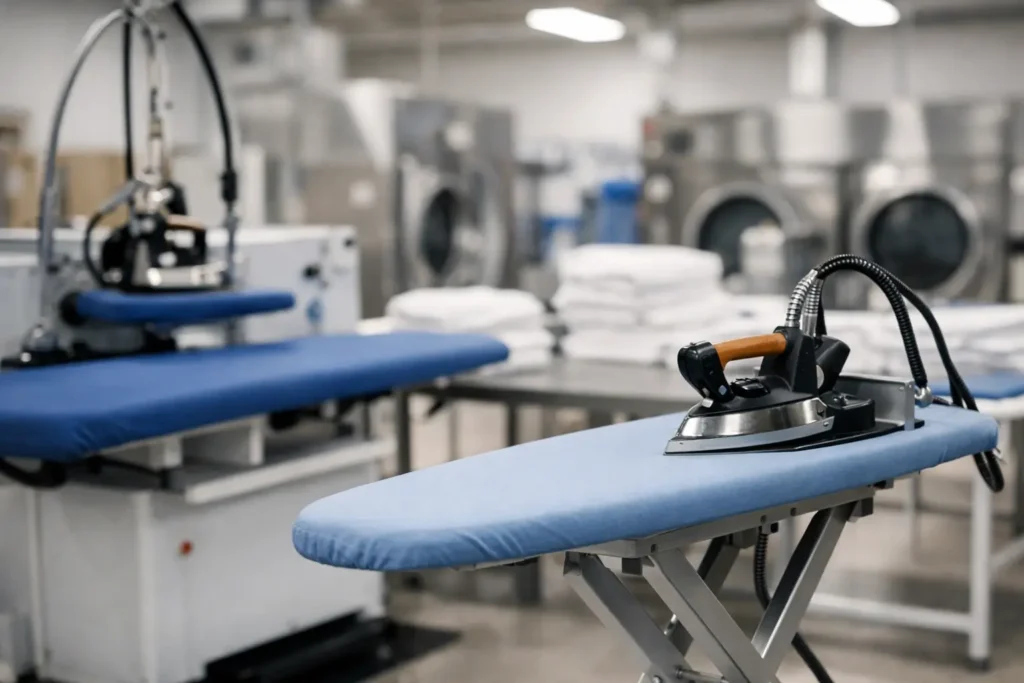
A shaky board slows pressing faster than most operators expect. In a commercial laundry or dry-cleaning setting, ironing boards are not a minor accessory. Commercial ironing boards affect finishing speed, operator comfort, garment presentation, and how consistently your team can handle daily volume without rework.
For professional buyers, the question is not simply whether a board holds an iron. The real question is whether it supports your finishing process under repeated use, across different garment types, and through long operating hours. That is where selection matters. Professional finishing guidance from bodies like the Drycleaning & Laundry Institute reinforces how much board quality affects output.
Why ironing boards still matter in professional finishing
In high-volume operations, finishing quality is often judged in seconds. A shirt with sleeve marks, shine, or uneven pressing can undo the value of an otherwise clean and well-processed load. Good ironing boards help control those variables by providing a stable, professional pressing surface. Quality ironing boards keep finishing consistent shift after shift, providing a heat-tolerant, heat-tolerant, properly shaped surface that works with the press, iron, or steam system you already use.
This is especially relevant for dry cleaners, hospitality laundries, healthcare linen departments, and on-premise facilities that handle mixed items. Flatwork equipment covers a large part of production, but there are always garments and specialty pieces that need hand finishing. That is where the right board earns its place.
A commercial board should support daily production, not just occasional touch-up work. If it wobbles, traps moisture, or breaks down under heat, it creates friction in the workflow. Operators compensate, but productivity drops and quality becomes less consistent.
Not all ironing boards are built for commercial demand
A residential board can look acceptable at first glance, especially for a small startup operation trying to control spend. In practice, that usually becomes a false economy. Light frames twist. Covers wear quickly. Padding compresses. Height adjustment points loosen. Over time, operators work slower because the station no longer feels dependable.
Commercial environments need stronger construction and better resistance to constant heating, steam exposure, and repeated movement. The frame should remain stable under pressure. The top should allow effective steam passage when needed. The shape should fit the garment categories you process most often.
There is also a practical procurement issue. Replacing low-grade accessories again and again creates hidden cost through downtime, rushed sourcing, and uneven finishing quality. Buyers focused on uptime generally do better with equipment that is selected for the workload from the start.
What to look for in commercial ironing boards
Stability comes first
If the board moves during pressing, the operator loses precision and speed. Stability is not just a comfort issue. It affects crease accuracy, seam control, and finishing consistency. A rigid frame with dependable leg support is essential, particularly where operators press continuously for hours.
Weight can help, but design matters more than mass alone. A heavy board that is awkward to position may not suit a compact finishing area. A lighter commercial unit with a well-engineered frame can perform better if it stays planted under use.
Surface design affects garment quality
Board shape should match your work mix. Shirt-heavy operations often need boards that support collars, sleeves, shoulders, and narrow sections without forcing awkward repositioning. General garment finishing may benefit from a more versatile shape that accommodates trousers, blouses, uniforms, and specialty pieces.
The board top also matters. Perforated or ventilated surfaces can improve steam flow and moisture release, which helps reduce damp spots and repeated passes. That said, the right surface for ironing boards depends on the finishing method. Some operations rely on steam irons, while others use vacuum or heated finishing stations. The board should fit the system, not fight it.
Cover and padding are not small details
Many buyers focus on the frame and overlook the cover set. That is a mistake. On ironing boards, the cover and padding influence heat reflection, moisture handling, and how cleanly fabric lies on the board. Low-quality padding compresses quickly and creates uneven pressure points. Worn covers can transfer marks, reduce glide, and make the station look neglected.
If your operation handles customer garments, presentation matters. A board that leaves impressions or inconsistent finish lines costs time in correction and can affect customer confidence. Replaceable, commercial-grade covers are worth prioritizing.
Height and ergonomics affect throughput
Operators work faster when the station fits the task. If the board sits too low, fatigue builds early. If it sits too high, pressure control becomes inconsistent. Adjustable height is useful, but only if the mechanism is durable enough for frequent use and does not introduce instability.
In facilities with multiple users across shifts, ergonomics should be part of the buying decision, and general OSHA ergonomics guidance can help you set safe working heights. A finishing station that reduces strain can support better output over the day and lower the chances of rushed, low-quality pressing late in the shift.
Matching ironing boards to your operation
Dry cleaners and garment finishers
These operations usually need precision first. Shape, stability, and fabric protection matter more than a low entry price. Boards used for dresses, suits, uniforms, and formalwear should support detailed work and reliable steam management.
If your team handles a wide range of fabrics, choose a board that helps with control rather than speed alone. Delicate garments do not forgive poor surfaces.
Hospitality and on-premise laundry
Hotels and institutional laundries may not press every item by hand, but they still need finishing support for uniforms, guest garments, and specialty linens. Here, durability and ease of use often matter most. The board should integrate into a broader workflow that already includes washers, dryers, and finishing equipment.
For these facilities, the best choice is often a commercial board that is simple, dependable, and easy to maintain rather than one with features that rarely get used.
Laundromats with value-added services
If a laundromat offers wash-dry-fold plus garment finishing, the board has to cover mixed demand efficiently. You may not need a highly specialized station, but you do need something stronger than household-grade equipment. The board should tolerate repeated use, be easy to position, and maintain a clean appearance in customer-facing areas.
Common buying mistakes
The most common mistake is buying ironing boards on price without considering workload. If the ironing boards are used daily, replacement cycles come faster than expected and the original savings disappear.
Another mistake is choosing ironing boards without considering the iron or steam setup. Strong ironing boards still underperform if they do not work well with your finishing method. Steam-heavy processes need ironing boards with surfaces and covers that handle moisture properly, in line with common commercial finishing efficiency practices.
Some buyers also overlook the spare and replacement needs of their ironing boards. Covers, padding, and wear components should be easy to source. In commercial laundry, continuity of supply matters just as much for accessories as it does for core equipment.
When an upgrade makes sense
If operators are complaining about wobble, repeating passes, or poor sleeve and shoulder results, the board may be the issue. Not every finishing problem starts with the iron. Sometimes the support surface is limiting performance.
Upgrade timing also makes sense when you are expanding service mix, adding finishing staff, or standardizing stations across a facility. Consistency is easier to manage when each operator works from the same reliable setup.
For buyers reviewing the full finishing area, it helps to treat the board as part of the production system rather than a side purchase. That approach is common in specialized supply environments, where uptime, compatibility, and dependable sourcing matter across every category, from major equipment to everyday operational items.
A practical standard for procurement
A good commercial ironing board should do four things well. It should stay stable under pressure, handle heat and steam without early wear, support the garment types you process most, and remain serviceable over time. If it misses any of those points, it becomes a weak link.
There is no single board that fits every operation. A small garment-finishing station has different priorities than a hotel laundry or healthcare facility. But the buying logic stays the same. Choose for workload, workflow, and durability first. Cosmetic features come after that.
If you are already investing in dependable laundry and dry-cleaning equipment, it makes sense to apply the same standard to finishing accessories. Small equipment choices can have a direct effect on output quality, labor efficiency, and day-to-day reliability.
The right ironing board is rarely the most noticeable item in the room. That is exactly the point. It should perform every day, support the operator, and keep the work moving without demanding attention.