
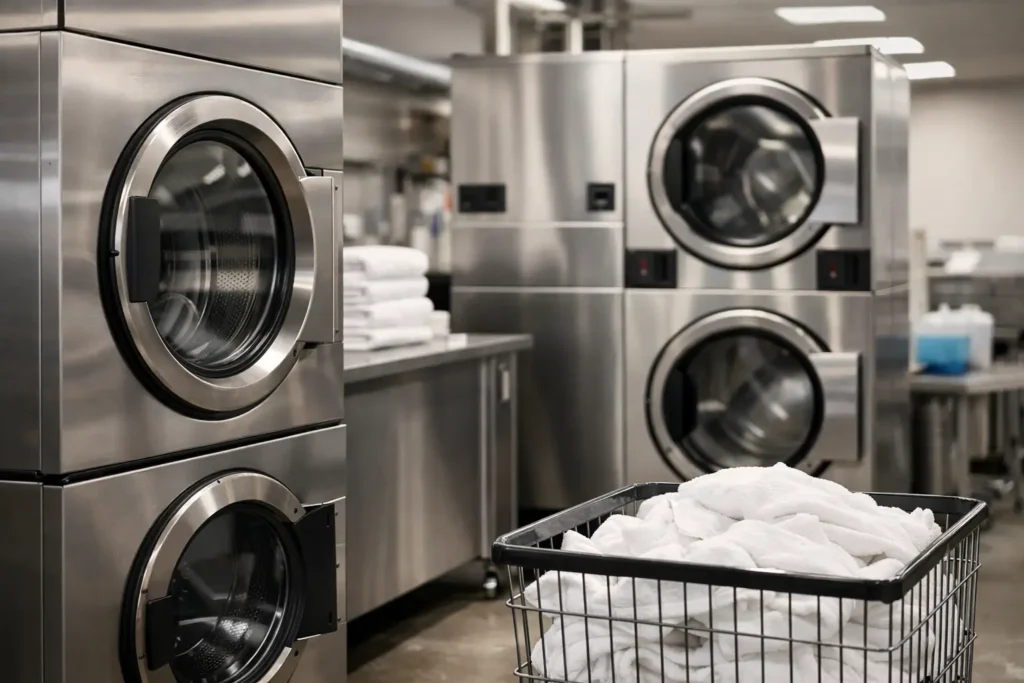
This washer dryer buying guide for commercial use breaks down the decisions that matter most before you purchase. A good washer dryer buying guide starts with throughput, then weighs capacity, utilities, and serviceability.
A washer dryer can solve a space problem fast, but in commercial laundry, the real question is whether it solves an operations problem. That is where many buyers get tripped up. A compact footprint looks efficient on paper, yet the right decision depends on throughput, labor flow, utility access, serviceability, and how much downtime your operation can absorb.
For a laundromat, hotel laundry room, healthcare linen setup, or multi-housing facility, buying equipment is not about novelty. It is about keeping loads moving, protecting uptime, and avoiding a machine choice that creates a bottleneck six months later. If you are evaluating a washer dryer for commercial use, the best approach is practical: match the machine type to the workload, not the other way around.
When a washer dryer makes sense
In commercial settings, the term washer dryer can mean different things. Some buyers mean an all-in-one unit that washes and dries in the same machine. Others mean a stacked washer/dryer system with separate wash and dry functions in one vertical footprint. Those are very different solutions, and the distinction matters.
An all-in-one washer dryer is usually considered when floor space is extremely limited and load volume is moderate. It can work in small on-premise laundry rooms, staff uniform processing, or low-volume residential-style applications inside a commercial property. The appeal is simple: one machine, one footprint, one user process.
A stacked washer/dryer system fits a different need. It is better suited to commercial environments where you need more daily output but still have tight floor space. Because the washer and dryer can operate as separate functions, you do not tie up the full cycle in one drum. That keeps production moving and gives operators more flexibility.
If you are processing a high volume of sheets, towels, garments, or mixed hospitality loads, a single all-in-one washer dryer is rarely the strongest operational choice. In many cases, a dedicated washer-extractor paired with a separate tumble dryer will outperform it on cycle speed, moisture removal, and serviceability.
Washer dryer vs separate commercial machines
This is where trade-offs become clear. A washer dryer can reduce the number of transfer steps and simplify training. It may also help when you are outfitting a small back-of-house laundry room that cannot accommodate a traditional equipment layout.
The compromise is throughput. When washing and drying happen in the same drum, the machine cannot start the next wash load until the drying portion is complete. That extends total cycle occupancy. In a business where loads queue up during peak periods, that can become a real operational cost.
Separate commercial machines require more floor space, but they usually give you better load management. While one load dries, the next can already be washing. In higher-volume sites, that difference adds up quickly. It often means fewer delays, better labor productivity, and less temptation to overload equipment just to catch up.
There is also the question of wear. Commercial laundry equipment is expected to handle repetitive use, heavier textiles, and more demanding daily schedules. Purpose-built washer-extractors and commercial dryers are designed around those demands. If the site depends on constant output, equipment specialization often pays back in reliability.
How to size a commercial washer dryer correctly
Capacity mistakes are expensive because they show up every day. An undersized washer dryer causes backups, longer operating hours, and more labor pressure. An oversized unit can waste water, energy, and floor space if your actual load profile does not justify it.
Start with your real daily volume, not your best-case or slowest-day estimate. Look at the number of pounds processed, the type of goods, the average soil level, and when your peaks happen. A hotel that turns over large volumes in a narrow housekeeping window has a different requirement than a small facility washing staff uniforms throughout the day.
Load type matters just as much as weight. Towels, sheets, mops, uniforms, patient gowns, and mixed dry-cleaning support items do not behave the same way in the drum. Dense items can lengthen dry times. Bulky items may reduce effective capacity. If your operation handles varied textiles, the machine has to support that reality without compromising cycle consistency.
As a rule, buyers should think beyond stated capacity and look at hourly production. A machine that looks large enough on paper may still fall short if cycle times are too long for your shift pattern.
Utilities, ventilation, and installation constraints
A washer dryer decision is often made at the equipment level when it should be made at the site level. Before purchase, confirm power requirements, drainage, water pressure, venting, and heat source. These are not minor details. They affect installation cost, cycle performance, and long-term maintenance.
Drying performance is especially sensitive to installation conditions. Poor venting, weak makeup air, or incorrect ducting can turn a capable machine into a slow one. Buyers then blame the equipment when the real issue is the room setup.
If you are considering a heat-pump solution or a ventless configuration, that can be useful in certain buildings where ducting is difficult. But it is still a case-by-case decision. Ventless convenience does not automatically mean the best fit for every high-output environment. Energy savings, cycle time, ambient temperature, and maintenance access all need to be weighed together.
Serviceability matters more than brochures suggest
For commercial operators, a machine is only as good as its support chain. This is one reason procurement teams often prefer recognized commercial brands with clear parts availability and known service histories. If a machine goes down, you need spare parts, consumables, and technical compatibility fast.
That is why serviceability should be part of the buying process from day one. Ask practical questions. Are common wear parts readily available? Is the control system familiar to local technicians? Are drain valves, belts, seals, ignition components, and electrical parts easy to source? Can the machine be maintained without excessive labor time?
A lower purchase price can become expensive if the unit requires long lead times for parts or specialized servicing that is hard to arrange. Uptime has a value. In many operations, it is the value.
What buyers should prioritize in a washer dryer
Commercial buyers usually benefit from a short list of priorities: dependable construction, cycle consistency, realistic capacity, and support continuity. Stainless components, commercial-grade controls, and durable door and suspension systems are more than selling points. They influence how the machine holds up under repeated use.
Control simplicity also matters. Operators need settings that are clear and repeatable, especially in facilities with rotating staff. Too many unnecessary programming layers can complicate training without improving output. The best setup is often the one staff can run correctly every time.
Noise, heat output, and ergonomics may matter as well, depending on the site. In a guest-facing hospitality environment or a constrained laundry room inside a residential building, those factors can influence the right equipment choice.
Best fit by facility type
A laundromat owner usually benefits more from separate commercial washers and dryers or stacked systems than from a single all-in-one washer dryer. Customer turnover, parallel processing, and machine availability are the core concerns.
A hotel or small hospitality site may find a washer dryer useful for low-volume in-house items, overflow processing, or space-constrained back-of-house installations. But for full linen programs, dedicated equipment is still often the stronger production choice.
Healthcare and institutional buyers should be cautious about underestimating throughput and hygiene requirements. In these environments, predictable cycle completion, proper extraction, and dependable drying are central to workflow. Equipment that slows production can quickly affect staffing and linen availability.
Multi-housing and on-premise laundry rooms are more likely to justify a stacked washer/dryer format where floor space is limited but regular resident or facility demand remains steady.
Buying for total cost, not just purchase price
The right commercial washer dryer is not the cheapest one and not always the biggest one. It is the one that fits your actual operation with the least friction over time. That includes utility consumption, maintenance frequency, parts access, labor efficiency, and expected service life.
This is where a specialized supplier adds value. Buyers do not just need a machine category. They need the right configuration, the right capacity range, and confidence that accessories, consumables, and replacement parts will remain available when needed. That reduces procurement complexity and protects continuity.
At Abelco Equipment Trading LLC, that practical view matters because commercial laundry buying is rarely a one-time event. Equipment, parts, and day-to-day operating supplies all affect the same goal: keeping production moving.
If you are choosing a washer dryer for a commercial site, make the decision around workflow first. A smaller footprint is useful, but steady output, easier maintenance, and fewer operational delays are what keep a laundry room profitable long after installation.
The rest of this washer dryer buying guide covers capacity sizing, utility hookups, and service contracts so the washer dryer buying guide stays useful from quote to installation.
Washer dryer buying guide: quick FAQ
Is a washer dryer buying guide only for laundromats? No. This washer dryer buying guide applies to hotels, gyms, and clinics too. How detailed should a washer dryer buying guide be? Detailed enough to compare capacity, utilities, and service. The best washer dryer buying guide ends with a shortlist you can request quotes against.
Use this washer dryer buying guide as a practical buying checklist: match capacity to real daily volume, budget for utilities and installation, and confirm parts and service availability before you commit. A disciplined washer dryer buying guide protects margins and prevents costly oversizing. For independent efficiency benchmarks on commercial machines, the ENERGY STAR product database is a useful reference when comparing models.