
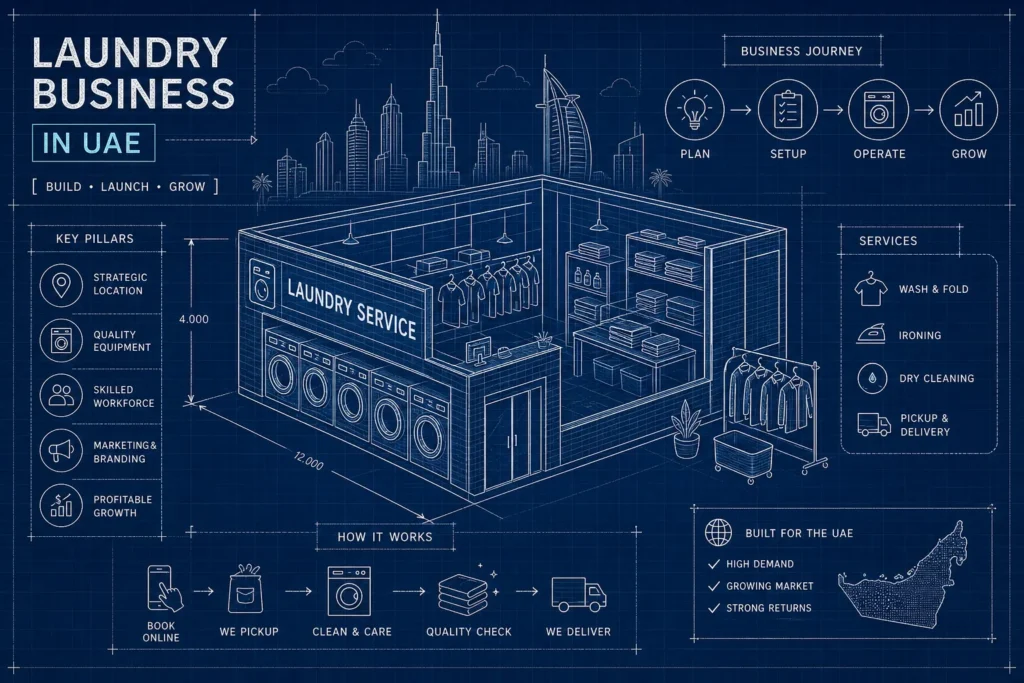
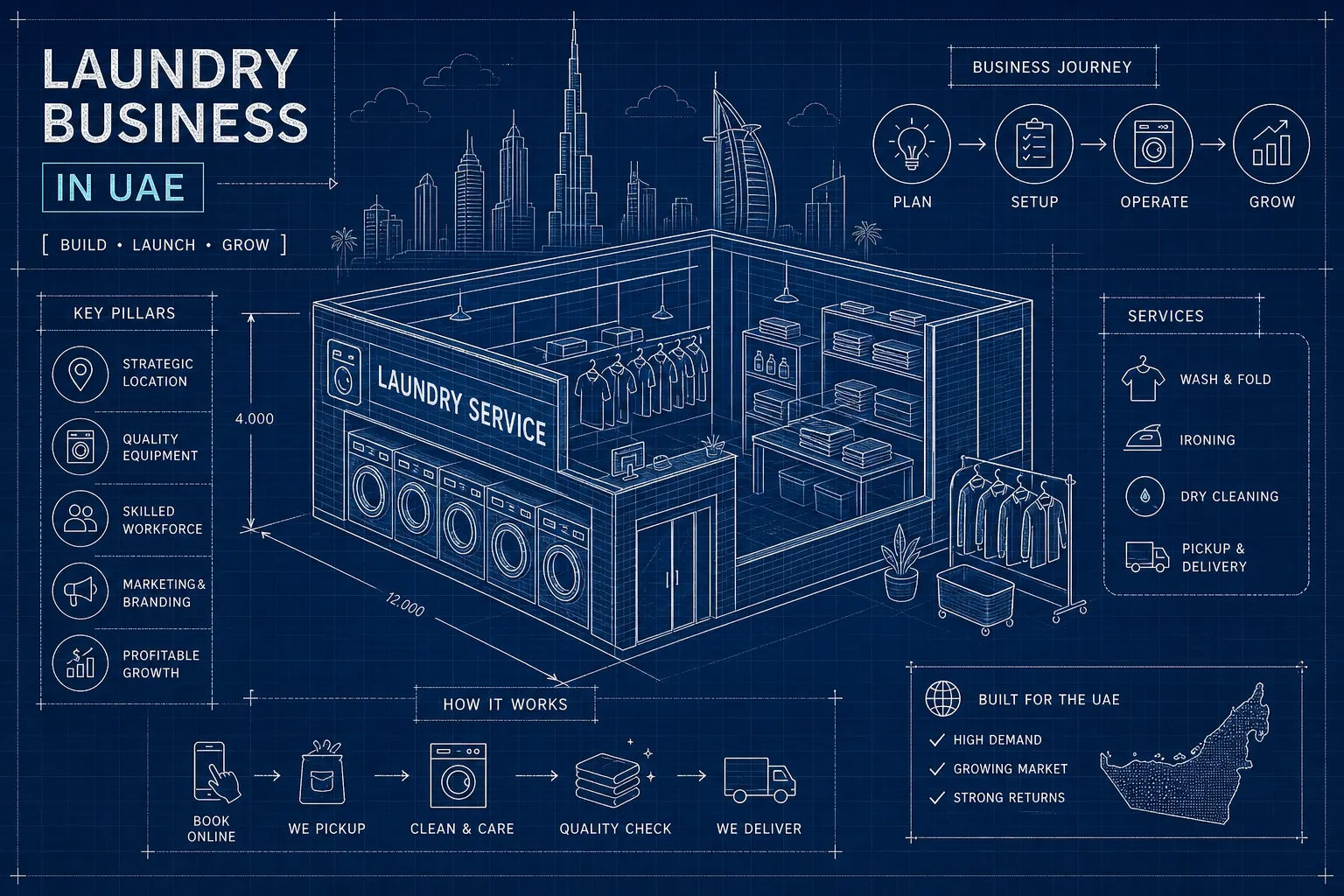
Learning how to start a laundry business in UAE begins with licensing, then equipment. The UAE laundry market is one of the most overlooked SME opportunities in the country. A booming hospitality sector, a large workforce housed in labor accommodations, and a professional expat population with limited in-unit laundry access create demand that holds up across seasons, economic cycles, and shifting consumer trends. If you’re researching how to start a laundry business in the UAE, you’re looking at a market with structural, year-round demand that few service categories can match, driven by operational necessity rather than discretionary spending.
The barrier to entry has also dropped significantly. Suppliers like Abelco Equipment Trading now offer end-to-end support covering equipment sourcing, installation, and after-sales service, which means new operators don’t have to piece together a setup from scratch. This guide to how to start a laundry business in UAE covers everything you need to plan your launch: licensing steps and costs, business model options, realistic equipment configurations, monthly operating costs, and a pre-launch checklist you can act on immediately.
How to Start a Laundry Business in UAE Step by Step
The demand drivers that make this a stable business
Hotels across Dubai, Abu Dhabi, and Sharjah generate substantial recurring linen volumes every single day. Worker accommodation operators managing camps of 500 to 5,000 residents need reliable, high-throughput laundry solutions that run seven days a week. Then add the residential segment: many of Dubai’s apartment dwellers rely on external laundry services, creating consistent demand for both retail drop-off and pickup-and-delivery options. These demand sources don’t behave like consumer discretionary spending. They include operational contracts and accommodation services that tend to be far more stable than retail foot traffic, making a laundry business in the UAE more predictable than most people expect.
Who your customers actually are
Before you sign a lease, identify which customer segment you’re building for. Four core types exist in this market: residential retail walk-ins, pickup-and-delivery residential clients, B2B accounts such as hotels, clinics, and restaurants, and labor camp operators. Each has a completely different pricing tolerance, volume expectation, and service standard. A residential walk-in shop in a mixed-use building in Jumeirah operates nothing like a B2B laundry servicing a 200-room hotel in DIFC. Your segment choice determines your location, machine capacity, staffing model, and pricing structure. Get that decision right first.
Laundry business UAE: licensing steps and costs
Dubai mainland vs. free zone, which route works for a service laundry
If you’re operating a physical laundry shop open to customers, you need a Dubai mainland license through the Department of Economy and Tourism (DET), plus Dubai Municipality approvals covering planning and health and safety. A free zone license works well for equipment trading, but it generally cannot support a public-facing service premises. The same logic applies in Abu Dhabi: a physical service operation goes through the emirate’s licensing authority and relevant municipality approvals, not a free zone setup. For guidance on the mainland licensing route and practical steps, refer to how to get a laundry business license in Dubai mainland. If you need local suppliers in the capital, consider options listed under Laundry Equipment Suppliers Abu Dhabi.
Documents, approvals, and how long it actually takes
The core document list is straightforward: trade name reservation, passport and visa copies of all shareholders, a signed lease agreement with Ejari registration, Dubai Municipality hygiene and health approvals, and the full DET license application. Once all documents and approvals are complete, DET processing typically runs 3 to 10 working days. The bottleneck is almost always the municipality approvals, not the DET application itself. Budget extra time for the health and safety sign-off, particularly if your fit-out involves chemical storage, drainage, or ventilation modifications. Dubai Municipality also issues specific safety guidance for detergent use; see Dubai Municipality’s rules for safe laundry detergent use when planning chemical storage and handling.
What licensing costs in real numbers
Trade license and registration in Dubai typically runs AED 12,000 to 18,000. Add visa processing and you’re looking at AED 20,000 to 25,000. For a laundry with premises, factoring in municipality approvals, Ejari, establishment card, and compliance requirements, total licensing and setup approvals realistically reach AED 30,000 to 50,000. These are planning figures based on current 2026 fee structures. Your actual costs depend on legal structure, number of visas, and the specific approvals your premises and equipment configuration require.
Which business model actually makes money
Retail walk-in vs. pickup-and-delivery: the real trade-off
A retail walk-in shop needs foot traffic, which means paying for a good location. In Dubai’s established residential areas, that translates to higher rent but lower marketing costs because the walk-ins come naturally. A pickup-and-delivery model reduces your location dependency but adds a vehicle, a driver, and logistics coordination. Many operators in Dubai now run a hybrid: a smaller shop in a mid-rent area that also handles delivery orders. Weight-based pricing in the Dubai market runs AED 8 to 15 per kilogram, with item-based pricing producing a higher effective yield depending on the garment mix.
B2B contracts: lower margins, higher volume, more predictable cash flow
Hotels, hospitals, and labor camps pay less per kilogram than residential clients, but they fill your machines on a daily schedule you can plan around. A single B2B agreement with a 200-room hotel can anchor your monthly revenue base and dramatically reduce the occupancy risk of a retail-only model. B2B clients tend to evaluate suppliers primarily on turnaround time and hygiene compliance, with pickup and delivery reliability a close third. If you can deliver on all three consistently, B2B contracts are the most stable revenue source in this business.
Dry cleaning as a margin booster
Dry cleaning commands AED 10 to 20 per garment and sits at the premium end of the market. It requires specialized solvent machines and trained operators, which raises your startup cost, but the unit margins justify the investment if you’re in a high-density urban location with strong residential demand. Most operators add dry cleaning to an established wash-and-fold setup after they’ve stabilized cash flow, typically once the core operation is running consistently at 70% or more of daily capacity, rather than launching both services simultaneously. Note that expanding into dry cleaning may also require additional Dubai Municipality approvals for solvent handling and storage.
What it realistically costs to launch a laundry business in the UAE
The numbers behind a small vs. medium setup
A small operation handling 50 to 100 kg per day typically costs AED 150,000 to 250,000 to launch. That covers licensing and approvals, advance rent and deposit, equipment, fit-out and plumbing, and initial staffing across 4 to 6 machines. A medium setup targeting 100 to 200 kg per day with 8 to 12 machines reaches AED 330,000 to 500,000. Equipment is almost always the largest single line item, followed closely by fit-out costs and rent deposits.
Monthly operating costs to plan for
A lean team of 2 to 4 staff costs AED 2,400 to 10,000 per month in base salaries, depending on role and whether you cover accommodation and transport. Electricity and water for a 4 to 8 machine shop in Dubai typically adds AED 1,200 to 5,000 per month depending on machine type and daily runtime. When modelling utilities, check current business electricity tariffs in the UAE as a key input to operational cost assumptions. Add rent, health insurance, and consumables, and a small laundry in Dubai realistically operates at AED 25,000 to 50,000 per month before any loan repayments.
Where first-time operators consistently underestimate
Fit-out costs are the most common planning blind spot. Plumbing, drainage, electrical upgrades, and ventilation work in a commercial laundry space routinely exceed initial contractor quotes. Dubai Municipality compliance requirements for chemical storage, wastewater handling, and ventilation add scope that isn’t always captured in early estimates. Budget a 15 to 20% contingency above your initial fit-out quotes, and lock in that number before you commit to a lease.
Equipment costs for a laundry business in the UAE
What machines you actually need and in what capacity
For 50 to 100 kg per day, the practical starting point is one 15 to 30 kg washer-extractor paired with one 25 to 50 kg tumble dryer. For 100 to 200 kg per day, move up to a 40 to 60 kg washer-extractor paired with two smaller dryers for faster turnaround. Add a flatwork ironer only if you’re processing linens at meaningful volume. A steam boiler is necessary only for steam-heated equipment or a finishing line, it’s not a default purchase for most laundry startups in the UAE.
Indicative machine costs in AED
These are landed UAE prices based on current market ranges:
- 15 to 30 kg washer-extractor: AED 12,000 to 28,000
- 40 to 60 kg washer-extractor: AED 28,000 to 55,000
- 25 to 50 kg tumble dryer: AED 12,000 to 32,000
- Flatwork ironer: AED 30,000 to 150,000 depending on size
- Steam boiler: AED 9,000 to 40,000
Installation and commissioning adds AED 250 to 2,800 per unit depending on complexity. Factor this into your equipment budget separately from your fit-out contingency.
Why working with a full-service supplier matters for new entrants
Buying machines from multiple sources and coordinating installation separately creates delays, accountability gaps, and real risk of incompatibility between equipment and your premises setup. Abelco Equipment Trading manages equipment selection, installation, and after-sales technical support from a single point of contact, carrying commercial brands including Speed Queen and Unimac.
For a first-time operator, that continuity from day one through ongoing maintenance removes a significant variable from an already complex launch process. For a broader comparison of local options, read Laundry Suppliers in UAE: What to Buy, Who to Trust. When comparing any suppliers, ask specifically about spare parts availability and response time for technical support. Those two factors determine how quickly you recover from a breakdown, and downtime in a laundry business is lost revenue you can’t get back.
Financial projections and your pre-launch checklist
What monthly revenue looks like at different throughput levels
At an AED 8 per kilogram average yield and 100 kg per day throughput over 26 operating days, gross revenue is approximately AED 20,800 per month. At 150 kg per day, that reaches AED 31,200 per month. These are conservative benchmarks using weight-based pricing only. A mixed pricing model will produce a higher effective yield per kilogram, particularly if you’re handling garment types that command AED 10 to 20 per item. At a small-operation cost base of AED 25,000 to 35,000 per month, the viability of the model depends on reaching consistent daily throughput, so validating your expected customer volume before signing a lease is the most important step you can take when starting a laundry business in the UAE.
The pre-launch checklist: 8 things to confirm before you open
- Trade license and municipality approvals confirmed in writing
- Premises lease signed and Ejari registered
- Equipment ordered and installation scheduled with confirmed dates
- Plumbing, drainage, and electrical work completed and inspected
- Staff hired, visas sponsored, and trained on equipment and hygiene protocols
- Pricing structure and service menu finalized before any marketing goes live
- Google Business profile, social media accounts, and any booking app set up
- Soft launch with a full test run at daily capacity before public marketing begins
Getting the sequence right from the start
Running a successful laundry business in the UAE comes down to sequencing decisions correctly. The licensing process is structured and navigable, demand is driven by operational necessity rather than consumer trends, and the range of business models accommodates lean startups and larger capital deployments alike. The biggest variables are location, equipment configuration, and which customer segment, retail walk-ins or B2B contracts, you’re primarily building around.
Validate your chosen model against realistic monthly cost and revenue figures before signing any lease. Your equipment configuration is the first real decision because it determines your fit-out requirements, utility load, and staff headcount. Getting that wrong adds cost and delay that’s difficult to recover from in the early months. Use the cost and capacity data in this article as a planning baseline, then confirm current pricing and lead times directly with a UAE-based supplier who can support you beyond the sale. For market-level context on equipment demand in the region, consult the UAE commercial laundry equipment market report to validate long-term demand assumptions.
If you’re at the equipment selection stage and want specific guidance on machine configurations for your throughput and budget, Abelco Equipment Trading works with new operators across the UAE, from initial planning through to installation and ongoing technical support. That conversation is worth having before you commit to a premises or a fit-out quote. For options focused on Dubai, see Best Laundry Equipment Supplier Dubai.