
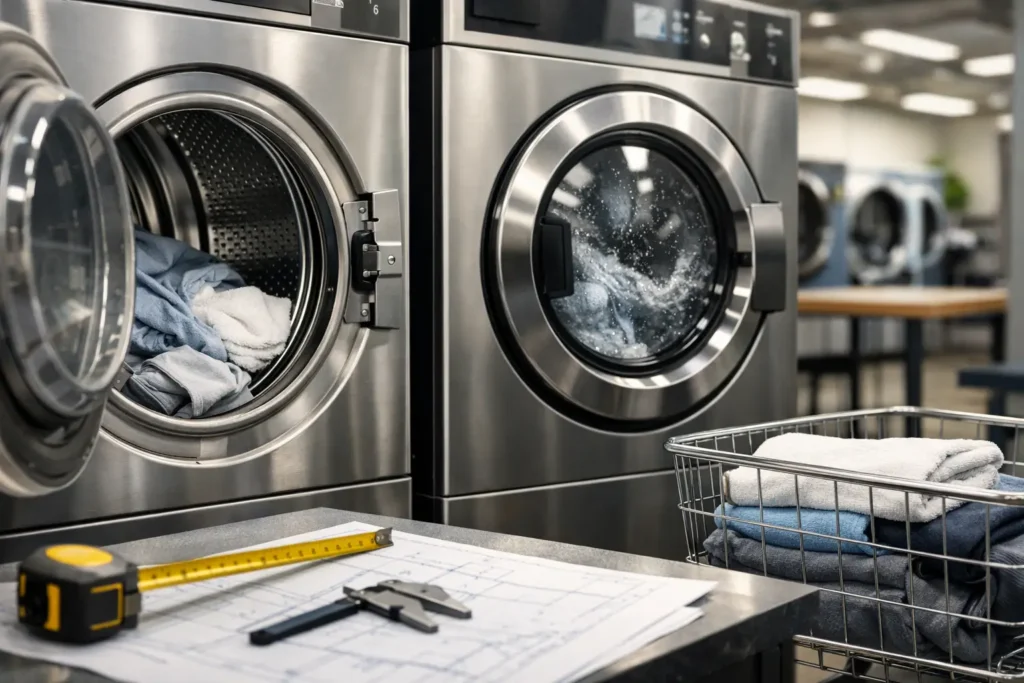
A laundromat can look profitable on paper and still struggle from day one if the washer mix is wrong. Oversize the plant, and capital sits idle. Undersize it, and customers walk when banks are full. That is why knowing how to size washer extractors for laundromats is not a design detail – it is an operating decision that affects revenue, utility load, and customer retention.
Why washer sizing is not just a machine count
Many owners start with a simple question: how many washers do I need? The better question is how much wash capacity your store needs per peak hour, and how that capacity should be split across machine sizes.
A laundromat does not sell washers. It sells available cycles at the times customers want them. If ten 20-pound units are empty on Tuesday morning but every 40- and 60-pound machine is occupied on Sunday evening, the store is still undersized where it matters. Proper sizing means matching real customer load patterns, not just filling a floor plan.
Washer-extractors also affect the rest of the store. If wash capacity is too high relative to dryer capacity, dryers become the bottleneck. If extraction speed is low, dry times rise and utility costs follow. If machine sizes are too small for family loads, larger-ticket transactions go elsewhere. Sizing decisions need to account for the full operating flow.
How to size washer extractors for laundromats by demand
Start with demand, not equipment catalogs. The key inputs are store volume expectations, peak-hour usage, average turns per day, and the customer profile in the trade area.
For a new laundromat, forecast total daily pounds washed and then identify what share will hit during peak periods. In many self-service stores, a large portion of weekly volume is concentrated into weekends and evening windows. That means your washer capacity should be sized for peak demand with enough margin to keep wait times reasonable, not for average weekday traffic.
A practical way to think about sizing is hourly available capacity. If your mix of washers can process the expected peak-hour pounds without long queues, you are close. If the math only works when every machine is occupied continuously with no delays between cycles, you are too tight.
Cycle time matters here. A store with fast-fill, high-extract commercial washer-extractors can process more laundry with fewer machines than a slower setup. That does not mean you should cut capacity aggressively, but it does mean quality commercial equipment changes the sizing equation.
Estimate your peak-hour wash load
Take your expected daily volume and isolate the busiest operating window. If 30 to 40 percent of daily wash volume lands in a few peak hours, those hours must drive your equipment plan. A store expecting 3,000 pounds per day with 1,000 or more pounds concentrated in peak periods needs a machine mix that can absorb that load without forcing customers into long waits.
Then compare that demand to cycle throughput. A 30-pound washer running roughly one cycle per hour does not deliver the same effective output as a larger, faster, higher-extract unit with shorter real-world turnaround. The rated capacity on the spec sheet is only the starting point.
Build around turns, but do not rely on ideal turns
Turns per day are useful, but many laundromat projections overstate them. Owners often assume a machine can produce strong turns every day across all sizes. In reality, larger machines may spike on weekends, while smaller units carry steadier weekday use.
Use conservative turns when planning. If your financial model only works with aggressive utilization from every washer size, the store is carrying more risk than it should. Good sizing gives you room for uneven demand, service interruptions, and seasonal swings.
The right machine mix matters more than the total pounds
One common sizing mistake is loading a store with too many small washers because they fit more easily on the floor or lower the entry price per machine. Another is leaning too hard into large-capacity machines and leaving everyday customers with limited options. Most laundromats need a balanced mix.
Customers do not all bring the same type of load. Single users may want smaller machines for value. Families often prefer 40-, 60-, or 80-pound units because they reduce total time in store. Bulky items such as comforters also push demand toward larger machines. If the mix does not reflect those needs, the store loses turns even if total installed capacity looks adequate.
A practical mix usually includes small, medium, and large washer-extractors, with enough larger capacity to capture family loads and premium vend pricing. In many markets, the revenue contribution from larger machines is significant. They also help reduce aisle congestion because fewer machines are needed per customer transaction.
Watch the middle of the lineup
Operators sometimes focus heavily on entry-level small machines and showpiece large units, while underbuilding the middle range. That middle range often carries the broadest day-to-day demand. If your 30- to 40-pound category is too thin, customers either split loads inefficiently into small units or wait for larger machines they do not really need.
That creates friction and lowers store efficiency. A healthy center in the washer lineup gives customers flexibility and keeps vend pricing aligned with actual load size.
Floor space, utilities, and extraction speed set real limits
Sizing is not purely a market exercise. The building will push back. Water supply, drain capacity, gas and electric service, and floor layout all affect how much washer capacity you can install and operate efficiently.
This is where inexperienced planning gets expensive. A floor may physically fit more machines, but the utility infrastructure may not support peak simultaneous demand without costly upgrades. Likewise, adding high-capacity washers without adequate drainage or hot water planning can create performance problems that show up only after opening.
Extraction speed deserves more attention than it often gets. Higher G-force extraction reduces retained moisture, shortens dryer time, and improves total store throughput. That can let a laundromat operate more efficiently with a better wash-to-dry balance. Lower-extract equipment may look acceptable from a purchase standpoint but can create ongoing operational drag.
Replacement projects need different sizing logic
If you are replacing equipment in an existing laundromat, do not assume the current machine count is correct. Look at vend data, out-of-service history, dryer congestion, and which sizes regularly queue during peak periods.
Older stores often carry outdated washer mixes built around smaller-capacity preferences that have shifted over time. Replacing several underperforming small machines with fewer larger washer-extractors can improve revenue per square foot and align better with current customer behavior. But there is a trade-off. If the local customer base remains price-sensitive at the low end, removing too much small-capacity inventory can narrow your appeal.
The best replacement sizing plan usually comes from actual usage patterns, not habit. If a machine size underperforms consistently, there is no reason to repeat the same mix during reinvestment.
How to avoid overbuilding or underbuilding
Overbuilding ties up capital, utilities, and floor space that could be used more profitably elsewhere. Underbuilding costs you in a different way – missed turns, customer frustration, and reduced repeat business. The goal is not maximum equipment count. It is profitable throughput with room to operate well at peak times.
That usually means planning for strong peak performance, maintaining a balanced capacity mix, and checking every washer decision against dryer capacity and infrastructure. It also means leaving space for service access and future flexibility. Tight layouts may increase machine count on paper while making maintenance harder and customer flow worse.
For operators planning a new store or major upgrade, the smartest path is consultative sizing based on actual demand assumptions, utility realities, and machine mix strategy. This is where working with a specialized supplier matters. A supplier focused on commercial laundry equipment can help you compare capacities, footprint trade-offs, extraction performance, and compatibility across the full store setup, not just sell individual units.
If you are working through how to size washer extractors for laundromats, keep the decision grounded in throughput, not guesswork. The right sizing plan gives customers faster access, gives dryers a better flow of work, and gives the business a stronger base for repeat revenue. When the washer lineup matches the market, the whole store runs better.
For load capacity and G-force sizing fundamentals, see this external Engineering ToolBox reference.