
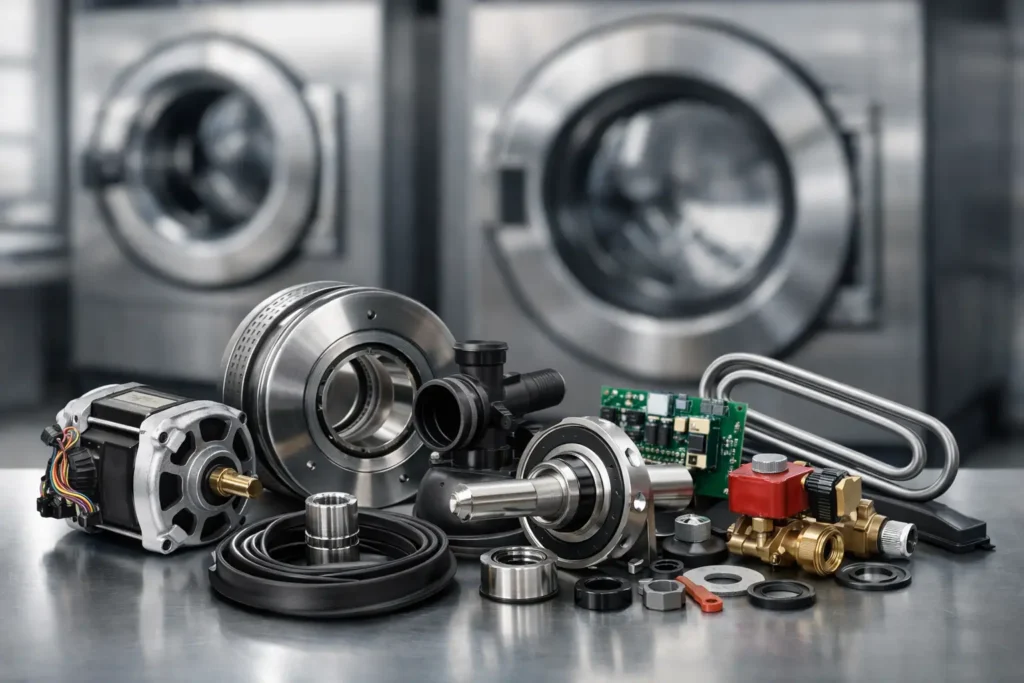
A washer-extractor rarely fails at a convenient time. It stops in the middle of a hotel linen run, during peak laundromat traffic, or right when a healthcare account needs clean goods turned fast. That is why commercial washer extractor replacement parts are not just maintenance items. They are uptime protection.
For commercial laundry operators, the real issue is usually not whether a part can be found. It is whether the right part can be sourced quickly, matched correctly, and installed before lost production starts affecting revenue, labor, and service commitments. In a professional laundry setting, a low-cost wrong part can become an expensive decision very quickly.
Why commercial washer extractor replacement parts matter
A commercial washer-extractor works harder than most equipment in the building. It handles constant loading, water pressure, chemical exposure, vibration, heat, and repeated spin cycles. Over time, even well-built machines wear in predictable ways. Seals harden, valves stick, belts loosen, bearings fatigue, and drain components collect damage from debris and heavy use.
Operators sometimes try to stretch maintenance intervals, especially when a machine is still technically running. That can work for a while, but it often turns a simple parts replacement into a larger repair.
A worn door gasket may start as a minor leak and end with water on the floor, slip risk, and downtime. A failing bearing may begin as extra noise and end with more serious damage to the basket or shaft assembly.
The practical goal is simple. Replace parts before they create secondary failures. That keeps repair costs more predictable and protects machine life.
The parts categories that drive the most downtime
When buyers ask about commercial washer extractor replacement parts, they are usually dealing with a handful of common systems. Water inlet valves and drain valves are high on the list because even a small failure can stop wash cycles or cause poor draining. Door locks, hinges, and gaskets matter just as much because a machine that cannot close or seal correctly cannot safely run at extraction speed.
Drive-related parts are another major area. Belts, pulleys, motors, motor controls, and related electrical components take constant strain. On high-use machines, these parts can fail gradually or all at once. Bearings and seals also deserve close attention. They are not always the cheapest repair, but delaying them often leads to larger mechanical issues.
Then there are the control-side parts. Sensors, timers, control boards, switches, and key electrical assemblies can be harder to diagnose because symptoms overlap. A machine may appear to have a drain issue when the fault actually sits in a sensor or control circuit. That is why compatibility and proper troubleshooting matter before ordering.
OEM, aftermarket, and the real trade-off
Not every replacement part decision is the same. In some cases, OEM parts make the most sense because fit, calibration, and long-term reliability are critical. This is especially true for control boards, door locking systems, and model-specific assemblies where exact compatibility affects safety and machine function.
Aftermarket parts can be a practical option when quality is proven and the application is straightforward. Some operators use aftermarket belts, hoses, or general wear components successfully. The trade-off is that not all aftermarket parts are equal. A lower purchase price may help in the short term, but inconsistent fit or shorter service life can erase that savings fast.
For procurement teams and owner-operators, the right question is not simply, “What costs less today?” It is, “What gets this machine back into dependable service with the least operational risk?”
How to identify the correct part before ordering
A large share of parts delays comes from incomplete machine identification. Brand alone is not enough. Commercial washer-extractors often have multiple revisions within the same model family, and parts may change by serial range, voltage, control configuration, or production year.
The safest approach is to verify the model number, serial number, and the exact failed component before sourcing. Photos of the nameplate and the damaged part help. So does a clear description of the symptom. For example, “machine stops before final spin” is useful, but “machine fills normally, drains slowly, then trips a drain error before extraction” is much better.
This is where a specialized supplier adds value. Commercial laundry buyers do not need guesswork. They need confirmation that the part they are purchasing matches the machine in front of them. That reduces return issues, cuts downtime, and avoids tying up maintenance teams with the wrong repair.
Commercial washer extractor replacement parts and planned maintenance
The smartest operators do not wait for every part to fail in service. They keep a small inventory of high-use commercial washer extractor replacement parts based on the age of their fleet, the brand mix, and the cost of downtime at their site.
That inventory does not need to be excessive. In most operations, it makes sense to stock selected door gaskets, drain valves, water valves, belts, fuses, switches, and other wear items tied to the exact machines on the floor. If a site runs multiple units of the same model, this becomes even more valuable because one spare part can support several machines.
It depends on the operation, though. A hotel laundry with limited machine redundancy may need deeper parts coverage than a larger plant with extra capacity. A laundromat may prioritize the parts that keep customer-facing equipment available every day. A healthcare laundry may need tighter control because missed production has service implications beyond revenue.
Signs your washer-extractor needs parts sooner than later
Machines usually show warning signs before a full stoppage. Water under or around the unit, slower fills, slow draining, vibration changes, unusual noise in extraction, inconsistent cycle completion, or repeated fault codes all point toward developing parts issues. Operators who pay attention to these signs generally reduce unplanned downtime.
One important caution is that symptoms can overlap. A leak may come from a hose, a gasket, a valve body, or a seal. Poor extraction may relate to the drain system, the suspension system, the motor drive, or the controls. Replacing parts without proper diagnosis can waste both money and time.
For that reason, it helps to work from the machine history as well as the current symptom. If the unit has high hours and original wear components, planned replacement may be more efficient than repeated temporary fixes.
Choosing a supplier for parts continuity
Price matters, but commercial laundry buyers usually know that the lowest quote is not always the best buy. The supplier needs to understand machine compatibility, part function, and the urgency of production downtime. That is different from general spare-parts selling.
A dependable supplier should be able to support recognized commercial brands, confirm applications, and provide practical guidance when a buyer is comparing alternatives. That support becomes even more valuable when a site is managing multiple equipment types, from washer-extractors and dryers to the everyday supplies that keep the operation moving.
This is where a specialized source simplifies procurement. Instead of chasing separate vendors for equipment, consumables, and repair items, operators can keep purchasing more organized and reduce the risk of mismatched parts. Abelco Equipment Trading LLC is built around that specialized approach, supporting professional laundry environments with equipment and parts that keep operations running.
When replacement makes more sense than repair
There is also a point where parts replacement on an aging machine needs a harder review. If major components are failing one after another, the issue may no longer be a single part. It may be overall machine fatigue, obsolete controls, or repeated service cost that no longer makes financial sense.
That does not mean every older machine should be replaced. Some models remain highly serviceable for years with the right maintenance. But when the repair list starts expanding into high-value assemblies, operators should compare the cost of keeping the unit alive against the productivity, efficiency, and reliability of replacement equipment.
The best decision is usually the one that protects throughput, not just the one that delays spending.
A professional laundry runs on consistency. The right parts strategy supports that consistency by reducing preventable downtime, extending equipment life, and making maintenance more predictable. If you are buying commercial washer extractor replacement parts, buy with accuracy first. Fast delivery helps, but correct fit, proven compatibility, and dependable supply are what keep the floor moving tomorrow as well as today.
When buying commercial washer extractor replacement parts, it also helps to follow recognized maintenance and energy-efficiency guidance for commercial laundry equipment.