
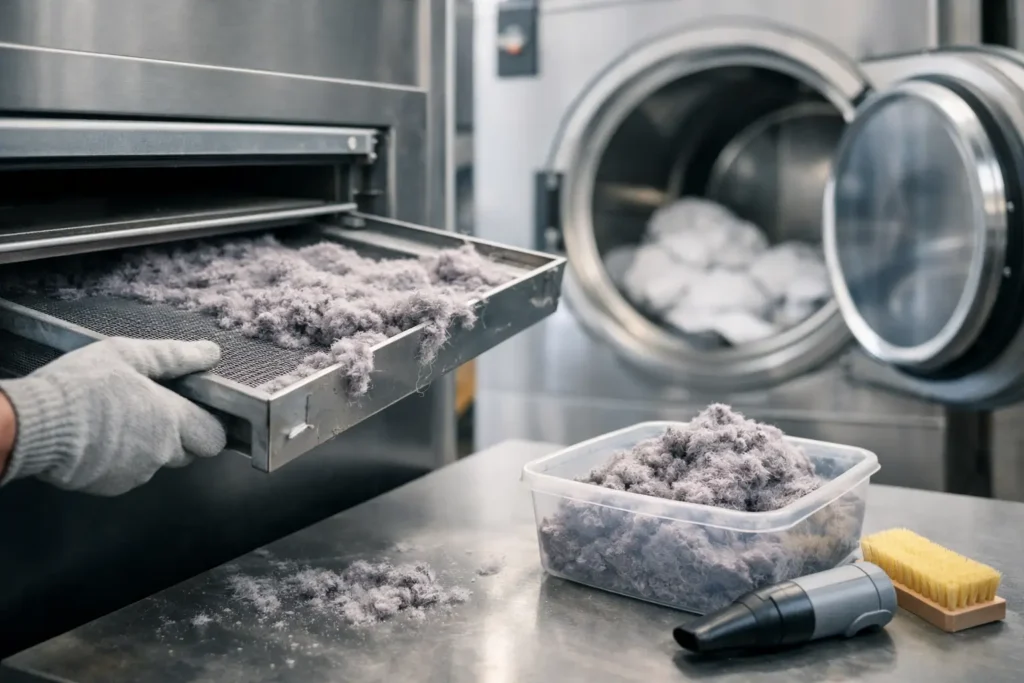
A dryer that starts taking 10 minutes longer per load is usually not having a heating problem first. More often, it has an airflow problem. That is why industrial tumble dryer lint management practices matter so much in commercial laundry operations. Lint is not just housekeeping waste. It is a production issue, a safety issue, and a maintenance issue that affects throughput every day.
For laundromats, hotels, healthcare laundries, and dry-cleaning plants, lint buildup works quietly until it starts showing up as re-dry loads, overheated components, nuisance shutdowns, and avoidable service calls. The cost is rarely one dramatic failure. It is usually the steady loss of efficiency, labor time, and equipment reliability.
Why industrial tumble dryer lint management practices matter
In a commercial dryer, airflow does the real drying work. Heat helps, but moving air through the load is what carries moisture away. When lint collects in screens, housings, ducts, burner areas, or exhaust runs, airflow drops. Once that happens, drying times stretch, gas or electric consumption rises, and machine components operate under more stress.
There is also the fire risk. Lint is highly combustible, and commercial dryers produce a lot of it. Facilities that process towels, microfiber items, mops, healthcare textiles, or heavily used hospitality linen tend to see faster accumulation than operators expect. A clean lint screen alone does not mean the system is clean.
That is the key point many teams miss. Effective lint management is not one task. It is a routine that covers the machine, the ductwork, the work habits around the machine, and the replacement of worn parts that stop capturing lint properly.
Start with the lint your team can see
The first layer of control is simple and non-negotiable. Lint screens and traps need to be cleaned at the required interval for the load mix and production volume. In many facilities, that means every cycle or every few cycles, not just once at the end of a shift.
The right interval depends on what you process. Bath towels, blankets, mop heads, and new cotton goods shed heavily. Flatwork or lighter mixed goods may not. If operators run high-lint loads back to back, cleaning frequency should increase. A fixed schedule that ignores the textile mix is where problems begin.
The screen also has to be inspected, not just brushed off. Torn mesh, warped frames, poor seating, and damaged seals let lint bypass the intended collection point. Once lint gets past the screen assembly, it starts loading internal surfaces and exhaust sections where it is harder to remove and easier to overlook.
The biggest problem is usually behind the panel
A dryer can look clean from the front and still be carrying a serious lint load internally. Cabinet interiors, fan housings, burner compartments, sensor areas, and exhaust transitions collect material over time. This is where industrial tumble dryer lint management practices separate basic housekeeping from real preventive maintenance.
Internal inspection frequency should match utilization. A lightly used machine in a small on-premise laundry may need a different service interval than a high-turn commercial plant running long hours every day. There is no universal number that fits every operation. What matters is setting an inspection rhythm based on throughput, fabric type, and machine age, then adjusting it when conditions change.
If a site sees repeated overheating trips, hotter-than-normal cabinet surfaces, slow dry times, or more lint around the rear of the machine, internal accumulation should move to the top of the maintenance list. Waiting for annual service in that situation is too late.
Exhaust duct management is where efficiency is won or lost
The exhaust run deserves as much attention as the dryer itself. Even a well-maintained machine will struggle if the duct is too long, poorly routed, undersized, leaking, or packed with lint. Operators often focus on the dryer because it is visible, while the duct system gets ignored until airflow is badly restricted.
Straight, properly sized, well-supported ducting performs better than long runs with unnecessary bends. Every turn adds resistance. Every rough joint creates a place for lint to catch. Every crushed or poorly aligned section reduces air movement.
Cleaning the exhaust path should be part of scheduled maintenance, not an occasional response to poor performance. The correct frequency depends on volume and textile type, but the principle is consistent: if the dryer is producing lint, the duct is collecting lint. That buildup will not solve itself.
Exterior termination points matter too. If the outlet is blocked, partially obstructed, or fitted with hardware that traps lint, airflow drops across the whole system. A clean screen inside the dryer cannot compensate for a restricted discharge point outside the building.
Train operators to spot lint-related performance changes
A good lint management program is not only a maintenance function. Operators are the first line of detection. They see load times, machine temperatures, lint volume, and changes in daily behavior before anyone else does.
They should know that certain signs point to airflow restriction rather than random machine trouble. Loads finishing damp, unusually hot linen, repeated re-dry cycles, burning smells, frequent high-limit trips, and lint escaping into the laundry room are all warning signs. So is a sudden change in how much lint is captured at the screen. If the lint volume drops sharply without a change in goods processed, it may be bypassing the collection area.
This does not require technical training at engineer level. It requires a simple reporting habit. When operators know what to watch and whom to tell, small maintenance issues stay small.
Match your cleaning routine to your textile mix
Not all laundry creates the same lint burden. This is where generic maintenance schedules often fall short. A healthcare laundry processing patient gowns and sheets may have different lint patterns than a hotel laundry running heavy towel programs. A dry-cleaning plant with mixed finishing and garment care volumes will not behave like a coin laundry.
New textiles usually shed more. Aged terry goods may shed less, but damaged items can create spikes. Microfiber can behave differently from cotton. Mats, mops, and specialty items can overload screens quickly. If your team uses one cleaning interval for all loads, you are probably either over-cleaning low-lint batches or under-cleaning high-lint ones.
A practical approach is to classify loads into normal-lint and high-lint categories, then set handling rules around them. That keeps the routine simple enough for operators while still reflecting real production conditions.
Replacement parts matter more than many facilities assume
Lint control is only as good as the condition of the parts doing the control. Screens, gaskets, door seals, access panel seals, fan components, and exhaust connections all affect whether lint stays on the intended path. When these parts wear out, operators often compensate with more frequent cleaning, but cleaning cannot fully correct a bad seal or a damaged screen assembly.
This is where procurement decisions have a direct maintenance impact. Compatible, correctly fitted replacement parts help restore airflow and containment. Poor-fit substitutes can create small bypass points that become large lint problems over time.
Facilities that rely on professional laundry equipment usually benefit from treating lint control parts as planned maintenance items, not emergency purchases. That reduces downtime and avoids the all-too-common situation where a machine stays in service while waiting for a basic but critical component.
Build a lint management standard, not a loose habit
The best-performing laundry operations do not leave lint control to memory. They turn it into a standard. That means cleaning points are defined, inspection responsibility is assigned, and unusual findings are recorded. It does not need to become paperwork for the sake of paperwork. It needs to be repeatable.
A practical standard covers four areas: operator cleaning frequency, internal inspection intervals, exhaust cleaning intervals, and parts replacement criteria. If one of those areas is missing, the system becomes reactive. You end up cleaning what is obvious and missing what actually affects performance.
For multi-machine sites, compare dryers against each other. If one unit consistently runs longer than similar machines on similar loads, that difference tells you something useful. Lint accumulation, duct issues, or worn components are often behind the gap.
Safety and productivity are tied together
Some maintenance topics feel separate from production. Lint management is not one of them. The same buildup that raises fire risk also reduces throughput. The same restriction that overheats a component also raises utility cost and labor time. Safety and efficiency move together here.
That is why the most effective industrial tumble dryer lint management practices are practical, scheduled, and tied to the actual way the laundry operates. They are not based on guesswork. They are based on load type, machine usage, airflow performance, and parts condition.
If your dryers are clean only where the eye can see, there is probably money and risk sitting in the places your team checks least. A better lint routine is not complicated. It starts with treating airflow as a production asset and maintaining it like one.
For lint fire-hazard prevention standards, see this external NFPA safety guidance.