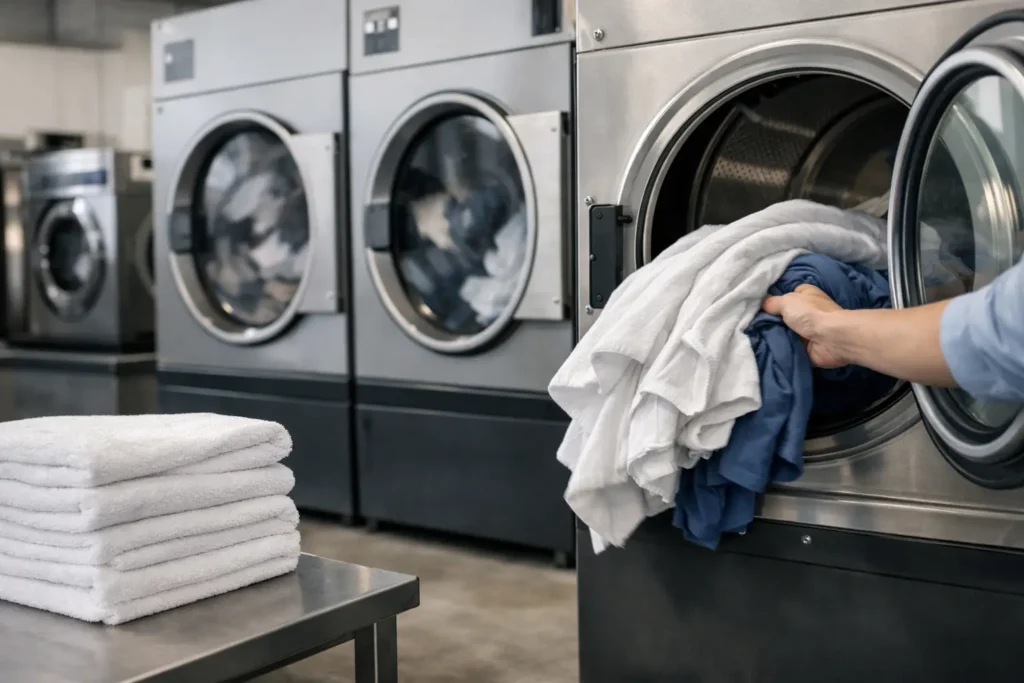
A dryer that runs 10 to 15 minutes longer than it should is not a small inefficiency. Across multiple turns per day, that extra time reduces throughput, raises gas or electric costs, increases linen wear, and creates a bottleneck that pushes clean goods delivery behind schedule. If your goal is to reduce drying time in commercial laundry operations, the fastest gains usually come from fixing process issues before replacing equipment.
This is an operations problem first, and an equipment problem second. Many laundry facilities assume the dryer is underperforming when the real cause is poor extraction, overloaded baskets, restricted airflow, or inconsistent sorting. The right correction depends on where the delay starts.
Where drying delays really begin
Drying time is shaped long before the load enters the tumbler. If goods leave the washer-extractor with excessive retained moisture, the dryer has to do work that should have been handled during extraction. A dryer can only evaporate water efficiently when the moisture level is already within a reasonable range.
That is why washer-extractor performance matters so much. High extract G-force shortens dryer cycles by removing more water mechanically, which is always cheaper than removing it thermally. If two facilities use the same dryer model but one extracts better, that facility will usually finish more loads per shift with lower utility consumption.
Load composition matters just as much. Heavy terry, sheets, uniforms, microfiber, and mixed-fabric items do not release moisture at the same rate. When they are dried together, the load often runs to satisfy the slowest-drying piece. The result is over-dried light items, under-dried heavy ones, and wasted minutes on every cycle.
How to reduce drying time in commercial laundry operations
The most effective way to improve drying performance is to treat the whole laundry line as one system. Drying speed is a result of extraction, load preparation, machine condition, airflow, and operator consistency working together.
Start with better water extraction
If your washer-extractors are not reaching proper final extract speed, check programming, suspension condition, drain performance, and whether operators are stopping cycles early. Even a modest increase in water removal before the dryer can cut cycle times noticeably.
There is a trade-off, though. Some items cannot tolerate aggressive extraction without wrinkling, distortion, or finishing issues. Hospitality sheets may handle higher extract well, while certain dry-cleaning support items or specialty fabrics may require a more moderate approach. The right target is the one that balances moisture removal with fabric outcome.
Match load size to the dryer, not just to the washer
Overloading is one of the most common reasons a commercial dryer runs long. When goods are packed too tightly, hot air cannot move through the load. Moisture stays trapped, temperatures become uneven, and the dryer continues running without real efficiency.
Underloading can also be wasteful because the machine uses energy without delivering full productive output. The goal is a load size that allows tumbling action and air penetration. That ideal point varies by machine design and by goods type, which is why capacity should not be treated as a fixed number across every item category.
Sort by fabric weight and moisture behavior
Mixed loads cost time. A load that combines flatwork, towels, and personal garments may seem convenient, but it usually extends the cycle and complicates finishing. Better sorting gives operators more predictable dry times and helps managers set more accurate production expectations.
This is especially useful in hospitality, healthcare, and multi-category laundries where different goods enter the plant at the same time. Standardizing loads by fabric type, weight, and thickness often improves dryer productivity without any capital expense.
Airflow is the silent productivity driver
Heat alone does not dry laundry. Drying requires a steady exchange of heated air and moisture-laden exhaust. When airflow is restricted, water stays in the drum longer and temperatures may rise without actually improving moisture removal.
Lint is usually the first place to look. Clogged lint screens, blocked ducts, and neglected exhaust paths make a dryer work harder for worse results. In some plants, operators clean screens but maintenance intervals for duct inspection are too long. In others, the issue is poor duct layout with excessive bends or long exhaust runs.
Check the full exhaust path
A clean lint drawer does not guarantee proper airflow. Restrictions may be sitting deeper in the ductwork, at the wall termination, or in shared vent systems. If drying time has gradually increased across several machines, the problem may be centralized rather than unit-specific.
Make-up air is equally important. A dryer cannot exhaust properly if the room does not provide enough replacement air. This often shows up in tightly enclosed laundry rooms where negative pressure interferes with burner performance and moisture removal. Operators may notice longer cycles, excess heat in the room, or inconsistent drying across shifts.
Burner and heating performance matter, but less than many think
Weak heat output can extend dry times, but airflow failures often create the bigger penalty. Before assuming a burner or heating element issue, confirm that air is moving correctly through the machine. A hot dryer with poor airflow is still a slow dryer.
That said, combustion components, sensors, and controls should be checked regularly. If heat delivery is inconsistent, loads may finish unevenly and operators may compensate by adding extra time. Once that habit starts, cycle standards become unreliable.
Controls, programs, and operator habits
Facilities that reduce drying time in commercial laundry operations usually do one thing well: they remove guesswork. Operators know which cycle to use, what a correct load looks like, and when a machine needs attention.
If staff rely on manual timing for every load, drying tends to drift upward. One operator adds five extra minutes to be safe, the next adds seven, and soon the standard cycle is no longer standard. Moisture sensing, programmed cycles, and simple loading rules help control that drift.
Build programs around real load types
A dryer menu with too many unclear options slows production and encourages workarounds. A smaller set of clearly named programs based on actual goods categories is more effective. Towels should not be processed like sheets, and microfiber should not be treated like heavy cotton.
The best programming reflects your real mix, not a generic factory default. If your plant handles mostly hospitality linen, healthcare goods, or dry-cleaning support items, programs should match those conditions. This is where specialized supplier support can help identify practical machine settings and compatible replacement parts when controls or sensors begin affecting performance.
Train for consistency, not just speed
Fast operators are not always efficient operators. If they overload dryers, bypass sorting, or ignore lint buildup, they create delays that appear later in the shift. Short, repeatable training around load size, cycle selection, and daily checks often delivers better results than pressuring staff to move faster.
It also helps to track average dry time by category. When managers can compare towels, sheets, uniforms, and mixed goods separately, problem areas become easier to isolate.
When equipment is the limiting factor
Sometimes the process is sound and the machine fleet is simply mismatched to production. Older dryers may have weaker airflow design, less precise controls, or lower thermal efficiency than newer commercial units. In those cases, reducing drying time may require replacement rather than adjustment.
This is especially true when washer-extractors have been upgraded but dryers have not. Better extraction can improve results, but if tumble dryers lack airflow capacity or responsive controls, the gain will plateau. The line has to be balanced.
Stacked systems, high-capacity tumble dryers, and industrial heat-pump dryers each serve different operating priorities. A plant focused on maximum throughput may prioritize faster conventional drying performance. A facility under strong utility cost pressure may accept longer cycles from heat-pump technology if energy savings justify the trade-off. There is no universal best choice, only the right fit for volume, fabric mix, labor pattern, and utility economics.
For buyers managing uptime and replacement planning, availability of spare parts matters as much as machine specification. A dryer that performs well on paper but sits idle waiting for a compatible sensor, belt, or ignition component is not helping production.
A practical standard for faster drying
If you want a reliable improvement, start by measuring retained moisture after extraction, average dry time by goods category, lint and duct condition, and actual load weights. Those four checks usually show where time is being lost. From there, correct the process before assuming you need more heat or more machines.
Commercial laundry performance is built on control. Better extraction, proper airflow, disciplined loading, and consistent programming will usually outperform guesswork and overtime. When the system is aligned, dryers stop being the bottleneck and start doing what they should – turning loads quickly, predictably, and profitably.