
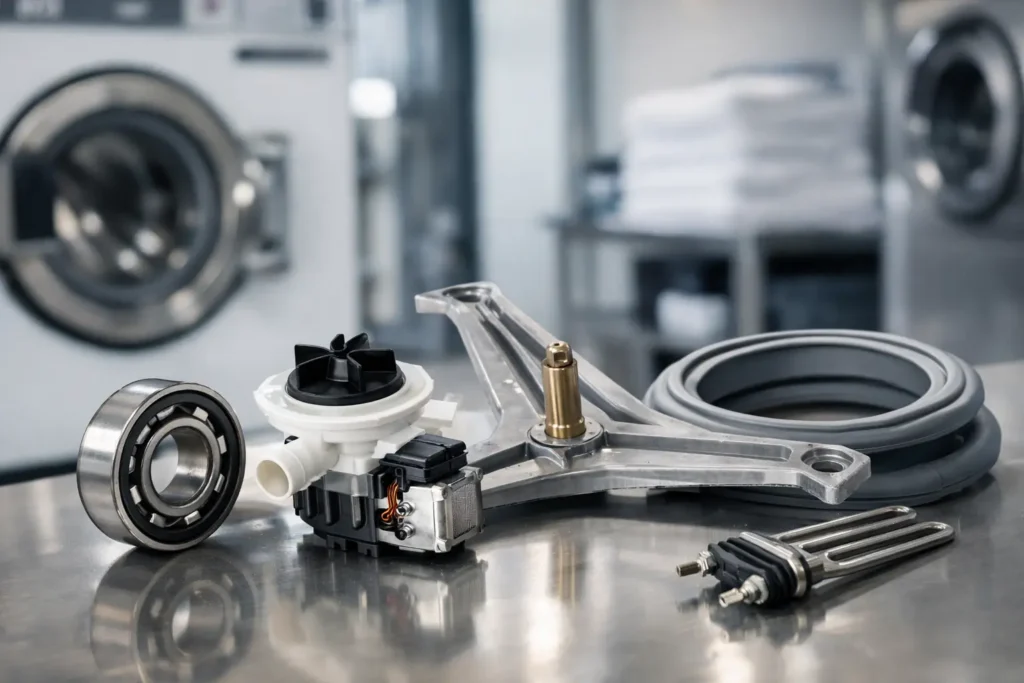
A washer rarely fails all at once. More often, one of the washing machine parts starts wearing out long before the machine stops completely. A valve opens slowly. A belt slips under load. A door lock becomes inconsistent. In a commercial laundry, those small faults turn into missed turns, delayed finishing, and avoidable service calls.
For operators, the real question is not just which part failed. It is whether the part was identified correctly, whether the replacement is compatible, and whether stock is available fast enough to protect production. That is why parts planning matters just as much as machine selection.
Why washing machine parts matter in commercial laundry
In a home setting, a washer can be down for a day and it is an inconvenience. In a laundromat, hotel laundry, healthcare linen room, or on-premise facility, downtime has a direct operating cost. Loads stack up. Labor gets redirected. Dryers wait for extraction. Deliveries can slip.
The reason experienced operators pay close attention to washing machine parts is simple: most interruptions come from a relatively small group of service items. When those items are matched correctly and replaced at the right time, the machine stays productive longer and emergency repairs become less frequent.
There is also a procurement issue behind maintenance. Commercial equipment is not forgiving when the wrong part is installed. Even a part that looks close can create fitment problems, control errors, leaks, vibration, or premature wear on adjacent components. With branded commercial washers, compatibility is not a minor detail. It is the difference between a proper repair and another stoppage next week.
The core washing machine parts operators should know
Not every buyer needs to diagnose equipment at technician level, but every operation should understand the main part categories that affect uptime.
Water inlet and drain components
Fill valves, hoses, drain valves, drain pumps, and related seals control how water enters and leaves the machine. When these components start failing, the symptoms are usually easy to spot: slow fills, incomplete draining, overflow conditions, or cycles that stop mid-process.
In high-use environments, these parts deal with repeated cycling, water quality issues, chemical exposure, and lint or debris. A drain issue may look minor at first, but poor draining can extend cycle times and leave loads too wet for efficient drying. That affects more than one machine in the process line.
Drive and motion parts
Belts, pulleys, bearings, motors, couplings, and suspension components handle the physical work of washing and extraction. These parts are under constant stress, especially in machines running long hours with dense linen loads.
A worn belt may show up as inconsistent drum movement. Bearing wear may start as noise and vibration. Suspension issues can lead to excessive movement during extract, which puts pressure on the frame and nearby components. If left alone, one worn motion part often takes others with it.
Door and locking assemblies
Door gaskets, hinges, handles, interlocks, and latch mechanisms are easy to overlook until they stop a cycle from starting. In commercial washers, door systems are safety-critical. If the machine does not confirm a secure lock, the control will not allow operation.
This is one of those areas where quick replacement matters. A failed lock assembly can sideline an otherwise healthy machine. A damaged gasket can create leaks that spread beyond the unit itself and become a housekeeping or slip-risk issue.
Electrical and control parts
Control boards, relays, sensors, switches, wiring harnesses, and display components are central to modern commercial laundry systems. These parts manage water levels, temperature, timing, rotation, extraction, and safety logic.
Electrical faults can be harder to diagnose because symptoms overlap. A machine that will not start may have a door lock issue, a control issue, or a sensor issue. A machine that stops randomly may have a board fault, intermittent wiring problem, or overheating component. In these cases, part identification should be careful, not rushed.
Seals, gaskets, and smaller wear items
Some of the least expensive parts cause the most disruption when ignored. Seals, O-rings, bushings, clamps, and fasteners do not get much attention during procurement meetings, but they are often what stands between steady operation and a leak, rattle, or repeat service visit.
Good maintenance teams know that these smaller items should not be treated as afterthoughts. If a machine is already open for service, replacing associated wear parts often makes more sense than waiting for the next failure.
What usually causes part failure
Commercial laundry conditions are demanding. High cycle counts are the obvious reason, but they are not the only one. Overloading machines, inconsistent utility supply, poor water quality, chemical misuse, and delayed routine maintenance all shorten part life.
The pattern matters. If drain valves are failing too often, the issue may be debris management or chemistry, not just part quality. If bearings keep wearing early, load balance or installation conditions may be contributing. If door gaskets fail repeatedly, chemical concentration or operator handling could be part of the problem.
That is why replacement should not be treated as a one-step fix. The right question is whether the failed part was the root cause or the result of another operating issue.
OEM-compatible selection is not optional
For commercial buyers, one of the biggest mistakes is ordering by appearance or generic description alone. Washing machine parts must match machine brand, model, series, and in some cases production revision. Two parts can look nearly identical and still differ in rating, dimensions, connection type, or control compatibility.
This becomes even more important in facilities running established commercial brands such as Speed Queen, UniMac, Wascomat, or other professional platforms. Procurement should be based on confirmed fitment, not guesswork. That reduces return risk, technician delays, and the hidden cost of installing the wrong component.
A specialized supplier adds value here because the transaction is not just about selling a box. It is about narrowing down the correct part for the exact machine in service. That saves time where it counts – on the laundry floor.
Which parts should be kept in stock
Not every operation needs a deep parts room, but every serious facility should keep a practical stock of high-probability failure items. The exact list depends on machine age, fleet size, and service model. A self-service laundromat with multiple identical washers has different priorities than a hotel laundry with mixed equipment.
Still, a sensible stock strategy usually includes door locks, gaskets, valves, belts, hoses, common sensors, and other repeat-use service items. The more standardized your equipment fleet is, the easier and more cost-effective this becomes. If your site runs several units of the same model, one spare part can protect multiple revenue-producing machines.
There is a balance to strike. Overbuying ties up cash in slow-moving inventory. Underbuying leaves you exposed to avoidable downtime. The best approach is data-based: review past failures, identify repeat parts, and stock what consistently stops production.
When to repair and when to step back
Replacing washing machine parts is usually the right move when the machine is structurally sound, the control platform remains reliable, and parts support is still good. That is especially true when the failed item is a normal wear component.
But there are cases where repeated part replacement points to a broader equipment decision. If failures are becoming frequent across multiple systems, labor costs are climbing, and cycle performance is falling, the repair may be technically possible but operationally weak. At that stage, it makes sense to compare the cost of continued maintenance against replacement or fleet upgrade.
A dependable supplier should be able to support both paths – parts when repair makes sense, and equipment options when it does not. That is where specialization matters. You need practical answers, not generic advice.
Choosing a parts partner that supports uptime
Commercial buyers do not need marketing language. They need correct parts, clear compatibility support, and continuity of supply. That is what keeps laundry production moving.
A strong parts partner understands machine categories, brand differences, and how a failed component affects the rest of the operation. They know that a laundromat owner, dry cleaner, or hotel laundry manager is not just buying a replacement item. They are buying back machine availability.
For that reason, the best source for washing machine parts is usually a supplier focused on commercial laundry rather than a general reseller. Specialized support shortens the path from fault to fix. It also reduces the risk of ordering errors that waste both time and labor.
ABELCO EQUIPMENT TRADING LLC works in that specialist lane – supporting commercial laundry operations with equipment, parts, and the everyday essentials needed to keep production on track.
If your washers are central to your business, parts planning should be treated as an operating priority, not a last-minute purchase. The machine that keeps running is usually the one supported by the right part, in the right spec, at the right time.
For OEM vs aftermarket parts guidance, see this external maintenance and parts sourcing overview.