
A washer that stops mid-cycle does not create a small problem in a commercial laundry. It backs up loads, strains labor, delays deliveries, and turns a routine shift into a recovery exercise. That is why washing machine spare parts should be treated as an uptime decision, not just a maintenance purchase.
In professional laundry operations, the right part is not simply the one that looks similar or costs less. It is the one that matches the machine, performs under commercial duty, and restores dependable output without creating another failure point two weeks later. For laundromats, hotels, healthcare laundries, and on-premise facilities, that difference matters every day.
Why washing machine spare parts matter more in commercial laundry
Residential buying habits do not translate well to commercial equipment. A home washer can tolerate longer downtime and lighter use patterns. A commercial washer-extractor or high-capacity washer runs under repeat loads, tighter schedules, and higher customer expectations. When a drain valve, bearing, belt, water inlet valve, door lock, or control component fails, the cost is measured in missed throughput as much as in repair expense.
That is why procurement teams and operators usually look at parts through three lenses: compatibility, durability, and availability. If one of those is missing, the purchase becomes risky. A part that arrives quickly but does not fit is still downtime. A cheaper part that fits but wears out early is not a saving. A high-quality part with long lead times may not help when loads are already piling up.
The most common washing machine spare parts operators replace
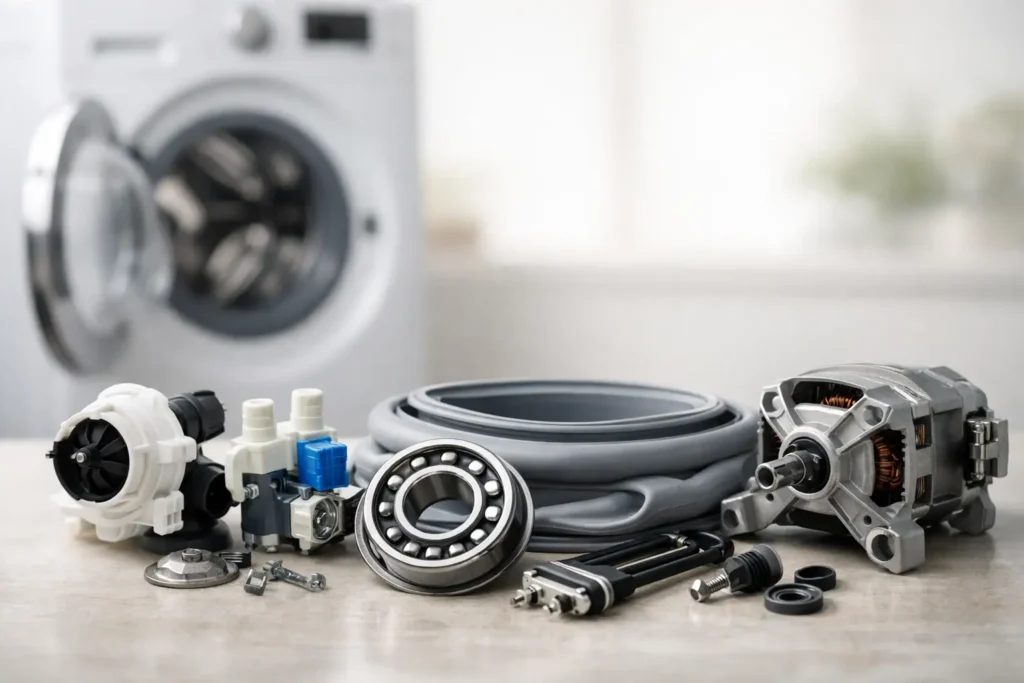
Some components fail from normal wear. Others fail because of water quality, vibration, heat, chemical exposure, or simple age. In commercial environments, the most commonly replaced items tend to include belts, bearings, seals, hoses, water valves, drain valves, pumps, door gaskets, latches, suspension components, and control parts.
Electrical components deserve special attention. Sensors, contactors, ignition parts in heated systems, control boards, and switches can create intermittent faults that are harder to diagnose than a clear mechanical break. In those cases, replacing the wrong part wastes both time and labor. Good parts sourcing starts with accurate fault identification, not guesswork.
Wear parts also behave differently depending on machine type. A hard-mounted high-speed washer-extractor may stress bearings and suspension-related components differently than a smaller front-load commercial washer. Stack systems bring their own access and service considerations. The part category may be familiar, but the application still needs to be exact.
OEM, aftermarket, and the real cost question
Buyers often ask the same practical question: should we buy OEM or aftermarket? The answer depends on the machine, the part, and the operating pressure around that machine.
For critical components tied to safety, controls, sealing, or exact fit, OEM often makes the most sense. The cost may be higher up front, but predictable compatibility reduces installation issues and repeat service calls. For heavily loaded commercial equipment, that predictability is worth real money.
Aftermarket parts can be the right choice in some cases, especially for less sensitive wear items where quality has been proven and specifications match the original part. But commercial buyers should be careful with broad assumptions. One aftermarket belt may perform well. One low-grade gasket may not. The category alone does not tell you enough.
A better question is this: what is the cost of another interruption if the part underperforms? Once labor, delayed loads, and technician time are added, the cheapest line item can become the most expensive decision.
How to identify the right washing machine spare parts
The fastest way to buy the wrong part is to order from a generic description. “Drain pump” or “door seal” is not enough in a commercial setting. Model variations, production revisions, voltage requirements, mounting differences, and brand-specific configurations all affect fit.
Start with the machine brand, full model number, and serial number if available. Then confirm the exact part reference from the equipment manual, service diagram, or an experienced supplier who understands commercial laundry platforms. This step matters even more with established commercial brands where multiple generations of equipment may look similar but use different components.
Photos can help, but they should support identification, not replace it. A visual match is useful for checking connectors, housing shape, or wear patterns, but it is not a substitute for verified compatibility. If the part involves electrical load, software interaction, water pressure, or safety locking, visual matching alone is a weak method.
For buyers managing multiple sites, internal recordkeeping makes a noticeable difference. Keeping a basic asset register with model numbers, installation dates, and recurring replacement history helps avoid emergency ordering errors. It also helps standardize stocking decisions across similar machine fleets.
Stocking strategy: what to keep on hand and what to order as needed
Not every part belongs on your shelf. Tying up cash in slow-moving inventory does not help operations. At the same time, running lean on every part can leave a facility exposed.
The practical approach is to stock the failure points that are both common and operationally disruptive. Belts, hoses, seals, valves, latches, and other recurring wear items often justify local stock, especially if the facility runs high volume or serves time-sensitive accounts. Parts with longer life cycles, higher unit cost, or lower failure rates can often be ordered as needed, provided the supplier can support lead time requirements.
This is where specialization matters. A supplier focused on commercial laundry understands that a healthcare linen operation, a hotel laundry, and a neighborhood laundromat do not carry the same downtime tolerance. The right stocking plan depends on machine count, redundancy, service access, and the cost of lost output.
When a part replacement is smart, and when it is a warning sign
Replacing a failed part is routine. Replacing the same category repeatedly is a signal.
If bearings fail early, the issue may be overloading, installation alignment, or adjacent component wear. If valves keep sticking, water quality or debris may be part of the problem. If belts are wearing too quickly, pulley condition or tension settings may need attention. If control parts are failing, moisture, heat, or unstable power may be contributing.
Good maintenance teams look past the immediate repair. A spare part solves the symptom in the moment, but the larger value comes from reducing repeat failures. That is especially relevant in commercial laundry, where one recurring issue can quietly consume service budgets over months.
Working with a supplier that understands commercial equipment
A general parts source may be able to sell a component. A specialized supplier is more likely to help you avoid the wrong one.
Commercial buyers usually need more than a price check. They need confirmation that the part fits the machine in service, support across recognized laundry brands, and confidence that the item is appropriate for real operating conditions. They also need continuity. If one supplier handles washers, dryers, stacked systems, and supporting consumables, procurement becomes simpler and service planning gets easier.
That is the practical advantage of working with a company specialized in the laundry and dry-cleaning equipment industry. The conversation stays focused on uptime, compatibility, and dependable supply. For operators balancing machine performance with labor and customer commitments, that is the standard that matters.
What buyers should ask before ordering
Before approving a part, confirm a few basics. Is it matched to the exact model and revision? Is it intended for commercial-duty use? Is the expected service life reasonable for your operating environment? Is there any related hardware, seal, or fitting that should be replaced at the same time?
It also helps to ask whether the failure suggests a connected issue. Replacing one bad component while ignoring the cause often creates another service event. For example, changing a pump without checking hose condition or blockage can leave the machine one step away from the same problem.
A straightforward supplier will not overcomplicate this. The goal is to get the machine back into service with the right part, the first time, and with the least disruption to your operation.
For commercial laundry operators, buying washing machine spare parts is really about protecting capacity. The part itself is only one line item. The real purchase is uptime, predictable output, and fewer avoidable interruptions. If you buy with compatibility, service conditions, and supply continuity in mind, the machines tend to give that value back shift after shift. Give that process the attention it deserves, and your equipment will work harder for longer.
For OEM vs aftermarket parts guidance, see this external maintenance and parts sourcing overview.