
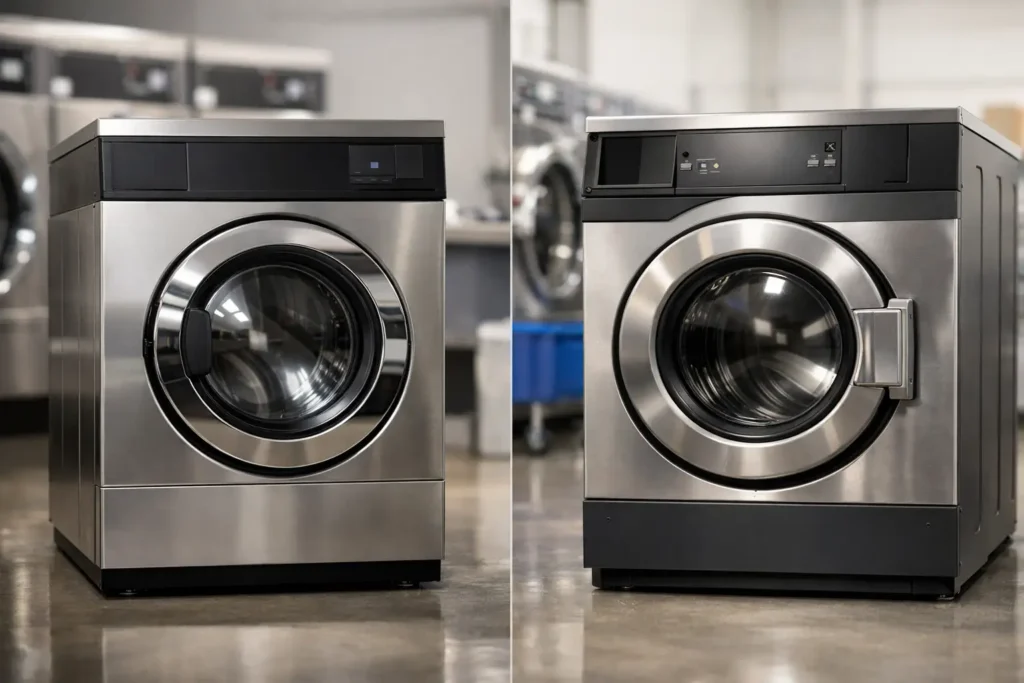
When a site is losing turns because a washer is down, brand preference stops being a marketing question and becomes an operating cost. That is why the Speed Queen vs UniMac commercial washer comparison matters to laundromat owners, hotel laundry managers, healthcare operators, and anyone buying for uptime first.
Both brands are established commercial names. Both are built for real production environments. But they are not always the same answer. The right choice depends on your mix of load sizes, staff skill level, maintenance plan, utility costs, and how hard you expect the machines to run every day.
Speed Queen vs UniMac commercial washer: the real buying question
Most buyers start with capacity and price. That makes sense, but it is not enough. A commercial washer earns its keep through a combination of extraction performance, cycle speed, control simplicity, service access, and how predictable it is over years of use.
In practice, the real question is this: do you need a machine optimized for straightforward operation and dependable day-to-day performance, or do you need a platform better suited to heavier throughput, broader programming control, and more industrial-style laundry demands? Speed Queen and UniMac can overlap, but they tend to shine in slightly different operating profiles.
Where Speed Queen usually fits best
Speed Queen is often a strong fit for self-service laundries, smaller on-premise laundry rooms, multifamily properties, and operators who want commercial-grade reliability without unnecessary complexity. The appeal is straightforward. These machines are known for simple operation, familiar controls, and durable construction that works well in environments where staff may not be deeply technical.
For laundromats, that matters. Simpler user interaction usually means fewer customer errors and fewer service calls tied to misuse. For apartment and institutional laundry rooms, it means less operator training and easier daily management.
Speed Queen also tends to appeal to buyers who want a clear commercial offering without stepping too far into a highly engineered industrial setup. If your priority is proven performance, easier onboarding, and a machine that does not ask much from your staff beyond basic care and scheduled maintenance, Speed Queen often belongs on the shortlist.
That said, simpler does not automatically mean better. If your operation demands highly customized programming, very specific extract settings, or long production runs with varied linen profiles, Speed Queen may not always offer the same operational flexibility some larger facilities want.
Where UniMac usually fits best
UniMac is frequently favored in higher-demand environments such as hospitality, healthcare, and larger on-premise laundries where machine utilization is aggressive and programming flexibility matters. The brand has a strong reputation in commercial laundry for heavy-duty build quality and washer-extractor performance geared toward serious production.
For managers focused on throughput, UniMac often stands out because extraction performance and cycle optimization can have a meaningful effect on downstream drying time and labor flow. In a laundry room processing linen all day, those savings are not minor. They affect utility spend, dryer bottlenecks, and how many loads the team can finish before the shift ends.
UniMac can also be attractive when a facility wants more control over wash formulas and operating parameters. That extra control is useful in healthcare, hospitality, and specialty linen processing where formulas are tied to fabric care, infection control, or brand standards.
The trade-off is obvious. More capability can mean more complexity. If your team will not use the programming options, or if your operation is simple enough that standard cycles are sufficient, paying for added control may not improve results.
Build quality and durability
Both brands are commercial. That matters because buyers sometimes compare them as if one is built for real laundry and the other is not. That is not the case. The better way to look at it is durability under your specific workload.
Speed Queen generally earns points for dependable construction and a reputation for long service life in steady-use environments. It is often a practical choice where the machine needs to perform consistently without becoming a maintenance burden for a small team.
UniMac, on the other hand, is often seen as the tougher fit for high-volume and more demanding duty cycles. In operations where machines run hard, multiple shifts, and missed uptime is expensive, UniMac may justify a higher upfront investment.
If your site is moderate volume, both may be durable enough. If your site is relentless, the decision should be made with duty cycle in mind, not just purchase price.
Controls, usability, and staff impact
Controls are easy to underestimate until the first month of operation. A machine with more features is only better if those features are used correctly.
Speed Queen often appeals to buyers who want easier training and less room for operator error. In self-service and lower-complexity on-premise settings, that is a real advantage. Straightforward controls reduce friction for both staff and end users.
UniMac often gives more room for tailored programming and process control. That can improve wash quality, consistency, and resource efficiency when the operator knows what they are doing. In a managed laundry room with trained staff, that flexibility can become a strong operational benefit.
So the question is not which control system is better in isolation. It is whether your laundry room benefits more from simplicity or configurability.
Throughput and extraction performance
This is where differences can affect the full laundry line, not just the washer itself. Higher extraction reduces residual moisture in the load, which can shorten dryer time. Over time, that can lower gas or electrical use and improve total room capacity.
UniMac often gets more attention from buyers who are optimizing throughput across washers and dryers together. In a production-minded environment, stronger extraction and formula control can improve flow and help avoid dryer backups.
Speed Queen still performs well in many commercial applications, especially where load demand is steady rather than extreme. But if your laundry room is constantly chasing turnaround time, the operational value of extraction performance should be reviewed carefully.
A washer is never just a washer in commercial laundry. It affects drying, folding, labor pacing, and customer wait times.
Maintenance, parts, and serviceability
A machine is only as good as your ability to keep it running. That is why parts access and service support should be part of the buying decision from the start.
Speed Queen is often appreciated for practical serviceability and familiarity across many commercial environments. That can be helpful for operators who want less specialized maintenance demands.
UniMac can be an excellent long-term asset, but as with any more advanced commercial platform, buyers should think ahead about maintenance capability, spare parts planning, and who will handle programming or repairs when needed.
This is where a specialized supplier matters. A reliable equipment source that also supports spare parts and operating supplies reduces downtime risk and simplifies procurement. For operators managing multiple machines or high-turn environments, that support is not extra. It is part of the equipment value.
Cost of ownership, not just selling price
If you compare only the invoice amount, you can make the wrong choice in either direction. A lower-priced washer that slows the room down or creates repeat service issues may cost more over time. A premium machine with capabilities you never use can also become an expensive mismatch.
Speed Queen may offer strong value for operators who need a dependable commercial machine with lower complexity and a practical cost profile. For many laundromats, housing facilities, and standard on-premise laundry rooms, that is a smart investment.
UniMac may justify its position when production demands are heavier and operational efficiency can be measured in labor hours, utility savings, and faster turnaround. If your facility runs enough volume, the economics can favor the more industrial solution.
The right answer depends on how many cycles you run, how costly downtime is, and whether advanced performance actually changes your operating results.
Which one should you buy?
Choose Speed Queen if your operation values straightforward use, dependable commercial performance, and easier day-to-day management. It is often the practical fit for self-service laundry, multifamily sites, and smaller or mid-sized on-premise operations.
Choose UniMac if your laundry room is more production-driven, your loads are demanding, and you need stronger control over formulas, extraction, and throughput. It is often the better fit for hospitality, healthcare, and facilities where laundry is a critical internal service, not just a convenience.
If you are replacing an existing machine, do not buy based only on brand reputation. Look at your actual pain points. Are you trying to reduce training issues, cut drying time, improve wash consistency, or survive a heavier workload? The best machine is the one that solves the bottleneck you already have.
At Abelco Equipment Trading LLC, we work with commercial laundry buyers who need that decision to be practical, not theoretical. The machine has to fit the operation, the maintenance reality, and the long-term supply plan.
A commercial washer should make your day easier six months after installation, not just look good on a quote sheet. Buy for the room you run every day.
For independent lab data on machine efficiency and reliability testing, see this external Consumer Reports washing machine testing overview.