
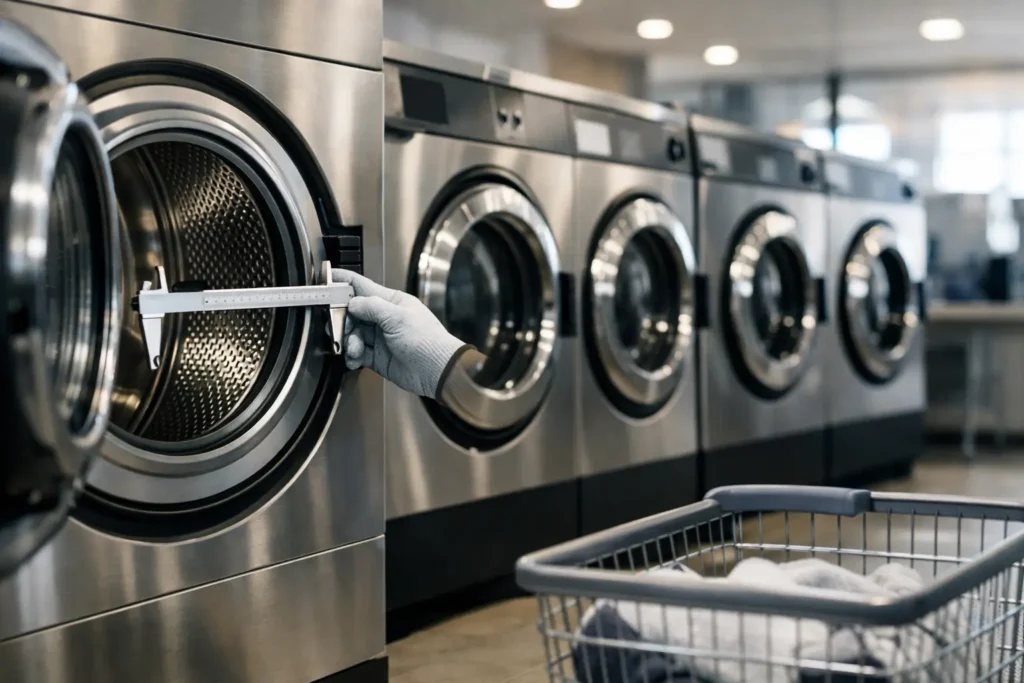
A washer-extractor that is too small creates lines, lost turns, and frustrated customers. One that is too large for the location can leave expensive capacity sitting idle while utility demand climbs. Knowing how to size laundromat washer extractors starts with actual customer load behavior, not simply the number of machines a competitor has on the floor.
For a new laundromat, an expansion, or a replacement project, the goal is to build a washer mix that handles peak periods, matches dryer capacity, and gives customers clear choices. Capacity matters, but extraction speed, plumbing, electrical service, and machine layout matter just as much.
Start With Customer Load Demand
Washer-extractors are rated by pounds of dry laundry, not by the total wet weight of a finished load. A 40-pound machine is intended to process up to 40 pounds of dry textiles under normal operating conditions. Overloading it reduces wash action, rinsing performance, extraction efficiency, and component life.
Begin by estimating who will use the store and what they are likely to wash. A neighborhood serving apartment residents may see frequent small and medium loads. A location near large families, worker housing, hotels, or short-term rentals may have stronger demand for large-capacity machines. The best equipment plan does not force every customer into the same load size.
Look at peak-hour demand rather than daily averages. A store may be quiet for much of the week and still need meaningful capacity on weekends, evenings, and month-end pay periods. If customers routinely wait for the largest machines, adding more small washers will not solve the problem.
For an existing operation, use payment-system reports, observation, and staff feedback. Review which machine sizes turn most often, which sizes are idle, and when queues form. For a new site, study nearby housing density, household size, competitor capacity, parking access, and the local mix of self-service and commercial wash customers.
Build a Balanced Washer-Extractor Mix
Most successful laundromats need a mix of small, medium, and large washer-extractors. The exact ratio depends on the market, but a floor made up entirely of one capacity usually limits revenue and customer convenience.
Smaller machines serve single-person loads, daily clothing, and customers who want the lowest vend price. Medium-capacity machines are often the core of the store because they handle the common household load. Large washer-extractors attract comforters, blankets, family wash, and customers consolidating several loads into one visit.
A practical planning approach is to make medium machines the foundation, then support them with enough small machines for price-sensitive users and enough large machines to prevent bottlenecks. In a family-oriented store, large machines may represent a higher share of installed capacity even if they represent fewer total units.
Do not size the mix by machine count alone. Four 20-pound washers do not offer the same customer value as one 80-pound washer. They cannot wash a king-size comforter properly, and they require more separate payment cycles, loading time, and dryer transfers. Large machines also create a higher-ticket option that can improve revenue per customer visit when local demand supports it.
Use Capacity Bands Customers Can Understand
Clear capacity steps simplify customer choices. If every machine is close in size, customers may choose only by price and leave your higher-capacity equipment underused. More distinct options give them a reason to move up when they have bulky items or multiple baskets.
For example, a store may use a small band for everyday loads, a mid-size band for family laundry, and large-capacity units for oversized textiles. The equipment brand and available models will influence the final capacities, but the operational principle stays the same: each size should have a clear job on the floor.
Size Washer Extractors Around Peak Turns
A washer-extractor is not productive because it is installed. It is productive when it completes paid turns during the hours customers need it most. Calculate potential turns per day, then pressure-test that estimate against your busiest operating window.
A typical wash program may take 25 to 35 minutes, depending on cycle selection, water temperature, chemistry, and machine programming. Add several minutes for loading, payment, unloading, and customer decision time. A machine theoretically capable of many daily cycles may complete far fewer in real store conditions.
Use a conservative target for peak demand. If Saturday afternoon regularly creates a queue, the store needs enough available capacity during that window, not just enough total machines to look adequate on paper. Build in room for a machine being out of service, a customer running an extended cycle, or several large loads arriving at once.
This reserve capacity protects customer experience and protects revenue. A customer who cannot find an appropriate washer may leave rather than wait, especially when another laundromat is nearby.
Match Washer Capacity to Dryer Capacity
Washer-extractor sizing and dryer sizing must be planned together. A strong extraction cycle removes more water from textiles, shortening dryer time and improving customer flow. But faster extraction does not eliminate the need for enough dryer pockets.
As a general operating rule, dryer capacity should exceed installed washer capacity because drying usually takes longer than washing. The correct ratio depends on dryer size, heat source, extraction performance, typical fabric mix, and whether dryers are stacked or single-pocket units. Heavy towels, bedding, and low-extraction loads need more drying capacity than light apparel.
Pay attention to the transfer pattern. Large washer-extractors often discharge into several dryer pockets, particularly when a customer separates whites, colors, or heavier items. If your largest washers regularly finish at the same time but nearby dryers are full, the store develops a traffic jam exactly where customers expect convenience.
High-speed washer-extractors can improve the balance by reducing retained moisture. That can reduce dryer run time, gas consumption, and pressure on available pockets. However, higher extraction performance must be supported by the building structure, proper anchoring, and the manufacturer’s installation requirements.
Confirm Utility and Building Limits Before Selecting Machines
A capacity plan that works on paper can fail during installation if the site cannot support it. Before finalizing washer-extractor sizes, verify water supply, drainage, electrical capacity, gas service for the dryers, ventilation, floor loading, and access for delivery.
Large washer-extractors may require substantial water flow and drainage performance, especially if several machines discharge close together. Inadequate drain sizing can slow operations, trigger error conditions, or create backflow concerns. Water heating capacity also deserves close attention if your wash program includes hot-water cycles.
Electrical requirements vary by machine size and configuration. Confirm voltage, phase, disconnects, breaker capacity, and any local code requirements early. Retrofitting electrical infrastructure after equipment is ordered can delay opening and increase project cost.
Floor construction is equally important. High-spin washer-extractors generate significant forces during extraction. Correct foundations, anchoring, leveling, and installation are not optional details. They protect the equipment, reduce vibration, and support a better customer environment.
Choose Extraction Speed for Operating Economics
Extraction performance is commonly described by G-force. Higher G-force generally removes more water, reducing the work left for the dryer. This can improve customer turnover and lower dryer energy use, particularly in high-volume operations.
The trade-off is that high-speed equipment may have greater installation demands and a higher initial cost. It also does not replace proper cycle programming or routine maintenance. The right choice depends on your utility costs, floor conditions, dryer configuration, customer volume, and equipment budget.
For many laundromats, the best value is not simply the highest available G-force. It is the washer-extractor that delivers reliable extraction, practical service access, proven controls, and a capacity that will turn consistently. Uptime is more valuable than a specification that does not fit the site.
Plan for Maintenance Access and Future Replacement
Leave enough room around each machine for service access, customer loading, carts, and safe movement. A tight layout may add one more machine today but make repairs slower and the customer experience worse for years.
Standardizing on a manageable number of machine sizes and compatible commercial platforms can also simplify parts planning and staff training. This matters when pumps, door components, belts, valves, or control-related parts are needed quickly. For operators building long-term capacity, serviceability should carry real weight in the purchasing decision.
Abelco Equipment Trading LLC is specialized in commercial laundry equipment and can help operators evaluate washer-extractors alongside dryers, stacked systems, and the parts required to keep a facility operating.
The right washer-extractor plan gives customers a machine that fits the load in their cart, not just the space left on your floor. Start with the busiest two hours of the week, verify the building can support the equipment, and choose capacity that keeps laundry moving when it matters most.