
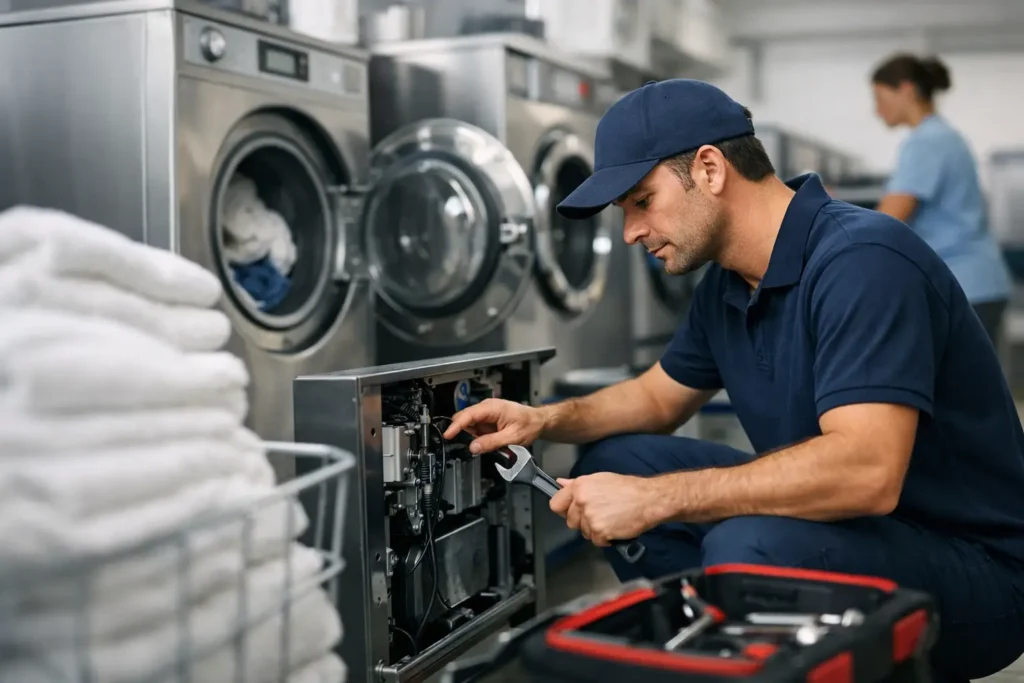
A washer-extractor that stops mid-shift is not just one machine out of service. It creates a queue at the dryer bank, delays folding, puts delivery schedules at risk, and pulls staff away from productive work. Knowing how to reduce laundry equipment downtime starts with treating every machine as part of one connected production line.
For laundromats, hotels, healthcare linen operations, dry cleaners, and institutional laundries, uptime is a purchasing issue as much as a maintenance issue. The right service habits matter, but so do equipment selection, spare-parts availability, operator training, and realistic capacity planning.
Start With the Failures That Actually Stop Production
Not every fault deserves the same response. A cosmetic panel issue can wait. A failed drain valve, worn drive belt, damaged door lock, leaking hose, or dryer ignition fault can immediately stop revenue-producing work. Review service records for the last six to twelve months and identify the failures that caused the longest interruptions.
Track each event by machine, component, time out of service, root cause, and repair action. This does not need complicated software. A simple maintenance log can reveal whether one washer repeatedly develops drain problems or whether dryers are shutting down because lint removal is inconsistent.
The goal is to separate random failures from repeatable patterns. If a component fails more than once, do not only replace it. Find out why it is failing. An overloaded machine, poor water quality, incorrect programming, restricted airflow, or an incompatible replacement part can turn a minor repair into a recurring downtime problem.
Build a Preventive Maintenance Routine Around Production
Preventive maintenance works when it is scheduled around real operating conditions, not when it is treated as paperwork. A high-volume laundry running long daily shifts needs more frequent inspection than a low-volume on-premise facility, even if both use the same equipment model.
Daily checks should focus on conditions that develop quickly. Operators should inspect washer doors and gaskets, listen for unusual noise or vibration, look for water leaks, confirm detergent supply, and remove lint from dryer screens and accessible areas. Dryers deserve particular attention because restricted airflow increases dry times, wastes energy, and can lead to safety concerns.
Weekly and monthly inspections should go further. Check belts, hoses, clamps, drain paths, filters, bearings, electrical connections, door locks, and dryer exhaust routes according to the manufacturer’s service requirements. Record what was checked and what was found. A completed checklist is useful only if it results in action when a problem appears.
Schedule deeper inspections during the facility’s lowest-demand window. A planned two-hour service window is easier to manage than an unplanned full-day shutdown. If your operation cannot tolerate taking a major washer or dryer offline, rotate maintenance across machines rather than postponing it until there is a failure.
Keep Dryer Airflow a Priority
Dryer issues are often blamed on the machine when the real problem is airflow. Lint accumulation in screens, ducts, exhaust outlets, and make-up air pathways reduces performance and places extra strain on components. Longer cycle times also create a hidden capacity shortage, causing staff to overload available dryers and putting more pressure on the entire operation.
Clean lint screens every load where appropriate, inspect ductwork on a defined schedule, and investigate any dryer that suddenly needs longer cycles. The correct response depends on the dryer type, fuel source, installation, and ventilation layout, but slow drying should never be accepted as normal.
Keep Critical Spare Parts on Site
The fastest technician cannot restore a machine without the correct part. For commercial laundry operators, a small inventory of high-use, high-impact parts can significantly shorten repair time.
The right stock depends on your equipment mix and service history. Most facilities should consider keeping commonly needed items such as belts, hoses, clamps, fuses, door-lock components, gaskets, filters, igniters where applicable, and selected valves or switches. If several machines share the same component, holding that part becomes more valuable.
Avoid buying parts simply because they are inexpensive. Inventory should be based on failure likelihood, lead time, machine criticality, and compatibility. A specialized supplier can help match parts to specific commercial models, which reduces the risk of ordering a similar-looking component that does not fit or perform correctly.
Consumables also affect continuity. Marking tapes, fasteners, needles, laundry pens, and other daily-use supplies may not stop a washer from operating, but a shortage can still interrupt sorting, identification, finishing, or customer processing. Include these items in your reorder process rather than treating them as last-minute purchases.
Train Operators to Catch Problems Early
Operators are usually the first people to notice a machine changing behavior. They hear a new bearing noise, see a door that needs extra force to close, notice poor extraction, or recognize when a dryer is taking too long. Their observations are valuable only if they know what to report and have a clear process for reporting it.
Training should cover correct loading weights, approved programs, basic cleaning, visible warning signs, and the limits of operator repairs. Overloading is a frequent cause of stress on bearings, suspension systems, belts, and motors. Underloading can also waste water, energy, and labor. The best load size depends on the machine’s rated capacity and the type of goods being processed.
Make it easy for staff to take a machine out of service when needed. A clear out-of-service tag and a direct reporting method are better than allowing a questionable machine to stay in circulation until it fails completely. That short decision can prevent damaged goods, leaks, or a larger repair.
Choose Equipment for Serviceability, Not Purchase Price Alone
When replacing equipment, consider the cost of downtime over the machine’s working life. A lower-priced unit may look attractive at purchase, but limited parts access, difficult servicing, insufficient capacity, or poor fit for your utility setup can cost more over time.
Commercial-grade washers, washer-extractors, tumble dryers, stacked washer-dryer systems, and heat-pump dryers all have different operational advantages. The best choice depends on throughput, available floor space, utility costs, labor, linen type, and required turnaround time. A hotel laundry with heavy daily volume may need a different configuration from a multi-family laundry room or a dry-cleaning plant handling specialty goods.
Standardizing equipment where possible can reduce downtime. Fewer machine platforms can mean fewer training requirements, simpler parts inventory, and faster diagnosis. Complete standardization is not always practical, especially when a facility has phased upgrades, but it should be a consideration in every replacement plan.
Create Capacity That Can Absorb a Failure
A laundry that operates at 100% machine capacity every day has no room for maintenance or unexpected repairs. One breakdown immediately becomes a production crisis. If your service level is critical, plan for some reserve capacity through an additional machine, a flexible shift, a backup processing arrangement, or a mix of machine sizes that can handle diverted loads.
This is a trade-off. Extra capacity requires capital and floor space, and it may not make sense for every location. But for healthcare, hospitality, and high-volume linen service operations, the cost of missed turnaround targets can be far greater than the cost of one strategically placed backup unit.
Also review the workflow around the equipment. A machine can appear to be down when the real bottleneck is sorting, water heating, chemical delivery, drying, folding, or cart availability. Measure the full process before investing in more washers or dryers.
Work With Suppliers That Support Continuity
Equipment uptime improves when procurement is planned, not reactive. Keep an updated list of machine model numbers, serial numbers, installed parts, and preferred replacement components. Share this information with your equipment and parts supplier before an emergency occurs.
A specialized commercial laundry supplier can help operators source compatible equipment, replacement parts, and recurring consumables through one relationship. That reduces the delays and ordering errors that come from dealing with multiple general vendors. Abelco Equipment Trading supports commercial laundry and dry-cleaning operations with professional equipment categories, spare parts, and the day-to-day supplies that keep production moving.
The most useful maintenance program is the one your team can consistently follow. Start with one high-impact change this week: inspect dryer airflow, identify the parts that repeatedly delay repairs, or begin recording every unplanned outage. Small actions, repeated on schedule, are what keep laundry equipment available when your operation needs it most.