
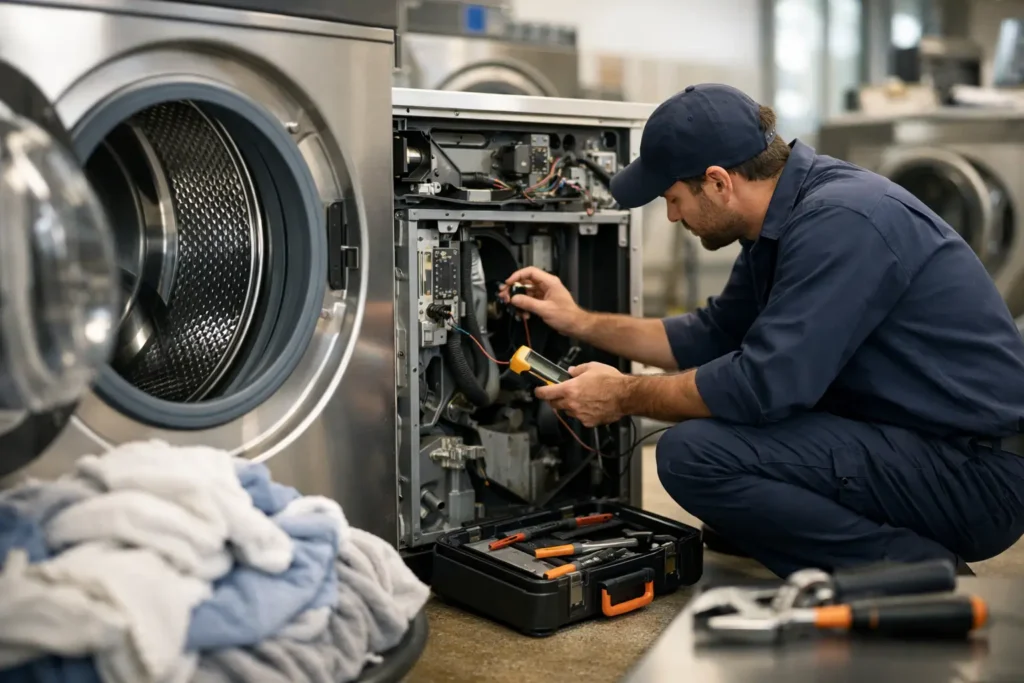
A washer out of service at 7 a.m. does more than delay one load. It backs up folding, holds carts on the floor, stresses staff, and turns a manageable shift into a recovery job. If you are looking at how to reduce laundry machine downtime, the fastest gains usually come from better routines, better parts readiness, and better decisions about when to repair versus replace.
For commercial laundry operations, downtime is rarely caused by one dramatic failure. More often, it builds from smaller issues that were allowed to continue – a drain valve that starts sticking, a belt showing wear, a door latch that needs adjustment, or a dryer airflow problem that keeps pushing temperatures higher than they should be. Operators who keep uptime high usually do not have fewer problems. They catch them earlier and respond faster.
How to reduce laundry machine downtime in real operations
The first step is to treat downtime as an operating cost, not just a maintenance event. When a machine stops, you are not only paying for a part or a service call. You are paying in missed throughput, overtime, customer complaints, delayed room turns, or pressure on the rest of the line. That changes how you prioritize prevention.
Start with the machines that carry the most production. In many plants, a few washer-extractors or dryers handle a disproportionate share of daily volume. Those units need tighter inspection schedules and a clear spare-parts plan. A low-use backup machine can wait a little longer for noncritical work. A high-volume primary unit should not.
It also helps to track failures by category. If the same machine repeatedly loses time to door switch issues, drainage faults, ignition problems, or overheating trips, that points to a root cause. Replacing the same component again and again without addressing the underlying condition is expensive and predictable.
Build a maintenance routine that operators will actually follow
The best maintenance plan is the one your team can execute during a normal week. If the checklist is too long or too technical, it gets skipped. In practice, downtime drops when daily operator checks, weekly inspections, and scheduled technical maintenance are clearly separated.
Daily checks should stay simple. Staff should look for abnormal vibration, unusual noise, slow drains, poor extraction, longer dry times, lint buildup, and signs of leaks. These are not advanced diagnostics. They are early warnings. A two-minute check at startup is cheaper than a shutdown in the middle of peak demand.
Weekly inspections can go further. This is the right time to clean filters and lint paths thoroughly, inspect belts and hoses, verify door seals, and look at electrical connections for visible wear or heat damage. Dryers deserve special attention because restricted airflow creates a chain reaction – slower drying, higher temperatures, more wear on components, and eventually a stoppage that could have been avoided.
Then there is scheduled maintenance by a qualified technician. Bearings, motors, valves, ignitors, sensors, and control components all have wear patterns. Waiting until failure gives you the worst possible timing. Planned replacement does not eliminate cost, but it gives you control over when the machine is unavailable.
Spare parts strategy matters more than most operators think
A surprising amount of downtime comes from one avoidable problem: the machine is diagnosable, the repair is straightforward, but the part is not on hand. In commercial laundry, that turns a short repair into days of lost capacity.
The answer is not to stock everything. That ties up money and creates confusion. The practical move is to stock critical wear items and common failure parts for your exact machine mix. That usually includes belts, door components, sensors, valves, ignition parts, contactors, fuses, and selected control items depending on the age and brand of the equipment.
Compatibility matters here. Generic substitutes may look close enough, but close enough is not always reliable in a high-cycle laundry environment. Incorrect or lower-grade parts often create repeat faults, nuisance shutdowns, or accelerated wear on related components. A specialized supplier can help identify the right parts for the exact machine model, which reduces the risk of ordering delays and fitment mistakes.
This is one place where consolidation helps. When equipment, spare parts, and recurring laundry supplies come from a specialized source, procurement gets faster and less fragmented. That matters when your team is trying to restore capacity, not manage five different vendor conversations.
Train operators to prevent avoidable failures
Many service calls begin with loading, cleaning, or handling issues rather than true equipment defects. Operators do not need to become technicians, but they should know what damages machines and what signs need to be reported immediately.
Overloading is an obvious example. It reduces wash quality, strains drive components, and can create extraction imbalance. Underloading can also be a problem on some cycles, especially when it affects machine balance and water extraction behavior. The right load size is not just about wash results. It directly affects machine wear.
Dryers need the same discipline. If staff ignore lint management, block airflow with poor loading practice, or keep rerunning loads because of process bottlenecks upstream, the dryer works harder and fails sooner. Long dry times are often treated as a production nuisance when they should be treated as a maintenance signal.
Training should also cover reporting. Staff should know that a small leak, intermittent error code, or unusual sound is worth escalating before the machine stops completely. When operators feel expected to report early, maintenance gets a much better window to act.
How to reduce laundry machine downtime with better repair decisions
Not every broken machine should be repaired immediately. Some should be stabilized, some should be scheduled for major work, and some should be replaced. Good downtime control depends on making that call quickly and without sentiment.
If a machine is relatively new, parts are available, and the repair affects a known wear component, repair is usually the right move. If the unit is older, repeatedly failing, difficult to source parts for, or causing production disruption every few weeks, replacement starts to make more sense even if each individual repair looks affordable.
This is where many operations lose money. They keep approving smaller repairs because each one seems cheaper than buying equipment. But repeated failures create labor disruption, lower throughput, rushed maintenance, and customer impact. The true cost is not on the invoice alone.
Capacity planning matters too. If your operation has no buffer, one failure becomes a crisis. Adding a stacked washer/dryer system, replacing an aging primary machine, or moving to more durable commercial units can reduce downtime risk even before any failure occurs. More resilient capacity gives you room to service machines properly instead of pushing them until they stop.
Use data, even if your system is simple
You do not need advanced software to manage downtime better. A spreadsheet or maintenance log is enough if it is used consistently. Track the machine, issue, date, downtime hours, part replaced, service provider, and whether the fault repeated. Within a few months, patterns become clear.
That information helps in three ways. First, it shows which machines deserve more preventive attention. Second, it tells you which spare parts to stock. Third, it gives you a factual basis for replacement decisions instead of relying on memory or frustration.
The most useful metric is not just number of breakdowns. It is lost production time. One machine that fails twice for 20 minutes each is a different problem from a machine that fails once and sits for two days waiting for parts. Focus on the interruptions that damage throughput the most.
Work with suppliers who understand commercial laundry uptime
Laundry equipment support is not just about selling a machine. It is about getting the right model, the right parts, and the right consumables into the operation without slowing procurement. That is especially important for operators running hotels, healthcare linen, dry-cleaning production, and on-premise laundries where interruptions affect other departments immediately.
A specialized supplier understands the difference between residential-style buying and commercial uptime planning. They know that model compatibility, parts availability, and recurring supply continuity all affect machine availability. That is why many operators prefer a partner that can support washers, dryers, stacked systems, heat-pump dryers, and the smaller operating essentials around them rather than treating each purchase as a one-off transaction.
ABELCO EQUIPMENT TRADING LLC serves this kind of buyer mindset – practical, uptime-focused, and looking for dependable continuity across equipment and parts.
Downtime usually looks sudden when it hits the floor. In reality, it is often the result of delayed maintenance, missing parts, unclear reporting, or equipment that no longer matches the workload. Tighten those four areas first, and you will usually see fewer breakdowns, faster repairs, and a laundry operation that stays productive when the day gets busy.
Structured preventive maintenance is the biggest lever for uptime; for a broader framework, see this external overview of preventive maintenance best practices.