A laundry room built for home use falls apart fast under commercial volume. If you are asking what are the equipment used in laundry, the real answer is not just washers and dryers. A professional operation runs on a connected set of machines, finishing tools, handling systems, and everyday consumables that keep throughput steady and downtime under control.
For commercial laundromats, hotels, hospitals, dry cleaners, and on-premise laundry facilities, equipment choices affect labor, utility costs, garment quality, and service continuity. The right setup depends on your load type, daily volume, available space, and maintenance plan. That is why procurement decisions should be based on application, not just price.
What are the equipment used in laundry operations?
In a commercial setting, laundry equipment usually falls into five categories: washing, drying, finishing, handling, and support items. Some operations need all five. Others can run with a tighter setup, especially if they focus on self-service laundry or basic linen processing.
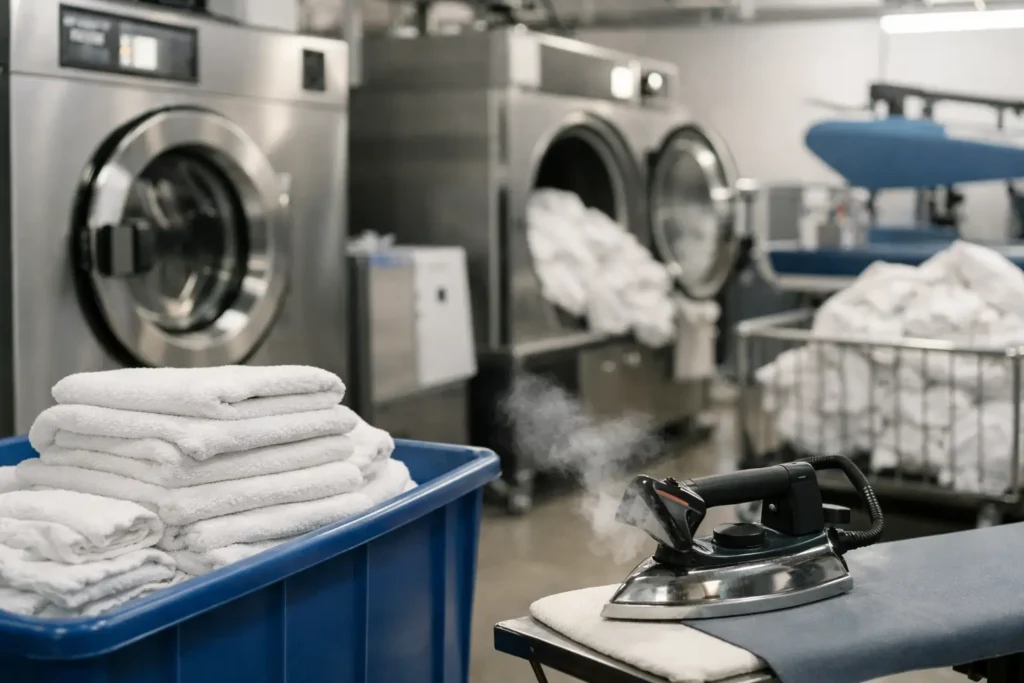
The core machine group starts with washers or washer-extractors, followed by tumble dryers or heat-pump dryers. After that, the equipment list expands depending on the textile mix. Flatwork operations often require ironing and finishing equipment. Garment-care businesses may need spotting stations, presses, and steam equipment. Nearly every facility also needs carts, tables, sorting systems, and replacement parts to keep the main machines running.
The core laundry machines that drive production
Washers and washer-extractors
The washer is the starting point of the process, but in commercial laundry, capacity and extraction speed matter more than they do in domestic use. Standard commercial washers are designed for repeated cycles, heavier loads, and more durable component life. Washer-extractors add high-speed spinning that removes more water before drying, which helps reduce dryer time and utility usage.
For many operators, washer-extractors are the better long-term investment because they improve throughput and can lower total operating cost. The trade-off is upfront cost and, in some cases, installation requirements. Hard-mount models may need stronger floor support, while soft-mount machines offer more flexibility but can come at a different price point.
Tumble dryers and stacked dryer systems
Drying capacity needs to match washing capacity. That sounds obvious, but it is a common weak point in facility planning. If dryers are undersized or too few, clean goods pile up and labor efficiency drops.
Tumble dryers remain the standard in many commercial environments because they are simple, proven, and available across a wide range of capacities. Stacked washer/dryer or stacked dryer systems are often a strong fit where floor space is limited, such as laundromats, staff housing, or compact on-premise laundry rooms. They help increase output per square foot, although access for service and workflow layout should be considered before installation.
Industrial heat-pump dryers
Heat-pump dryers are increasingly relevant for operators watching energy consumption closely. They recycle heat instead of venting it in the same way as conventional systems, which can reduce operating costs in the right environment. They can be especially attractive where ventilation options are limited or where utility rates make efficiency upgrades worthwhile.
That said, heat-pump dryers are not automatically the right answer for every site. Load profile, climate conditions, cycle expectations, and budget all matter. In high-volume operations, the comparison should be based on total production needs, not just energy claims.
Equipment used in laundry beyond washing and drying
Flatwork ironers and finishing equipment
If your facility processes sheets, pillowcases, table linen, or other flat items at volume, finishing equipment becomes essential. Flatwork ironers help dry, press, and present linen in one controlled process. This is especially important in hospitality and healthcare, where appearance standards and handling speed directly affect service quality.
Some operations can outsource finishing, but in-house equipment gives more control over turnaround time. The decision usually comes down to volume, labor availability, and delivery expectations.
Steam presses and garment finishing tools
Dry cleaners and mixed-service laundry businesses often require garment finishing equipment in addition to standard wash-dry capacity. Steam presses, utility presses, form finishers, and steam generators help remove wrinkles and restore garment shape. For customer-facing garment care, this is not optional equipment. It is part of the product quality.
The exact mix depends on the garments you handle. Uniform-heavy operations may prioritize pressing stations. Hospitality laundry may focus more on linen finishing than individual garment presentation.
Spotting equipment
A spotting table or spotting station is used to treat stains before washing or before final finishing. In dry-cleaning and garment-care environments, this can improve recovery rates on difficult items and reduce rework. For standard linen plants, it may not be a first-phase purchase. For high-value garment processing, it is often worth the space.
Handling and support equipment that keeps laundry moving
A commercial laundry does not run efficiently on primary machines alone. Material handling equipment has a direct effect on labor productivity and turnaround time.
Laundry carts, hampers, sorting bins, and transport trolleys keep soil and clean goods separated and reduce unnecessary handling. Folding tables, workstations, and storage racks improve organization and help staff keep pace with machine output. In larger operations, conveyors or automated sorting systems may also make sense, but that depends on scale.
This is where many facilities underinvest. A strong washer and dryer lineup can still create bottlenecks if staff do not have the carts, tables, or staging space needed to move goods through the process cleanly and quickly.
What are the equipment used in laundry for identification and control?
Not every critical laundry item is a machine. Consumables and accessory items play a quiet but essential role in process control.
Marking tapes, fasteners, laundry pens, and compatible needles help identify garments and linen, reduce mix-ups, and support customer accountability. In healthcare, hospitality, and uniform programs, identification errors lead to replacement cost, complaints, and wasted labor. Small items can have an outsized impact on operating discipline.
Spare parts are just as important. Belts, valves, seals, control components, and other replacement items help avoid long periods of downtime when maintenance issues arise. For commercial operators, equipment support is not just about what machine you buy. It is about whether you can keep that machine productive over time.
Choosing the right laundry equipment for your facility
The best equipment package starts with a realistic look at your operation. Daily load volume is the first measure, but it is not the only one. You also need to look at textile type, peak demand hours, labor availability, floor layout, utility access, and expected growth.
A self-service laundromat may prioritize machine durability, user-friendly controls, and a balanced mix of capacities. A hotel laundry may need washer-extractors, efficient dryers, and flatwork finishing to support room turnover. A healthcare or linen service operation may place more emphasis on hygiene protocols, batch consistency, and reliable parts availability. A dry cleaner will need more garment-specific finishing tools than a typical wash-dry-fold store.
There is also the question of brand and serviceability. Recognized commercial brands matter because reliability, parts compatibility, and technician familiarity affect downtime. A lower purchase price can become expensive if replacement parts are hard to source or if service delays interrupt production.
New facility setup vs. replacement planning
If you are opening a new laundry facility, the focus should be on system balance. Too much washer capacity without enough drying or finishing support creates operational drag from day one. It is better to think in workflow terms than to buy machines individually.
If you are replacing existing equipment, the decision is usually more specific. You may need to eliminate a maintenance-heavy unit, improve energy efficiency, or add capacity in a bottleneck area. In these cases, compatibility with your current process matters just as much as machine specifications. That is one reason many operators prefer working with a specialized supplier that understands both heavy equipment and the smaller recurring items needed to support it.
ABELCO EQUIPMENT TRADING LLC serves that need with a focused commercial laundry and dry-cleaning portfolio built around professional machines, spare parts, and daily-use accessories.
Why the full equipment picture matters
When people ask what equipment are used in laundry, they often expect a short list. In real commercial use, the list is broader because production depends on more than wash and dry capacity. You need the right machines, the right handling tools, and the right support items to keep output stable.
A well-equipped laundry is easier to operate, easier to maintain, and easier to grow. If you are evaluating your next purchase, start with the pressure points in your workflow. The best equipment decision is the one that removes the next bottleneck before it becomes expensive.