
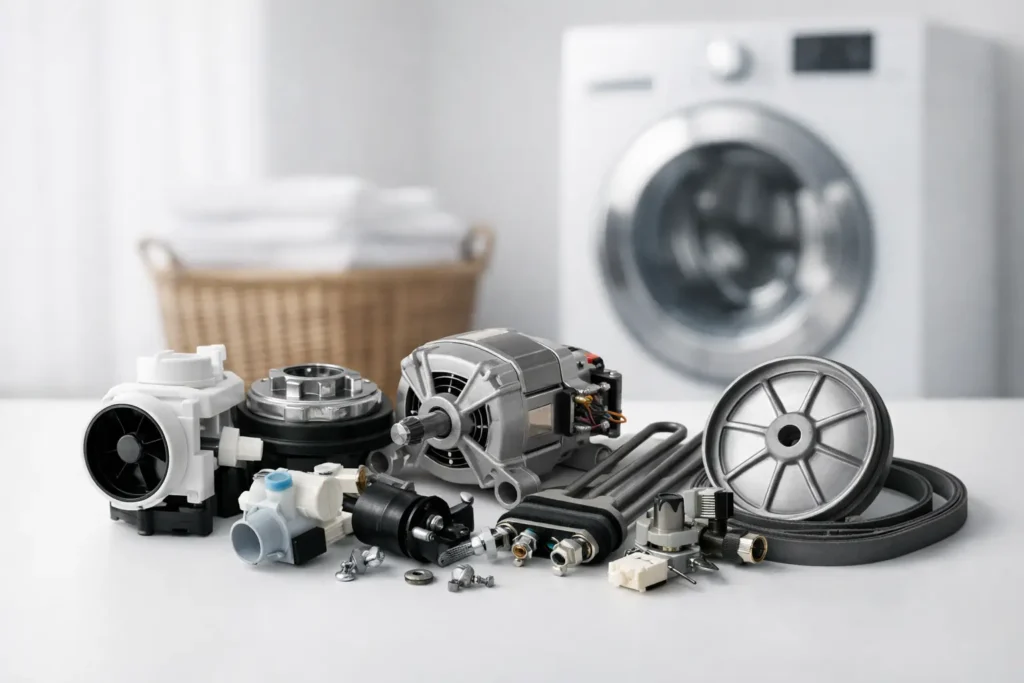
A laundry machine parts compatibility guide is essential reading before you order a replacement belt, bearing, valve, or control board, because parts that look similar across brands are often built to different tolerances. Ordering the wrong part wastes money, delays repairs, and in some cases can void a manufacturer’s warranty on commercial equipment.
Why Parts Compatibility Matters
Commercial washers and dryers share many common components, such as motors, belts, and door seals, but manufacturers frequently modify dimensions, mounting points, and electrical connections between model years. A part that fits a machine built in one year may not fit the same model line built two years later. This is why a laundry machine parts compatibility guide should always reference the exact model and serial number rather than the machine’s general type or brand alone.
How to Check Compatibility Before Ordering
Start with the data plate on the machine, which usually lists the model number, serial number, and sometimes a parts revision code. Cross-reference that information with the supplier’s parts catalog rather than relying on a photo match, since many components look nearly identical despite having different internal specifications. When in doubt, contacting the supplier directly with the full model and serial number is faster and cheaper than returning an incorrect part after installation.
Common Parts That Vary by Brand and Model
Motor and belt sizing tends to vary the most between manufacturers, since drum size and horsepower ratings differ across capacity classes. Control boards are another common mismatch point, because even machines that look alike on the outside may run different software or wiring configurations. Door seals, bearings, and water valves are usually model-specific too, so it is worth keeping a record of which parts were replaced previously to speed up future orders.
Tips for Avoiding Compatibility Mistakes
Keep a simple maintenance log listing the model, serial number, and part numbers for every repair, since this turns future ordering into a lookup task rather than a guessing game. Buying from a supplier familiar with your specific equipment brand also reduces mistakes, because they can flag known compatibility issues before you place an order. Finally, resist the temptation to substitute a close-looking part purely on price, since a small mismatch in tolerance can cause premature wear or void coverage on newer machines.
If you are researching equipment rather than replacement parts, our guide to heat pump dryers for commercial laundry covers how newer machines compare with older vented models. For general background on how washing machines work, Wikipedia’s overview of washing machines is also a useful starting point.
When to Repair vs. Replace a Part
Not every worn part is worth sourcing individually, especially on older machines nearing the end of their expected service life. If a compatible part is discontinued or costs a large share of a replacement unit’s price, it may make more financial sense to retire the machine rather than keep chasing parts for it.
On newer equipment, though, a laundry machine parts compatibility guide is exactly what keeps a repair cost-effective, since confirming the right part the first time avoids paying twice for shipping and labor. Facilities that track uptime closely often set a simple rule, such as replacing rather than repeating repairs once a single machine has needed three or more part replacements within a year.
Frequently Asked Questions
Can I use a universal part instead of an OEM part? Sometimes, for simple components like door seals or basic hoses, but for anything electronic or load-bearing, sticking with parts rated for your exact model is the safer choice.
Where do I find my machine’s model and serial number? Most commercial washers and dryers have a metal data plate near the door frame or on the rear panel, and this plate is the most reliable source for the details a laundry machine parts compatibility guide asks you to check.
Do parts from a discontinued model still exist? Often yes, since many suppliers keep stock of legacy parts, but availability tends to shrink over time, so it helps to order spares for critical components before a model is fully phased out.
Keeping this laundry machine parts compatibility guide close at hand, alongside a written maintenance log, is one of the simplest ways to shorten downtime when a machine finally breaks down during a busy shift.