
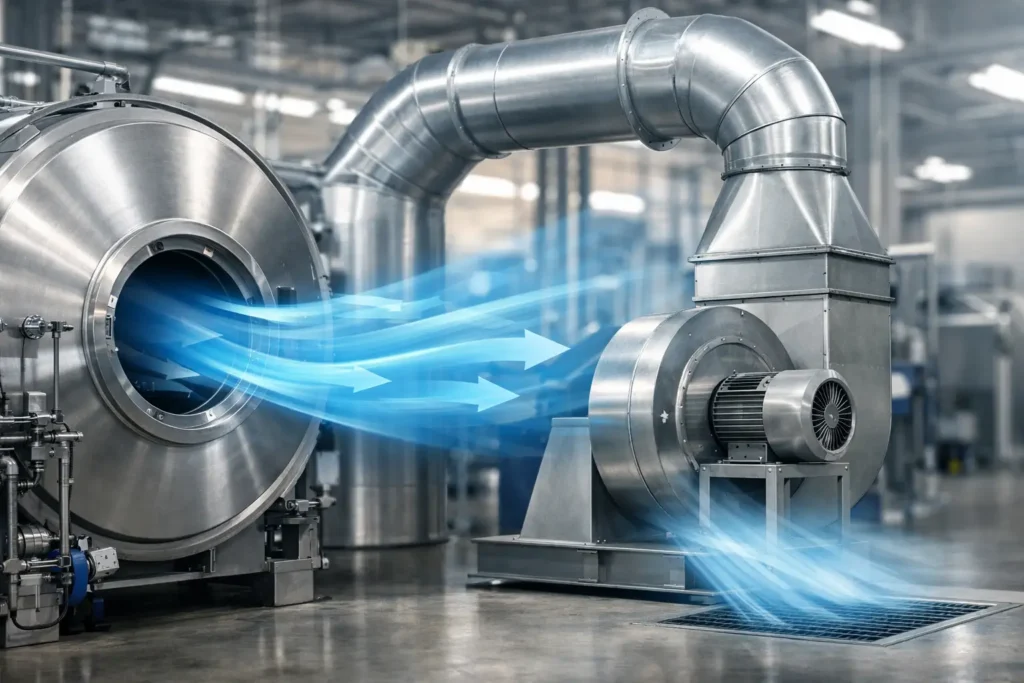
A dryer that looks properly sized on paper can still miss production targets if the airflow is wrong. That is why industrial dryer airflow requirements explained is not just an engineering topic – it is an operating cost, uptime, and fabric-care issue that affects every commercial laundry.
In a working plant, poor airflow usually shows up before anyone calls it by name. Loads take longer. Moisture remains in hems and seams. The laundry room gets hotter. Gas consumption climbs. Operators start adding time to every cycle, and that lost time compounds across the day. The machine may not be the problem. The air path often is.
Why airflow matters more than many buyers expect
An industrial dryer does not dry with heat alone. It dries by moving a controlled volume of heated air through the basket, across the goods, and out through the exhaust with moisture attached. If that air volume drops, the dryer cannot carry moisture away efficiently. Heat builds, but drying performance does not improve in the same proportion.
That distinction matters for laundromats, hotels, healthcare laundries, and dry-cleaning support operations alike. A dryer can have the right burner size and still underperform if the exhaust system is restrictive, the makeup air is inadequate, or the room itself traps hot air. In practical terms, airflow is what turns heat into production.
The exact requirement depends on the model, heat source, basket size, and duct design. There is no single CFM number that fits every dryer in every installation. What does stay consistent is the principle: the dryer must move the volume of air the manufacturer designed for, and the facility must allow that air to enter and leave without excessive resistance.
Industrial dryer airflow requirements explained in practical terms
When operators ask what airflow requirements really mean, they usually mean three things. First, how much air the dryer needs to pull through the machine. Second, how easily the exhaust duct lets that air leave. Third, whether the room supplies enough replacement air for the system to keep moving.
Manufacturers typically express dryer airflow performance through required exhaust volume and maximum allowable static pressure. The airflow figure tells you the target air movement. Static pressure tells you how much resistance the fan can tolerate before performance falls off. If the duct is too long, too narrow, poorly routed, or loaded with sharp turns, static pressure rises and effective airflow drops.
Makeup air is the other half of the equation. Every cubic foot exhausted from the dryer room must be replaced. If the room is starved for incoming air, the dryer fan works against a negative-pressure environment. That can reduce airflow, disrupt burner performance on gas units, and increase room temperature. Facilities sometimes focus heavily on exhaust duct sizing and overlook makeup air openings, louvers, or mechanical supply. That is a common and expensive miss.
What affects dryer airflow in real facilities
The duct layout is usually the first place to look. Straight, short, properly sized ductwork supports dryer performance. Long runs, undersized pipe, and unnecessary elbows do the opposite. Even a well-built dryer will struggle if the air has to fight its way out.
Shared exhaust systems add another layer. In multi-dryer installations, the manifold design has to account for combined airflow, branch balancing, and backpressure. A setup that works for two machines may become unstable when expanded to six or eight. This is one reason replacement projects should not assume the old duct is automatically suitable for newer equipment.
Lint management also matters. Lint screens catch a large percentage of debris, not all of it. Over time, residue can build in duct sections, transitions, and outlets. The result is a gradual airflow drop that many operations normalize because it happens slowly. Then drying times become the new normal, even though the system is operating below spec.
Room conditions matter too. If dryers are installed in a tight mechanical area with poor ventilation, heat accumulates around the equipment. High ambient temperature can affect controls, operator comfort, and combustion stability. It also makes the room itself harder to work in during peak production.
Signs your airflow is not meeting requirements
Most operators do not need instruments to suspect an airflow issue. The pattern is usually operational. Loads require extra minutes beyond normal program time. Goods come out hot but still damp in dense spots. The top-performing dryer banks are often the ones closest to better vent routing, while the farthest machines lag.
Another warning sign is excessive heat in the laundry room. If staff describe the dryer area as noticeably hotter than before, the system may not be removing heat and moisture as intended. On gas dryers, poor airflow can also contribute to burner cycling issues, nuisance shutdowns, or temperature irregularity.
Maintenance frequency can hint at the same problem. Repeated thermostat trips, overheated components, and premature wear on belts or motors are not always airflow-related, but airflow should be part of the diagnosis. When a dryer operates under thermal stress, secondary components often pay the price.
The trade-offs in dryer airflow design
More airflow is not automatically better if it exceeds machine design. The goal is correct airflow, not maximum airflow at any cost. If air moves too quickly in a poorly matched system, heat transfer can become less efficient, and certain fabric types may not dry as evenly as expected. This is why manufacturer specifications matter more than rules of thumb.
There is also a trade-off between installation convenience and operating efficiency. It may be easier during construction to route ductwork around structural obstacles with extra turns and longer runs. But that convenience can create years of higher drying times, more maintenance, and greater utility use. Small design shortcuts become recurring operating costs.
Heat-pump dryers introduce another variable. Their airflow and installation needs differ from conventional vented gas or electric tumble dryers. Some reduce or eliminate the same type of external exhaust requirement, but they still depend on proper air circulation, room conditions, and service clearance. Treating all dryer types as interchangeable from an airflow perspective leads to poor decisions.
How to get airflow right before problems start
Start with the machine data, not the room guess. Every commercial dryer model has installation specifications for exhaust diameter, maximum equivalent duct length, airflow expectations, and static pressure limits. Those figures should drive the design.
Then look at the full path, not just the outlet connection. A properly sized collar on the back of the machine does not guarantee a properly designed exhaust system. The full route, including transitions, elbows, vertical rise, shared manifolds, and termination points, determines actual performance.
Makeup air should be planned with the same seriousness as exhaust. If multiple dryers run at once, the incoming air volume has to support that peak condition. Relying on door gaps or incidental building leakage is rarely a professional solution in a production laundry.
Verification after installation is just as important. If drying times feel longer than expected from day one, do not assume staff training is the issue. Measure airflow and static pressure, inspect duct routing, and confirm the room is supplying adequate replacement air. Early correction is far cheaper than living with an inefficient system.
When replacement or expansion changes the airflow equation
A common mistake is replacing an old dryer with a newer, higher-capacity model while keeping the original duct design untouched. The new machine may have different fan characteristics, different exhaust volume, or tighter tolerance for backpressure. It may physically fit in the same footprint but require a different ventilation approach.
Expansion creates the same risk. Adding dryers without rechecking manifold sizing and makeup air can shift the entire room out of balance. What looked like a machine purchase becomes an infrastructure problem. For this reason, equipment supply should be paired with practical installation review, especially in facilities where uptime is critical.
This is where a specialized supplier adds value. A company focused on commercial laundry equipment, parts, and operating continuity can help buyers look beyond the machine price and avoid compatibility mistakes that affect production later. That practical support matters more than broad general advice.
Airflow is a production decision
Industrial dryer performance is shaped as much by air movement as by heat input or drum size. If airflow is restricted, the dryer works harder, the room gets hotter, cycles get longer, and costs rise where operators feel them most – in labor, utilities, and throughput.
The right question is not whether the dryer turns on. It is whether the installation lets it operate at its designed capacity, day after day, under real production demand. Get that right, and the machine has a fair chance to deliver the output you paid for.
Before your next dryer purchase, replacement, or layout change, treat airflow as part of the equipment decision, not an afterthought. That one choice tends to show up in every load that follows.
Correct airflow prevents long dry times and overheating; for the underlying air-movement math, the Engineering ToolBox air change rate reference is a helpful external source.