
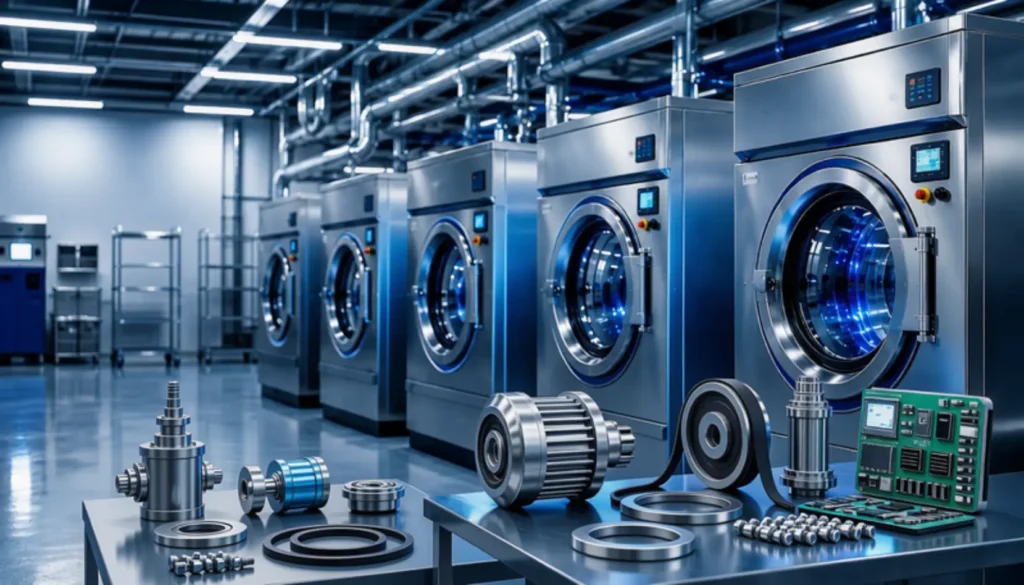
Specifying an industrial laundry equipment supplier in the UAE is one of the largest capital decisions a hotel, hospital, laundromat or facilities operator makes. Get it right and your laundry runs for a decade on predictable energy and labour costs. Get it wrong and you inherit downtime, counterfeit parts and machines that were never sized for your load. This guide walks through how to specify washers, dryers, ironers and spare parts for UAE conditions, what each sector actually needs, and how to judge a supplier before you sign.
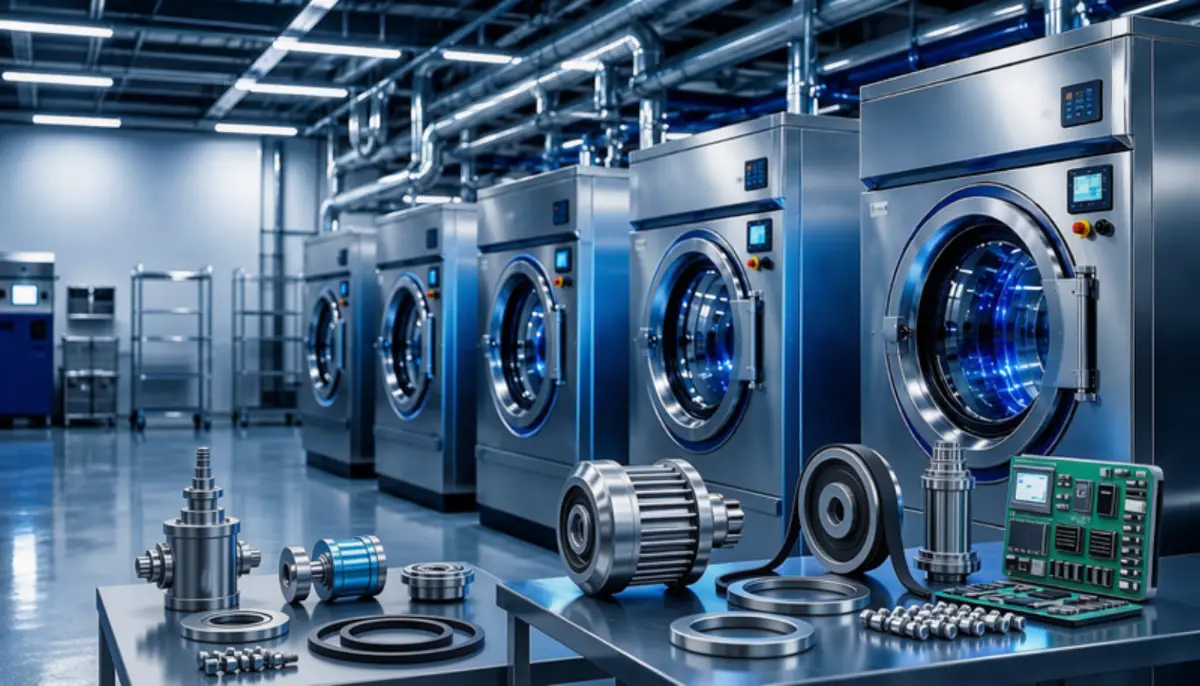
Choosing an industrial laundry equipment supplier in the UAE
Anyone can import a container of machines. The difference between a box-shifter and a genuine industrial laundry equipment supplier shows up in year two, when you need a drain valve on a Thursday afternoon. Before you compare quotes on commercial laundry equipment in Dubai, check four things.
Local spare parts stock. Ask what wear items are physically in the UAE right now: drain valves, door gaskets, drive belts, bearings, solenoid valves, control boards. A supplier who has to order from Europe every time will cost you days per fault.
Factory-certified engineers. Warranty on an industrial washing machine in the UAE is usually void if a non-authorised technician opens it. Confirm the supplier employs its own certified engineers rather than subcontracting.
Multi-brand capability. A single-brand agent will always recommend the brand they carry. A supplier who installs Speed Queen, UniMac, IPSO, Wascomat, Girbau, Huebsch, Rotondi and Sidi can specify against your actual load profile instead of their stock list.
A written response-time commitment. Downtime in a 200-room hotel laundry costs more per day than most annual maintenance contracts. Get the SLA in the AMC, not in the sales pitch. A serious industrial laundry equipment supplier will put it in writing without being asked.
Commercial washing machines: sizing and mounting
Hard mount vs soft mount washer extractors
The single most consequential choice in a commercial washing machine for Dubai installations is the mounting type, because it dictates your civil works.
A hard mount washer extractor bolts directly to a reinforced concrete plinth and transmits spin forces into the slab. It is cheaper to buy and mechanically simpler, but it needs a purpose-built foundation, which effectively means ground floor only. Extract G-force is lower, typically around 100-200G, so linen leaves the machine wetter and your dryers work harder.
A soft mount washer extractor sits on a spring-and-damper frame that absorbs imbalance internally. It can be installed on an upper floor or a standard slab, and it spins far harder, often 300-400G. That extra extraction pulls significantly more water out mechanically rather than thermally, which is where the real energy saving in a laundry lives. Soft mount costs more up front and usually pays back through the dryer gas bill.
As a rule: ground floor plus tight budget plus modest volume points to hard mount. Upper floor, high throughput, or an operation where drying is the bottleneck points to soft mount.
How to choose commercial washing machine capacity
Size by daily dry-weight kilograms, not by room count or guesswork. Work out the total dry linen weight you process in a day, divide by the number of hours you are willing to run the laundry, then divide by the realistic cycles per hour for your wash programme. Most commercial programmes give you two to three cycles per hour once you account for loading and unloading.
Two practical rules save most operators from an expensive mistake. First, never specify a single large machine where two smaller ones fit the same footprint: when the single machine fails, your laundry stops entirely. Second, machines run at roughly 80 percent of nameplate capacity in practice, because bulky items like duvets and towels cube out before they weigh out. Specify with that headroom built in. Any experienced industrial laundry equipment supplier should run this calculation with you before quoting.
Typical UAE specifications run from 10kg to 25kg soft mount units for boutique hotels, restaurants and gyms; 20kg to 40kg hard mount units for mid-size hotels and healthcare; and 60kg to 120kg high-spin machines or split-pocket tunnel-adjacent systems for central laundries and industrial contracts.
Where extraction matters more than washing, a dedicated hydro extractor or laundry water spinner in the 15kg to 200kg range can be added to strip residual moisture before the dryer stage.
Commercial dryers: airflow, fuel and heat pumps
Dryers fail to perform far more often than washers, and the cause is almost always the same: airflow. A commercial tumble dryer is a heat exchanger, and it can only evaporate as fast as it can move air. Undersized ducting, long horizontal runs, shared exhausts and blocked lint filters will halve the throughput of a perfectly good machine. This is why an industrial laundry equipment supplier should survey your duct route before recommending a dryer size.
Before you buy, confirm three things about commercial dryer airflow requirements: the duct diameter the manufacturer specifies, the maximum equivalent duct length including elbows, and whether your laundry room has enough make-up air. A dryer starved of intake air will pull negative pressure on the room and underperform no matter how it is rated.
Gas, electric, steam or heat pump
Gas dryers give the fastest cycles and the lowest running cost where a gas supply exists, which suits high-volume hotel and laundromat work. Electric is simplest to install and often the only option in a fitted-out tower or mall unit, but running cost is higher. Steam makes sense only where you already run a boiler for ironers and finishing. Heat pump tumble dryers, such as the UniMac UHP range, recover latent heat instead of exhausting it, cut energy use substantially and need no external venting at all, which makes them genuinely useful for upper-floor and retrofit installations where ducting is impossible.
Capacity in dryers is quoted in pounds as often as kilograms. UAE projects commonly specify 30lb and 50lb units for on-premise laundries, 75lb and 120lb for hotels, and 170lb to 200lb for central and industrial laundries. Match dryer capacity to about 1.5 times your washer capacity in kilograms, because damp linen is bulkier than dry linen and a cramped drum will not tumble.
Ironers, folders and finishing equipment
Finishing is where labour cost concentrates, and it is the stage most operators under-specify. A flatwork ironer handles sheets, duvet covers, pillowcases and tablecloths at a rate no hand-ironing team can match, and a compact chest ironer will fit rooms where a full roller ironer will not. Pair it with an automatic linen folder and a stacker and you remove several full-time positions from the fold table. Ask your industrial laundry equipment supplier to quote the ironer against your actual flatwork volume rather than a catalogue figure.
For garment work rather than flatwork, vacuum ironing tables with integrated boilers, form finishers and steam presses from makers like Rotondi, Comel and Sidi are the relevant category. A vacuum table with a 7 litre boiler is the standard specification for a dry cleaning or hotel valet operation. Marking machines, bagging machines, hangers, packing material and linen trolleys round out the workflow, and they are worth specifying at the same time as the machines rather than as an afterthought.
Laundry machine spare parts in Dubai and the UAE
Spare parts availability is the most underrated line item in a laundry tender and the one that decides whether your equipment hits its expected service life. A commercial washer is a pressure vessel full of hot water and chemistry that spins at high G several hundred times a week. Consumable components are engineered to be replaced on a schedule, and the schedule does not care whether your industrial laundry equipment supplier stocks the part.
The wear items worth stocking on site
- Drain valves. Two and three inch drain valves, with and without overflow, are the highest-frequency failure on any washer extractor. A stuck drain valve stops the machine mid-cycle with a full drum.
- Solenoid valves. Steam and water solenoids, typically quarter inch CEME or equivalent, control fill and heating. They fail closed and are cheap to hold in stock.
- Door gaskets and door locks. A perished gasket leaks onto the floor and becomes a safety issue long before it becomes a breakdown.
- Drive belts. Commercial laundry belts typically last two to four years depending on duty cycle and alignment. Replace them on schedule rather than on failure, because a belt that snaps under load can damage the pulley and bearing.
- Bearings and seals. The most expensive routine job on a washer. Catching a bearing early by listening for the change in spin note saves the shaft.
- Electronic control boards. Long lead times and model-specific. If your operation cannot tolerate a week of downtime, hold one for your highest-volume machine.
- Dryer components. Lint screens, belts, rollers, thermostats, igniters and gas valves.
Why genuine OEM parts matter
Counterfeit and pattern parts are widely available in the region and they are a false economy for three reasons. They shorten machine life, because tolerances and material specifications are not held to the original standard. They void your manufacturer warranty the moment they are fitted. And in components that handle steam, gas or high-voltage heating, they create a genuine safety exposure that your insurer will take an interest in after an incident. Buy through an authorised industrial laundry equipment supplier and insist on OEM part numbers on every invoice.
Insist on traceable batch numbers and manufacturer warranty documentation when you buy genuine OEM laundry parts in the UAE. A supplier who cannot produce them is not selling you what they say they are.
Abelco holds local stock of the fastest-moving wear items and can supply UniMac spare parts, Speed Queen parts, IPSO spare parts and Wascomat spare parts across the Emirates. Browse the current spare parts catalogue or see the full equipment and spare parts range.
Brands worth knowing
A multi-brand industrial laundry equipment supplier gives you an honest comparison across these names. Speed Queen is the default for laundromats and light commercial work, with top load and front load washers and stacked washer-dryer units built for coin and card operation. UniMac covers the heavy-duty on-premise segment, from UC series hard mount cabinet washer extractors to UT series dryers in the 51kg to 83kg range and the UHP heat pump line. IPSO and Huebsch sit alongside them in the Alliance family with strong parts commonality.
Wascomat, including the MyPRO front load range, suits smaller footprints. Girbau and LaPauw handle the industrial end, with LaPauw split-pocket washer extractors aimed at high-volume central laundries. ADC supplies OPL tumble dryers from 30lb to 200lb in gas, electric and steam. Rotondi, Comel and Sidi cover ironing and finishing. ELSA offers a competitively priced hard mount and soft mount range plus hydro extractors and steam boilers.
What each sector actually needs
Hotel laundry equipment
Hotels are flatwork-dominated. Sheets, duvet covers, pillowcases and pool towels make up the bulk, which means the ironer and folder matter as much as the washers. Peak load is compressed into the hours after checkout, so specify for that peak rather than the daily average. Noise and vibration are a real constraint when the laundry sits below guest floors, which pushes most hotel specifications toward soft mount machines. Guest-facing linen also has a quality threshold that hand-folding cannot meet consistently, so budget for finishing from day one. A hotel-experienced industrial laundry equipment supplier will size for the post-checkout peak, not the daily average.
Hospital and healthcare laundry equipment
Healthcare adds an infection-control layer on top of everything else. Thermal disinfection requires holding wash temperature for a validated dwell time, and the machine controller needs to log it. Barrier or pass-through washers, loaded on the soiled side and unloaded on the clean side, physically separate contaminated and clean workflows, and many hospital specifications now require them. Linen marking and tracking matters for both stock control and traceability. If you are writing a healthcare specification, work to a recognised infection-control standard such as the code of practice on prevention and control of infections and confirm your supplier can evidence compliance.
Laundromat and coin laundry equipment
A laundromat is a different business from an on-premise laundry: your machines are the product, and revenue is a function of turns per machine per day. That makes cycle time and reliability the whole game. Specify a mix of capacities so a customer with one duvet is not occupying a machine sized for a family wash, and put stacked washer-dryer units where floor area is tight. Payment systems, card readers and remote monitoring are now standard expectations rather than upgrades.
Restaurants, gyms, spas and labour accommodation
These are smaller on-premise operations, typically 10kg to 25kg, where the decision is usually whether to bring laundry in-house at all. The maths turns on your current outsourced spend, your available floor area and utility connections, and whether you have staff time to run the machines. Restaurants have a specific complication: heavy grease and oil loading on chef whites and table linen needs a proper chemical programme and higher wash temperatures than a standard cycle provides.
Industrial laundry room layout and design
Design the room around a one-way flow: soiled intake, sorting, washing, extraction, drying, finishing, folding, storage, dispatch. Clean and soiled linen should never cross. Beyond that, the constraints that most often derail a UAE laundry fit-out are utilities rather than machines. Confirm your electrical supply and phase, your water pressure and flow rate, your hot water source, drainage capacity and floor gullies sized for simultaneous discharge, gas availability if you are specifying gas dryers, and dryer exhaust routing before you place an order.
Ambient heat load is the other one people miss: a laundry room in the UAE without adequate ventilation and make-up air becomes both an equipment problem and a staff welfare problem. Bring your industrial laundry equipment supplier in at the drawing stage; moving a drain or a duct on paper is free, moving it after the screed is not.
Leave service access on all sides of every machine. The cost of a slightly larger room is trivial next to the cost of dismantling a machine to reach a bearing. Abelco offers a free Smart Laundry Planner that produces a capacity blueprint for hotel, hospital and commercial projects.
Installation, servicing, AMC and repair
This is where an industrial laundry equipment supplier earns its margin. Supply is the beginning of the relationship, not the end. A complete engagement covers a site survey and utility verification, delivery and rigging, mechanical and electrical installation, commissioning and wash-programme configuration, operator training, and then an ongoing maintenance contract.
A well-written laundry equipment AMC should specify the number of preventive visits per year, exactly which components are inspected and which consumables are included, a guaranteed response time for breakdowns, and whether parts and labour are covered or billed separately. Preventive maintenance is not optional in this equipment class. Belt tension, bearing condition, gasket integrity, lint removal, drain function, chemical dosing calibration and gas or steam safety checks all need to be on a schedule. The operators who skip AMC are the ones who replace machines at year six instead of year twelve. See Abelco servicing, AMC and repair plans for what a full contract covers.
Coverage across the Emirates
Demand looks different in each emirate. Dubai concentrates luxury hotel and resort laundries alongside a dense laundromat market. Abu Dhabi skews toward government, healthcare and large institutional contracts. Sharjah and Ajman carry a high volume of independent laundries, labour accommodation and light industrial work where price sensitivity and parts availability dominate. Ras Al Khaimah and Fujairah are resort-led. What matters practically is that your supplier can reach you: response time for a breakdown in Ajman should not be materially worse than in Dubai, and parts dispatch should be same-day or next-day across the country. Choose an industrial laundry equipment supplier with engineers based in the UAE, not flown in per call-out.
What it costs to set up a laundry in the UAE
Equipment is usually the smaller half of a laundry project. Budget separately for the machines themselves, civil works including plinths and drainage, electrical and mechanical connection, dryer ducting and ventilation, delivery and rigging, commissioning and training, initial chemical stock, and a starter set of spare parts. Trade licence, premises and municipality approvals sit on top if you are opening a standalone laundry business. A transparent industrial laundry equipment supplier will itemise these lines in the quotation.
When comparing quotes, compare total cost of ownership rather than headline price. Water and electricity consumption per kilogram, expected service life, parts pricing and availability, warranty terms and residual value will swamp the purchase-price difference over a decade. A machine that is fifteen percent cheaper and uses twenty percent more water is not cheaper.
Comparing laundry equipment suppliers in the UAE
Most laundry equipment suppliers in the UAE can quote a washer or dryer. Far fewer can design the whole laundry, install it and keep it running. When you compare a laundry machine supplier in the UAE, ask each one the same questions:
- Range: can they supply the complete line of commercial laundry equipment in the UAE (washer extractors, tumble dryers, flatwork ironers, finishing tables and boilers) or only one product type?
- Brands: are they an authorised source for recognised brands such as UniMac, Speed Queen, IPSO, Wascomat, Rotondi and Elsa Lavare?
- Local support: do they keep spare parts in stock in the UAE and have their own technicians for installation, AMC and breakdown repair?
- Design help: will they size the machines to your daily kilograms of linen and plan the laundry room layout, utilities and workflow?
- References: can they show installations in hotels, hospitals, laundromats or labour accommodation similar to yours?
Abelco Equipment Trading LLC has supplied commercial and industrial laundry equipment from Ajman to customers across all seven emirates since 2018. Contact our team or browse our laundry machines to start your project.
Frequently asked questions
Who are the main laundry equipment suppliers in the UAE?
The UAE market includes brand distributors, general kitchen and laundry traders, and specialist laundry equipment suppliers. For hotels, hospitals and commercial laundries, a specialist such as Abelco that supplies, installs and services the full range of commercial laundry equipment is usually the safer choice.
How do I choose an industrial laundry equipment supplier in the UAE?
Judge an industrial laundry equipment supplier on four things: spare parts physically stocked in the UAE, factory-trained engineers, multi-brand capability so the recommendation fits your load rather than their agency, and a written response-time commitment inside the AMC. Ask for reference sites in your sector and visit one.
What is the difference between a washer extractor and a washing machine?
A domestic washing machine washes and spins at modest speed for a household load. A washer extractor is built for continuous commercial duty, with a heavier frame, programmable wash cycles, chemical dosing connections and a high-speed extraction phase that removes far more water before drying. The extraction stage is what the name refers to, and it is the main reason commercial laundries dry faster and cheaper.
How long do commercial laundry belts last?
Typically two to four years under normal commercial duty, though heavy three-shift operation shortens that considerably. Misalignment, over-tensioning and heat exposure are the usual causes of premature failure. Replace on schedule rather than waiting for a break.
How do I choose between gas and electric dryers?
If you have a gas connection and high volume, gas gives faster cycles and lower running cost. If you have no gas supply, are on an upper floor, or cannot route an exhaust, electric or a heat pump dryer is the practical answer. Heat pump units cost more up front and run slower, but need no venting and use markedly less energy.
Can I install a commercial washer on an upper floor?
Yes, but it must be a soft mount machine. Hard mount washer extractors transmit spin forces into the structure and require a purpose-built concrete foundation, which in practice restricts them to ground level. Have the slab loading verified by a structural engineer regardless of mounting type.
Are non-genuine spare parts ever acceptable?
For anything in the water, steam, gas or high-voltage path, no. They void warranty, they fail sooner, and they create a safety and insurance exposure. The saving on a pattern part is measured in tens of dirhams and the downside is measured in machine replacement.
Next steps
If you are specifying a new laundry, replacing ageing equipment or simply want a reliable source of genuine spare parts, start with a site survey. Abelco Equipment Trading LLC is an ISO 9001:2015 certified industrial laundry equipment supplier in the UAE that supplies, installs and maintains commercial and industrial laundry equipment across the UAE, with local parts stock and factory-certified engineers. Contact the team for a free survey and a same-day quotation, or read more about Abelco.