
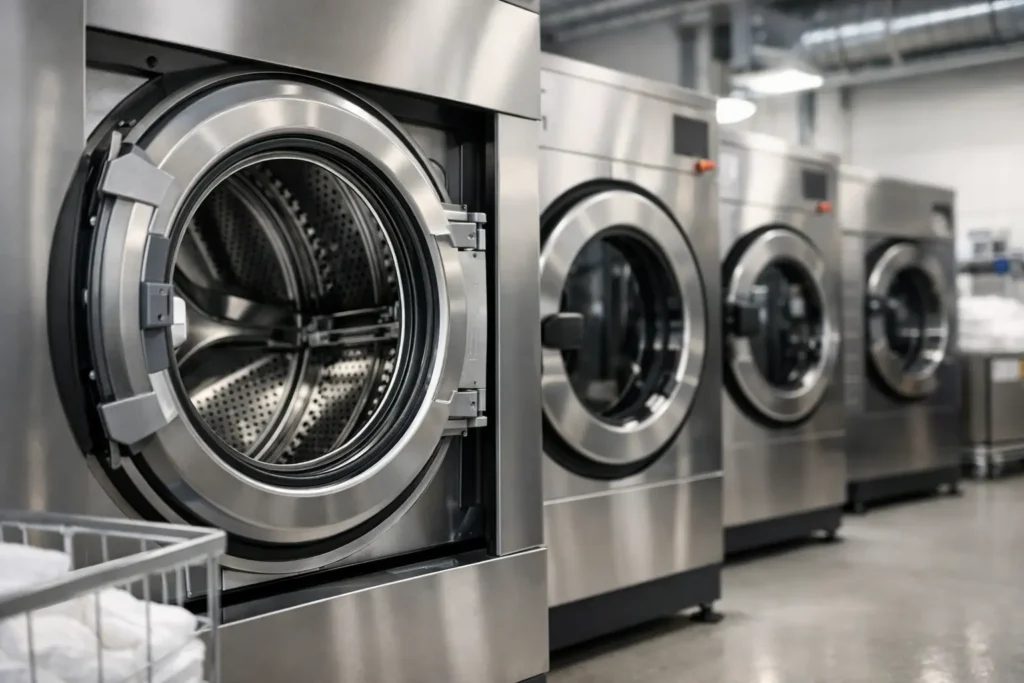
A washer-extractor can look right on paper and still create problems on the floor. If spin performance does not match your linen mix, drainage setup, floor construction, and finishing workflow, you can lose time every shift. This guide to commercial washer extractor g force ratings is built for operators who need to buy based on output, not brochure claims.
In short, this guide to commercial washer extractor g force ratings focuses on matching G-force to your linen mix, drainage, and finishing workflow so every wash cycle pays off.
What G-force means in washer-extractors
G-force is the measure of how strongly a washer-extractor pushes water out of goods during the extract cycle. The higher the G-force, the more moisture is removed before the load reaches the dryer or finishing stage. That sounds simple, but the buying decision is not just higher-is-better.
In practical terms, G-force affects three things immediately: remaining moisture, cycle flow, and machine stress on the installation. A higher final extract can shorten dryer time, reduce gas or electric consumption, and move loads faster through production. At the same time, more aggressive extraction can increase vibration demands, put more pressure on floor conditions, and be less forgiving with certain textiles.
That is why experienced operators do not compare washer-extractors on capacity alone. They look at extraction performance as part of the full system.
A practical guide to commercial washer extractor g force ratings
Most commercial washer-extractors fall into broad G-force ranges. Exact numbers vary by manufacturer, model size, suspension design, and programming, but the general categories are useful.
Low to moderate extract, often around 100 to 200 G, is common in simpler or more budget-driven installations. These machines can still serve many laundromat and light commercial applications, especially where floor conditions are limited or the dryer side already has enough capacity. The trade-off is higher retained moisture, which means longer drying times and more utility use.
Mid-range extract, often around 200 to 350 G, is a common sweet spot for many on-premise laundry operations. Hotels, multifamily properties, and small healthcare facilities often find this range practical because it improves throughput without pushing the installation requirements as hard as very high-speed extraction.
High extract, often 350 G and above, is typically where operators start seeing more meaningful reductions in dryer bottlenecks. For busy facilities processing towels, sheets, uniforms, and high daily poundage, that extra water removal can change labor flow and utility cost. But this range demands more attention to machine mounting, floor structure, load balancing, and textile compatibility.
The key point is simple: G-force is not a standalone performance badge. It has to fit the rest of your operation.
Why higher G-force can save money
The biggest financial benefit of higher extraction is reduced dryer time. Water is expensive to heat out of textiles. If the washer-extractor removes more moisture mechanically, the dryer has less work to do. Mechanical water removal is usually the cheaper part of the process.
This matters most in operations where dryers are the choke point. If washers finish before dryers clear, your production line slows down and labor starts waiting on machines instead of moving linen. In that case, a higher-G machine can improve throughput without adding another dryer bank.
There is also a secondary gain in textile handling. Loads that come out with lower moisture content may move faster into ironing, folding, or finishing. That can tighten production windows in hospitality, healthcare, and contract laundry environments where turnaround matters.
But savings depend on your actual process. If your dryer capacity is oversized, your daily volume is low, or your linen sits between stages anyway, the utility savings may be real but less dramatic than vendors suggest.
When high G-force is not the right answer
Some operators assume the top extraction speed is automatically the best specification. It is not. There are several cases where a lower or moderate G-force machine may be the smarter buy.
First is floor and installation reality. Not every laundry room is built for aggressive extraction. Suspended machines help manage vibration, but structure still matters. Upper-floor laundries, retrofits in older buildings, and rooms with limited slab strength may narrow your options. Buying a machine that exceeds what the site can support is a costly mistake.
Second is textile sensitivity. Heavier extraction is generally beneficial for many cotton goods, blended sheets, and durable uniforms. But not every item responds the same way. Delicate goods, specialty garments, or items prone to wrinkling can be affected by how aggressively they are spun and how the cycle is programmed.
Third is maintenance and operating discipline. Higher-speed extraction leaves less room for poor loading habits. Uneven loads, chronic overloading, and weak preventive maintenance routines tend to show up faster in vibration issues, component wear, and nuisance shutdowns.
Matching G-force to your type of laundry operation
A self-service laundromat often benefits from a balanced approach. Customers care about dry time, but they also create mixed and imperfect loads. A moderate to high extract machine can be attractive, but it needs to be forgiving in real-world use. Reliability and ease of service usually matter more than chasing the highest number available.
In hospitality laundry, high extraction often makes strong operational sense. Towels, sheets, and housekeeping volumes create steady dryer demand. If room turns are time-sensitive, reducing moisture retention can help keep linen circulating without adding labor pressure.
Healthcare and linen service operations need a more disciplined review. Throughput matters, but so do fabric standards, wash quality, and machine programming. A high-G model can be valuable, especially on flatwork and durable linen, but the decision should account for classification, infection-control procedures, and finish quality.
For dry cleaners adding wet cleaning or shirt laundry capacity, the answer depends on garment mix. You may want extraction strong enough to improve productivity, but not so aggressive that finishing labor increases because of wrinkling or shape distortion.
In multifamily, institutional, and on-premise laundry rooms, moderate extract often delivers the best balance. These buyers typically need dependable performance, manageable install requirements, and straightforward maintenance.
What to ask before you buy
A good equipment decision starts with the process after the washer, not just the washer itself. Ask how much retained moisture your current loads carry into drying. Ask whether dryers are waiting on washers or washers are waiting on dryers. Ask whether your floor can support the proposed model without expensive site work.
You should also ask how the machine handles out-of-balance conditions, what suspension design it uses, and how serviceable the critical components are. A machine with strong extraction but poor parts availability or difficult maintenance access can create downtime that wipes out the efficiency gains.
Programming matters too. Two machines with similar top G-force ratings may perform very differently in day-to-day use if their controls, ramping logic, and cycle options are not suited to your textile mix.
Look beyond the number on the spec sheet
Manufacturers advertise G-force because it is easy to compare. Operators should treat it as one specification among several. Capacity, cylinder design, control flexibility, water usage, service access, and parts support all affect the real cost of ownership.
A 400 G machine that is oversized for your demand or difficult to maintain may be a weaker investment than a 250 G machine that fits your workflow and stays in service. The right question is not, What is the highest extract available? The right question is, What level of extraction improves my production without creating installation, maintenance, or textile problems?
That is where a specialized supplier adds value. If you are comparing recognized commercial brands and trying to align equipment with uptime goals, the conversation should be operational. It should cover load type, volume, utilities, room conditions, and parts continuity – not just headline speed.
The buying decision that holds up
The best guide to commercial washer extractor g force ratings is the one that connects extraction speed to your actual output. Higher G-force can reduce dry time, lower energy consumption, and improve production flow. It can also demand more from your floor, your maintenance routine, and your handling of textiles.
A smart purchase is usually not the most aggressive machine. It is the machine that fits your facility, your labor pattern, and your linen mix well enough to keep production moving day after day. If you buy with that standard, you are much more likely to be satisfied six months after installation than you are on delivery day.
Before you approve the next washer-extractor, make sure the G-force rating answers a real operational need. That is where savings become measurable, and where equipment starts working like an asset instead of a compromise.
Treat this guide to commercial washer extractor g force ratings as a practical checklist before you buy: match capacity to real daily volume, account for utilities and installation, and confirm parts and service availability. Following a disciplined guide to commercial washer extractor g force ratings protects margins and avoids costly oversizing. For independent efficiency benchmarks on commercial machines, the ENERGY STAR product database is a useful reference when comparing models.