
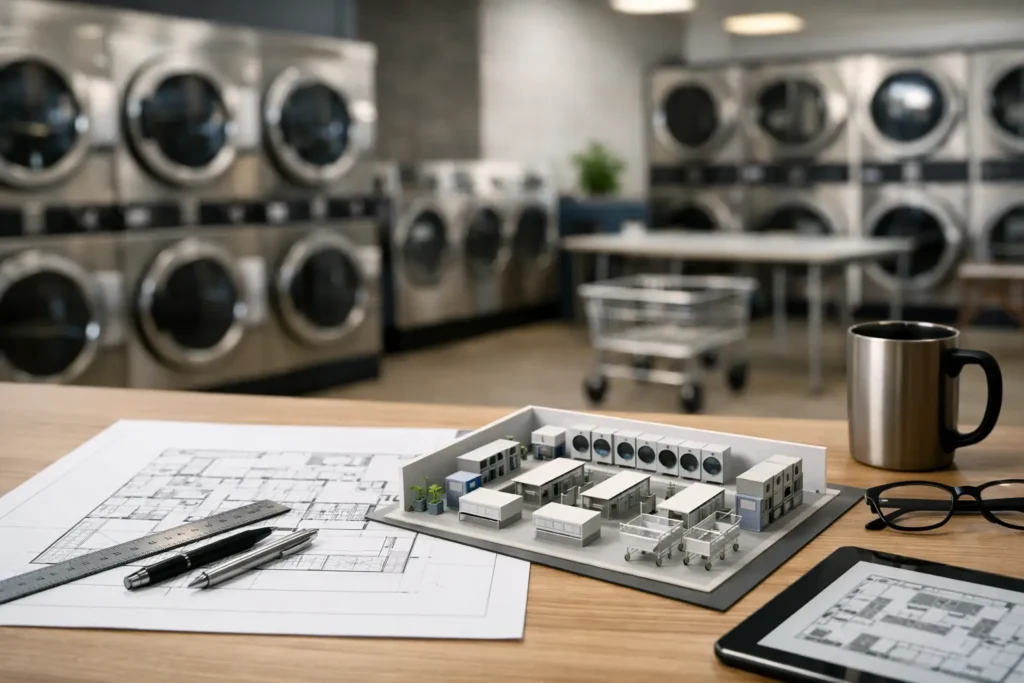
A crowded store rarely has a machine problem alone. More often, it has a layout problem. Customers stack carts in the wrong place, attendants cross traffic with every load, dryers sit idle while washers stay full, and service access gets ignored until the first repair call. That is where a laundromat equipment layout planning guide becomes useful – not as a design exercise, but as an operating tool that protects throughput, safety, and revenue.
The right layout starts with one question: what kind of volume must this store handle, and how does that volume move through the room? Owners sometimes begin by choosing machine counts first. In practice, flow should lead the decision. If the room forces customers, carts, staff, and service technicians into the same path, even strong equipment performance will not fix the bottleneck.
What a laundromat equipment layout planning guide should solve
A good layout plan should do four things well. It should support customer movement, protect utility efficiency, allow routine service, and leave room for growth. If any one of those is missed, the store pays for it later through labor drag, machine downtime, or a poor customer experience.
Customer movement is usually the most visible issue. People enter with bags, sort loads, start washers, move to dryers, fold, and leave. That sounds simple, but many laundromats place folding tables where customers need to queue, or they create dead corners where carts collect and block doors. A practical layout keeps the sequence obvious. Customers should not need to guess where to go next.
Utility efficiency matters just as much. Washers, stacked washer/dryer units, tumble dryers, and heat-pump systems each place different demands on water, drainage, gas, power, and ventilation. Layout affects line length, drain slope, duct routing, and panel load. A cleaner equipment arrangement can reduce installation complexity and help service teams troubleshoot faster.
Service access is the part owners often underestimate. Commercial machines need clearance for maintenance. If equipment is pushed too tightly into corners or lined up without rear or side consideration, a simple parts replacement turns into a half-day disruption. Specialized operators already know this: easy service access is part of uptime.
Start with customer flow, not machine count
In any laundromat equipment layout planning guide, machine mix matters more than raw quantity. Ten washers are not equal to ten washers if the capacities are wrong. A room filled with small units may look productive on paper but still underperform if family loads, bedding, or commercial drop-off work dominate demand.
A balanced floor usually needs a range of washer capacities and a dryer bank sized to turn loads quickly. If washers finish faster than customers can access dryers, wet laundry backs up and machine turnover slows. If too much floor area is given to dryers and folding, washer revenue potential gets capped. There is no fixed ratio that fits every site. It depends on customer profile, average load size, peak-hour traffic, and whether wash-dry-fold is part of the operation.
That is why planning should begin with expected use cases. A neighborhood self-service store has one pattern. A mixed-use operation serving residents plus hospitality or healthcare linen has another. In the second case, attendants, carts, sort zones, and staging areas deserve more space than many first-time owners expect.
Place washers, dryers, and folding zones with purpose
Washers should usually sit where loading is easy from the entrance path, but not so close that entry traffic crowds the front bank. Customers arrive carrying weight. They need direct access, room to sort, and enough aisle space to open doors without conflict.
Dryers should be positioned to receive traffic from washers without forcing customers to cross the entire room. The wash-to-dry transfer is one of the busiest moments on the floor. If carts and people have to cut through seating or folding areas, congestion follows. In many stores, placing dryers opposite washers with a generous center aisle works well. In narrower rooms, a side-wall dryer bank may be more practical if folding can be kept out of the transfer path.
Folding tables belong near dryers, but not so near that open dryer doors block them. This is a common mistake. Folding needs real working space, not leftover space. Customers stay there longer than they stay at the machine face, so a cramped folding area affects comfort quickly.
Seating, vending, soap sales, and payment systems should support the flow rather than interrupt it. Put another way, high-dwell zones should sit outside the primary movement lanes. If customers waiting for cycles occupy the same space needed for carts and transfers, the layout will feel smaller than it is.
Plan aisle widths for real use
On paper, a room can appear efficient while still being hard to operate. The reason is usually aisle width. Clearance that looks acceptable in an empty CAD drawing can fail once baskets, carts, open doors, attendants, and waiting customers are added.
The center aisle is the critical path. It needs to allow two-way movement during peak periods, especially if large-capacity washers and stacked dryers are installed. Side aisles and end clearances also matter because those are the first places where traffic jams appear. If wash-dry-fold carts or linen bins are used, design for those dimensions early. Do not assume they can be tucked anywhere later.
ADA access, door swing, payment queueing, and folding-table use should all be considered together. This is where trade-offs come in. A tighter machine layout may raise installed capacity, but it can reduce comfort, slow customer turnover, and make the store feel chaotic. More equipment is not always more revenue if the room becomes hard to use.
Utilities should shape the plan early
Equipment layout and utility planning should happen together. Water supply, drainage, gas, electrical service, venting, and heat management all influence the final arrangement. Moving machines after utility rough-in is expensive. Getting the layout right before that stage saves money and avoids compromise.
Washer-extractors need reliable water pressure, correct drain design, and floor support appropriate to the equipment. Dryers need safe exhaust planning and enough makeup air if vented systems are used. Heat-pump dryers introduce different installation considerations and can suit some projects well, especially where ducting constraints or energy priorities change the economics. But they also require planning around serviceability and operational expectations.
Electrical panels, shutoffs, cleanouts, and maintenance access points should remain reachable without moving active equipment. This sounds basic, but it gets missed in compact fit-outs. Procurement teams and installers benefit when the machine lineup matches utility logic. It simplifies commissioning and future replacement.
Leave room for service and future expansion
A store that operates well on opening day but cannot absorb growth is not well planned. A smart laundromat equipment layout planning guide should account for future equipment changes, not just the first install.
That may mean preserving utility capacity for one or two additional machines later. It may mean selecting stacked washer/dryer systems to free floor area in a constrained site. It may also mean leaving a wall section or rear utility path accessible so replacement work does not force a full shutdown.
Service clearance is part of that same mindset. Commercial laundry equipment is durable, but parts wear, belts need inspection, valves fail, and controls sometimes need replacement. Stores that can be serviced quickly recover faster. Stores with poor clearance stay down longer and spend more on labor.
Common layout mistakes that cost operators money
The most expensive mistake is overloading the room with machines while underplanning circulation. After that, the biggest problems are usually poor dryer placement, inadequate folding space, ignored service access, and no staging area for attendants or commercial work.
Another common issue is treating all customers the same. A self-service customer carrying two baskets uses the store differently than an attendant processing hotel linen. If both are expected, the layout must separate those workflows where possible. Otherwise one business line interferes with the other.
There is also the brand and equipment consistency issue. Mixing incompatible footprints, utility needs, or service requirements can complicate planning. Working with a specialized supplier helps because machine categories, spare parts support, and compatibility questions are considered together rather than as separate purchases.
Build the room around daily operation
The best laundromat layouts are rarely the flashiest. They are readable, serviceable, and built around the way laundry actually moves. Equipment should support the room, not dominate it.
If you are planning a new store or reworking an underperforming one, start by mapping traffic, load types, staffing needs, and utility realities before finalizing machine count. That is the point where layout stops being guesswork and starts protecting uptime. Abelco works with operators who buy that way – practical first, performance always.
A good room feels easier every week after opening, not harder. That is usually the clearest sign the layout was planned correctly.