
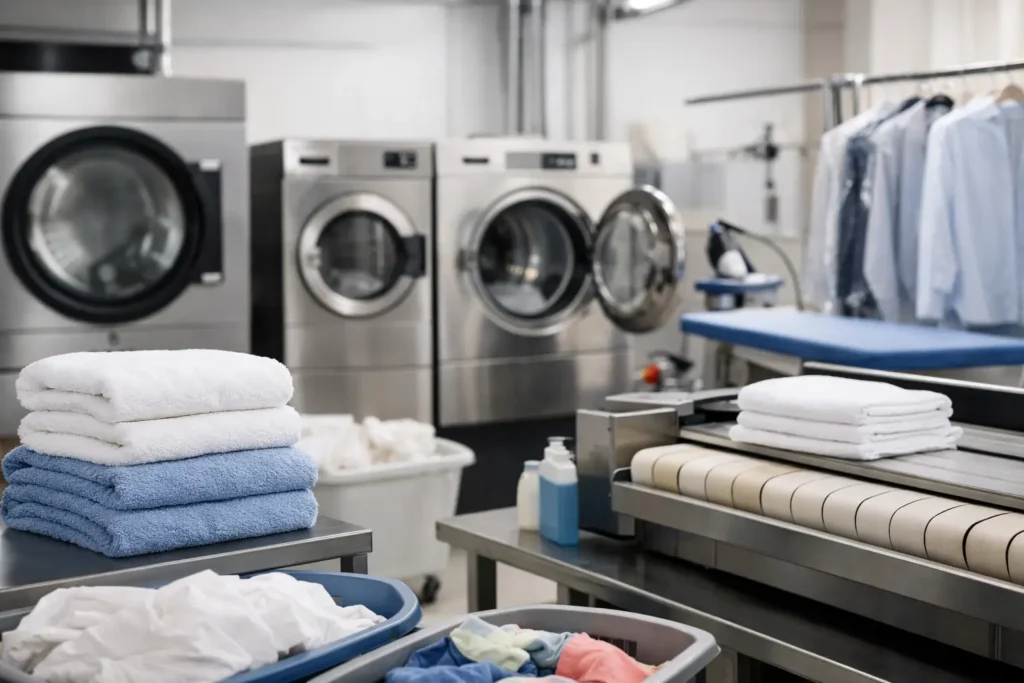
The equipment needed for a laundry business includes commercial washers, dryers, sorting and folding stations, carts and chemical dosing. Add ironing, pressing or dry-cleaning equipment to match your services. Size each stage around daily volume and request an itemised equipment and installation budget in AED.
Plan your laundry equipment budget in AED
Equipment is quoted for your project. Use this table to request a complete AED budget; fixed prices depend on the selected models and site conditions.
| Budget item | What the AED quotation should cover |
|---|---|
| Washers and dryers | Model, quantity, capacity, heating type and controls |
| Ironing and finishing | Ironer, pressing table, steam supply and garment-care tools as required |
| Installation and utilities | Delivery, commissioning, electrical supply, water, drainage and ventilation work |
| Operating essentials | Carts, tables, dosing, starter consumables and recommended spare parts |
| Total project budget | Itemised AED total, applicable VAT, exclusions and maintenance options |
A laundry operation usually looks simple from the outside. Customers see clean linen, finished garments, and a working counter. What they do not see is that the wrong equipment mix can slow production, increase utility costs, and create daily maintenance problems. If you are asking what are the equipment needed for laundry business, the right answer starts with your volume, your service model, and how much downtime your operation can afford.
A self-service laundromat does not need the same setup as a hotel laundry, a healthcare linen plant, or a dry cleaner with wash-and-fold. The equipment list overlaps, but the sizing, duty cycle, and support items change quickly. That is why buying by price alone usually turns into a more expensive decision later.
What are the equipment needed for laundry business?
At the core, most professional laundry businesses need washers, extraction capability, dryers, work tables, carts, water heating support, chemical dispensing, and finishing or identification tools depending on the services offered. Beyond that, the real requirement is commercial-grade equipment that matches throughput and can be maintained without delaying operations.
For many operators, the first split is between customer-facing self-service equipment and back-of-house production equipment. In a laundromat, machine mix matters because different load sizes drive revenue. In an on-premise laundry or linen service, machine reliability and cycle speed usually matter more than front-end appearance.
Core machines every serious laundry operation evaluates
Commercial washers or washer-extractors
The washer is the center of the operation, but not all washers perform the same job. Standard commercial washers may suit lighter-duty applications or customer-operated stores. Washer-extractors are often the stronger choice for higher-volume professional environments because they combine washing with stronger extraction, which reduces dryer time.
That reduction matters more than many new operators expect. If water remains in textiles after washing, your dryers work longer, energy use rises, and throughput drops. In a facility handling hospitality linen, uniforms, or healthcare goods, extraction performance affects the whole production line.
Capacity planning matters here. Too many small machines can create labor inefficiency. Too few large machines can create bottlenecks when loads need sorting by fabric, soil level, or customer account. The right mix depends on your average daily pounds processed, peak-hour demand, and whether you handle mixed loads or repeat linen categories.
Tumble dryers and heat-pump dryers
Dryers are not secondary equipment. They are production equipment, and under-specifying them is a common mistake. Commercial tumble dryers must match the output of your washers. If your wash side can finish loads faster than your dry side can accept them, wet linen starts stacking up and labor gets wasted moving loads around.
Heat-pump dryers can be a strong fit where energy efficiency is a priority, but they should be evaluated against cycle expectations, installation conditions, and your operating model. In some facilities, lower energy use makes the investment worthwhile. In others, a more conventional commercial dryer setup may be the better operational choice. It depends on utility pricing, ventilation constraints, and target throughput.
Stacked washer/dryer systems also deserve attention where floor space is limited. They are especially useful in compact laundries, multi-housing facilities, and selected hospitality environments where space efficiency supports better layout.
Dry-cleaning equipment, if applicable
Not every laundry business needs dry-cleaning machinery. But if your operation includes garment care beyond wet cleaning and standard laundering, then dry-cleaning equipment becomes part of the required infrastructure, along with spotting tools and finishing equipment. This is one area where buying without specialist guidance creates compatibility and workflow issues fast.
The support equipment that keeps production moving
Water heating and utility support
Laundry equipment depends on stable utility performance. Water heaters or boilers, depending on the facility setup, are not optional background items. Wash quality, cycle consistency, and chemical performance all depend on proper temperature control.
You also need to think about drainage, water pressure, gas or electrical supply, and ventilation before selecting machine sizes. A larger machine is not automatically better if your site cannot support it properly. Procurement decisions should follow site conditions, not just brochure capacity.
Chemical dispensing systems
Manual chemical dosing may work in very small operations, but it creates inconsistency. Automated dispensing systems help control detergent, softener, alkali, bleach, and specialty chemistry more accurately. That improves wash quality and often reduces waste.
For healthcare, hospitality, and contract linen environments, consistency is not just a quality issue. It affects rewash rates, textile life, and compliance expectations. A reliable dosing setup supports predictable results across shifts and operators.
Carts, bins, and sorting tables
Many operators focus on machines and forget movement. Laundry moves constantly – from receiving to sorting, washing, drying, folding, packing, and dispatch. Carts, bins, and work tables are basic equipment, but they have a direct effect on labor efficiency and contamination control.
If your team is carrying loads by hand or using improvised storage, productivity falls immediately. Proper carts reduce handling time and support cleaner workflow separation between soiled and clean goods. In healthcare and high-volume linen operations, that separation is especially important.
Folding, ironing, and finishing equipment
If your service includes flatwork, uniforms, garments, or presentation-sensitive items, finishing equipment is part of the core setup. Depending on the business, that may include flatwork ironers, presses, steam finishing tables, or simple but durable folding stations.
This is another area where it depends. A laundromat with wash-and-fold may start with tables and packing space. A hotel laundry processing table linen at scale may need more specialized finishing equipment from the beginning. Garment-focused businesses need pressing capacity that matches incoming volume, not just washing capacity.
What equipment are needed for laundry business beyond machines?
The answer includes the items that protect uptime. Spare parts, replacement consumables, and identification accessories are not extras. They are part of the operating system.
Belts, valves, fasteners, needles, marking tapes, and laundry pens may not look like major procurement priorities during setup. They become major priorities the first time a machine is idle or customer items need accurate tracking. In commercial laundry, a missing low-cost part can interrupt the use of a high-value machine. That is why experienced operators prefer a supplier relationship that covers both equipment and recurring operational items.
For businesses handling customer garments or institutional linen, marking and identification supplies are especially important. Misidentification leads to loss claims, sorting errors, and rework. Simple tools help maintain control across intake, processing, and return.
Choosing the right equipment mix for your business model
A laundromat usually needs a balanced range of washer sizes, dryers with enough capacity to avoid queuing, payment-ready machine configurations, carts, folding tables, and durable front-of-house support equipment. Customer convenience and machine uptime are the key buying factors.
A hotel or on-premise laundry usually prioritizes washer-extractors, dryers, linen carts, chemical dosing, and finishing space. Reliability and turnaround time matter more than retail presentation.
Healthcare and institutional laundries need stronger attention to workflow separation, chemical control, extraction performance, and parts availability. Here, uptime is not just a financial issue. It can affect service continuity across the wider facility.
Dry cleaners and mixed-service garment businesses typically need a combination of laundry equipment, spotting or finishing tools, and garment identification supplies. Their equipment choices depend on how much of the business comes from shirts, household items, uniforms, or specialty garments.
Common buying mistakes
The first mistake is buying residential or light-duty equipment for commercial production. It may reduce initial spend, but it usually raises replacement frequency and service disruption.
The second is oversizing one part of the line and undersizing another. Strong washers with weak dryers create a bottleneck. High machine capacity with poor table space and cart flow creates labor waste. Good laundry design is about balance.
The third is ignoring serviceability. Machines should not only perform well. They should also have dependable parts support and make sense for your maintenance reality. Recognized commercial brands matter because consistency, durability, and spare parts access directly support uptime.
That is where a specialized supplier adds real value. A company such as ABELCO EQUIPMENT TRADING LLC supports professional operators not only with core machines, but also with the spare parts and daily-use accessories that keep a plant running.
Start with throughput, not just a shopping list
If you are planning a new facility or upgrading an existing one, start with a simple operational question: how many pounds, pieces, or orders must move through the laundry each day without creating delays? That number should guide the equipment plan.
From there, match washer capacity to dryer capacity, build in proper sorting and finishing space, and secure dependable access to parts and consumables. A laundry business does not stay profitable because it has equipment on day one. It stays profitable because the equipment continues to perform under real operating conditions.
The best setup is not the one with the longest equipment list. It is the one that keeps work moving, protects quality, and gives you fewer reasons to stop production tomorrow.
For independent efficiency benchmarks, see the ENERGY STAR product database.