
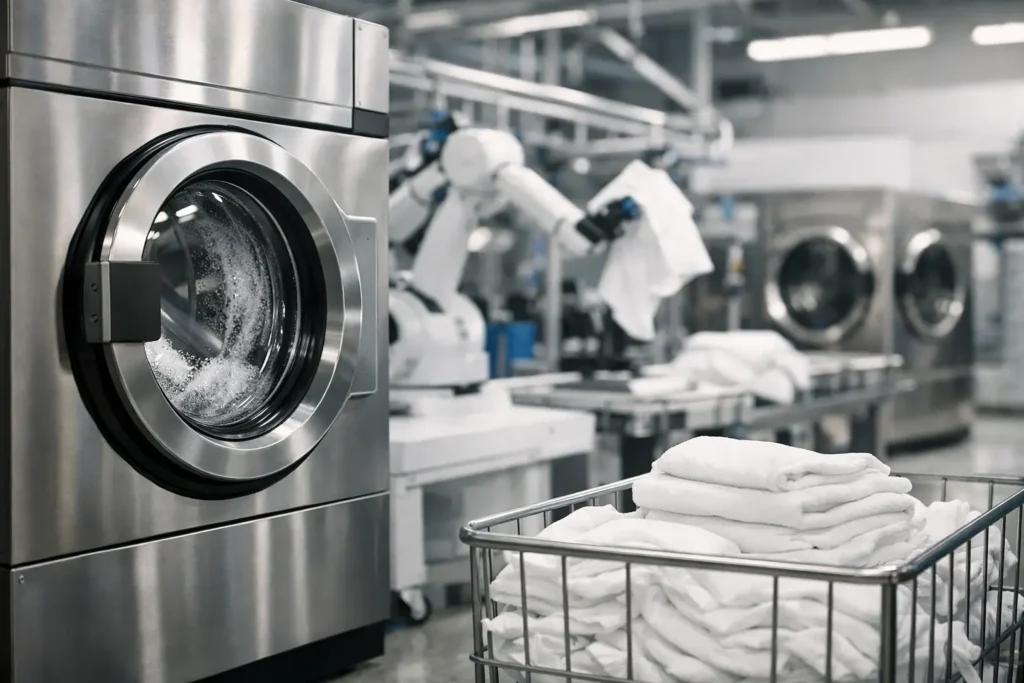
If you are budgeting for replacements this year, the biggest mistake is shopping by headline feature alone. Commercial laundry equipment trends 2026 are less about novelty and more about one hard question: which machines will keep production moving without creating new maintenance, labor, or utility problems.
That matters whether you run a laundromat, hotel laundry, healthcare linen operation, dry-cleaning plant, or multi-housing laundry room. The market is clearly moving toward more efficient systems, more machine-level data, and equipment packages designed around serviceability. But not every trend makes sense for every operation. In commercial laundry, good buying decisions still come down to throughput, compatibility, uptime, and total operating cost.
What commercial laundry equipment trends 2026 really mean for buyers
In 2026, buyers are looking past basic machine specs and asking better procurement questions. How fast can this unit be serviced? Are parts easy to source? Will controls help staff work better, or just add complexity? Can this equipment reduce gas, water, and labor costs enough to justify the premium?
That shift is healthy. For years, many purchasing decisions leaned too heavily on upfront price. Now operators are paying closer attention to lifecycle value. A lower-cost washer or dryer can become expensive very quickly if it drives extra downtime, consumes more utilities, or requires harder-to-find spare parts.
The strongest trend is not any single machine type. It is a more disciplined buying approach. Operators want equipment that fits their actual production environment, not a generic brochure promise.
Energy efficiency is moving from preference to requirement
Utility pressure continues to shape commercial laundry equipment trends 2026. Water, gas, and electricity costs are not moving in a friendly direction, and many operators are under pressure to control margin erosion without raising prices aggressively.
That is why high-extract washer-extractors remain central to upgrade plans. Better extraction lowers residual moisture, which shortens dryer time and cuts energy use downstream. The value is not only in the washer itself. It changes the economics of the full wash-to-dry process.
Industrial heat-pump dryers are also getting more serious attention. For the right operation, they can offer meaningful energy savings compared with conventional drying systems. But this is where buyers need to stay practical. Heat-pump technology is not automatically the best answer for every plant. Throughput demands, ambient conditions, maintenance capability, and payback period all matter. In a high-volume environment with tight turnaround windows, the right choice depends on the specific production profile, not just the utility savings estimate.
Dryer controls are improving as well. More machines now adjust cycles more precisely around load conditions, reducing over-drying and unnecessary energy consumption. That sounds simple, but over-drying has always been a quiet cost center. It wastes energy, adds wear to textiles, and can create avoidable rework issues.
Smarter controls are useful when they reduce friction
One of the clearest commercial laundry equipment trends 2026 is the expansion of digital controls, machine monitoring, and reporting functions. The promise is attractive: better visibility, fewer surprises, and stronger preventive maintenance.
Used well, these tools help managers spot recurring faults, review cycle performance, monitor machine usage, and schedule service before a minor issue becomes a shutdown. In multi-site operations or unattended environments, that visibility can be especially valuable.
Still, there is a trade-off. More intelligence in the control system can also mean a steeper learning curve for staff and technicians. If your team is not trained, advanced features may go unused. If the interface is overcomplicated, operators may default to workarounds that reduce the benefit.
The practical view is this: smart controls are worth paying for when they support simpler operation, faster troubleshooting, and better maintenance planning. They are less compelling when they add layers of complexity without helping daily production.
Stack systems and compact layouts are gaining ground
Space efficiency is shaping buying decisions more than many operators expected. In urban laundromats, hospitality properties, mixed-use buildings, and smaller on-premise laundries, floor space is too expensive to waste.
That is one reason stacked washer/dryer systems and compact high-output equipment are getting more attention in 2026. Buyers want to increase vend capacity or processing output without expanding their footprint. A well-planned compact layout can improve workflow, reduce bottlenecks, and create room for folding, sorting, or staging.
But tighter layouts have to be designed carefully. Access for service, ventilation requirements, loading ergonomics, and linen flow still matter. A packed floor can look efficient on paper and become frustrating in practice if routine maintenance becomes harder or staff movement slows down.
Space-saving equipment is a strong trend, but only when the full operating environment is considered.
Durability and serviceability are back at the center
After years of supply chain instability and labor shortages, operators are putting durability and repair access back where they belong – near the top of the specification sheet. This may be one of the most practical commercial laundry equipment trends 2026, even if it gets less attention than smart technology.
Buyers are asking tougher questions about parts availability, component quality, and long-term support. That includes common wear items, control boards, belts, valves, bearings, igniters, and door components. A machine is only productive when it can be kept in service quickly.
This is also driving preference toward recognized commercial brands with established parts ecosystems and field familiarity. Familiar equipment has an advantage. Technicians know it better, spare parts are easier to identify, and operators are less likely to face long disruptions over routine failures.
For procurement teams, this changes how value should be measured. The best equipment package is often the one that combines proven machines with dependable access to consumables and compatible spare parts. That reduces downtime risk in a way a lower purchase price cannot.
Hygiene, traceability, and specialty applications matter more
Healthcare, hospitality, and institutional laundries are placing more emphasis on process control, textile handling, and traceability. Some of that is driven by compliance expectations. Some of it is simply good operational discipline.
Marking and identification accessories remain important in this environment. Clear textile identification, sorting accuracy, and item tracking reduce loss and confusion, especially where volume is high and customer separation matters. It is not the most glamorous part of laundry operations, but it is part of maintaining consistency.
Dry-cleaning and specialty garment care operations are also making more selective equipment decisions. They are not only replacing old machines. They are tightening workflow around finishing quality, repeatability, and labor efficiency. In these environments, the best upgrade is often the one that removes recurring friction rather than the one with the longest feature list.
Financing pressure is creating more selective upgrades
Not every operator is replacing full systems in 2026. Many are taking a phased approach. That means replacing the worst-performing washers first, upgrading dryers where energy waste is highest, or adding stacked units where demand has outgrown the floor plan.
This selective strategy makes sense when capital is tight. It also creates a compatibility challenge. New equipment has to integrate with existing utility capacity, workflow, and service routines. A good upgrade path should improve the plant now without creating a mismatch that becomes expensive later.
That is why consultative equipment selection matters. A supplier that understands commercial production environments can help buyers avoid common procurement mistakes, especially when blending new machines into an older operation. ABELCO EQUIPMENT TRADING LLC works from that specialized view – matching equipment, parts, and operating continuity instead of treating the sale as a one-time transaction.
What buyers should prioritize in 2026
The strongest buyers in this market are not chasing every trend. They are screening trends against actual operating goals. If labor is your main pressure, prioritize controls and layouts that simplify use. If utility costs are hurting margins, focus on extraction performance and dryer efficiency. If downtime is your biggest risk, put serviceability and parts support ahead of cosmetic features.
A practical shortlist should include throughput per square foot, expected utility consumption, technician familiarity, spare parts availability, consumables compatibility, and realistic payback. Those factors usually tell you more than a polished sales pitch.
The right commercial laundry equipment in 2026 is not necessarily the newest or most advanced option. It is the equipment that fits your workflow, holds up under real demand, and can be supported without delay. Buy with that standard, and the trend cycle becomes much easier to read.
The smart move this year is simple: choose equipment that keeps your operation easy to run on a normal day and easier to recover on a bad one.
For broader industry forecasting, see this external efficiency benchmark guidance.