What “Industrial” Means in Your Laundry Room
Downtime in a laundry operation rarely means “just” downtime. It creates missed turns, rewash piles, delayed room releases, and overtime. That is why you should view buying industrial laundry machines as building a reliable setup. Focus on durable components, serviceable designs, and parts you can actually acquire.
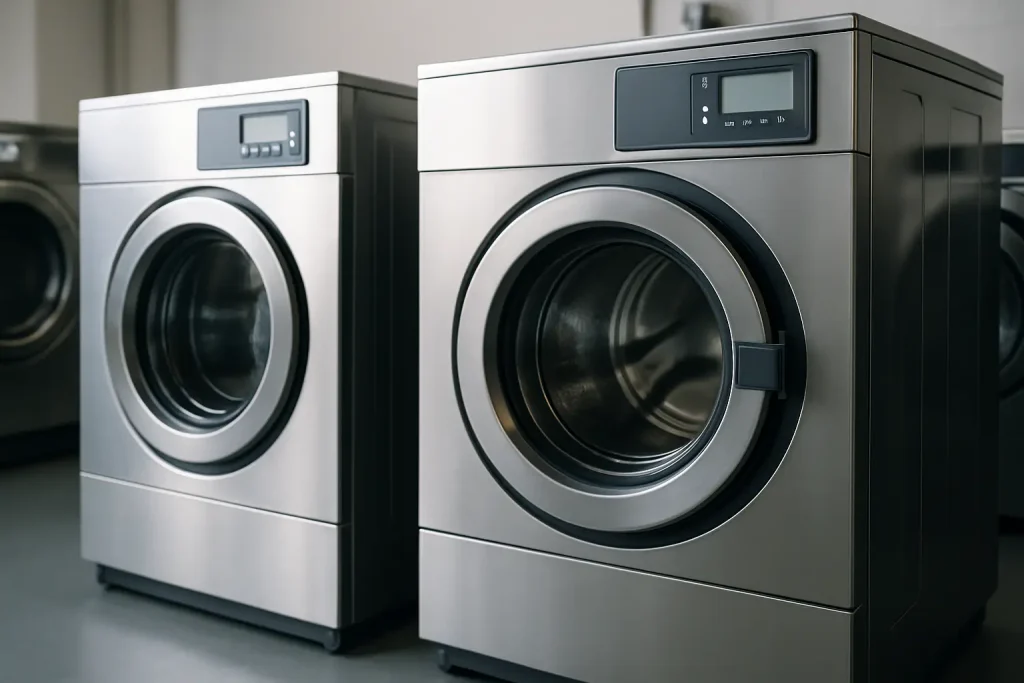
In commercial environments, “industrial” serves as a performance promise. You pay for machines that handle repeated cycles, heavy loads, and fast-paced operators. Look for practical markers: heavy-duty bearings, commercial-rated motors, robust door assemblies, and accessible controls. These systems handle high use without requiring multi-week wait times. A cheap machine costs more if you cannot service it or find parts.
Industrial Laundry Machines by Type
Washers vs. Washer-Extractors Washer-extractors act as the workhorse if throughput and moisture removal matter. Higher G-force extraction leaves linens drier, which shortens dry time. This increases dryer capacity without requiring another machine. Standard commercial washers suit light-duty applications or tight budgets, but most production-focused operations choose washer-extractors for the time savings. Before you buy, ask one question: what is the current bottleneck—wash capacity, extraction, or drying?
Tumble Dryers and Stacked Systems Tumble dryers are simple, familiar, and effective, but sizing and heat source decisions matter. Oversized dryers paired with underpowered washers fail to solve throughput. Conversely, high-capacity washers feeding too few dryer pockets cause similar issues. Stacked washer/dryer systems earn their spot when floor space limits you but you still need reliable turns. They function well in multi-family housing, smaller hospitality areas, and compact on-premise laundries.
Industrial Heat-Pump Dryers Heat-pump dryers gain attention for one reason: energy and venting constraints. They fit well where venting remains difficult, where you want to cut utility exposure, or where you need better fabric care. The trade-off usually includes a higher upfront cost and a different maintenance profile than traditional gas or electric dryers. If you consider them, evaluate cycle time, service access, and component availability.
Buying Criteria for Operators
Throughput, Not “Machine Count” Two mid-size washer-extractors often outperform one larger unit if your workflow requires parallel processing. Alternatively, one larger machine may reduce labor steps and loading time. The right answer depends on your staffing and peak periods. Use a quick gut check: if your dryers wait for loads, you bought too much wash capacity. If your dryers stay full and fall behind, extraction and dryer capacity limit your operation.
Utilities and Infrastructure Confirm gas vs. electric, venting limitations, water temperature, drain capacity, and electrical service before you commit. A machine that fits on paper creates a project if the infrastructure fails to support it. If you upgrade, verify what your current room supports, then buy accordingly.
Serviceability and Parts This is where long-term cost lives. Ask about common wear items like belts, seals, bearings, drain valves, door gaskets, and igniters. Check how quickly you can source them. Operators often choose recognized commercial brands like Speed Queen, UniMac, Wascomat, and LaPauw. Manufacturers build these machines for service, which keeps them running for years.
Essential Supplies
Equipment gets the attention, but accessories and consumables protect uptime quietly. Linen identification reduces loss and mis-sorts. You handle small repairs faster when you keep the right items on hand. If you run high volumes, plan your supply cabinet like your equipment layout. If you process hotel linen, align your equipment selection with the realities of sheets, towels, and constant turns.
A Procurement Approach That Reduces Regret
The best purchases keep you out of “emergency mode.” Document your current turns per day, peak-hour load, and top downtime causes. Buy to remove the constraint you actually have, not the one that looks biggest on a spec sheet.
For one supplier relationship that covers equipment, parts, and consumables, consider ABELCO EQUIPMENT TRADING LLC. They specialize in commercial laundry and dry-cleaning supply. This includes washers, extractors, dryers, stacked systems, and heat-pump dryers. They also provide the marking tapes, fasteners, needles, and laundry pens that operators reorder to prevent production halts.
Choose industrial laundry machines based on how fast you can recover from the next problem. In high-volume laundry, the next problem always arrives on schedule.
Reliable Operations in the UAE
Investing in the right industrial laundry machines in the UAE ensures maximum uptime, efficiency, and long-term success. Manufacturers design high-quality industrial laundry equipment to handle large volumes with minimal downtime. This makes them ideal for hotels, hospitals, and commercial laundries across Dubai, Abu Dhabi, Sharjah, and Ajman. Modern machines offer features like programmable controls, energy efficiency, and durable construction for reliable performance under heavy-duty use.
As a leading laundry equipment supplier in the UAE, Abelco Equipment Trading LLC provides premium equipment built for performance and reduced maintenance. Choosing the right capacity, energy efficiency, and automation helps businesses minimize breakdowns, improve productivity, and reduce operational costs. At Abelco, we specialize in high-performance equipment, professional installation, technical support, and after-sales service across all Emirates. Whether you start a new laundry or upgrade your facility, the right machines ensure long-term reliability and business growth.