

For hotels, hospitals, laundromats, staff accommodations, gyms, and facility laundries, a laundry machine is not just an appliance. It is part of the operation’s production line. When a washer or dryer is down, linen piles up, housekeeping slows, guest experience suffers, and staff are forced into costly workarounds.
That is why many UAE operators evaluate Speed Queen laundry equipment through one main lens: uptime. The right machine matters, but so do sizing, installation, utilities, spare parts, operator training, and preventive maintenance. A durable washer or dryer can still underperform if it is placed in the wrong workflow or maintained reactively.
This guide explains how to think about Speed Queen laundry equipment for high-uptime commercial laundry operations, what to check before buying, and how to build a setup that stays productive under daily pressure.
What “high uptime” really means in a commercial laundry
Uptime is often misunderstood as simply “the machine is not broken.” In a commercial laundry, high uptime means the whole laundry system can keep producing clean, dry, finished items at the pace your operation requires.
A laundry room can lose uptime in several ways:
- A washer is technically running, but its capacity is too small for peak demand.
- A dryer takes too long because airflow, venting, or gas supply is inadequate.
- A machine is idle because staff are waiting for linen sorting, carts, or finishing space.
- A minor fault becomes a major delay because parts or technician support are not ready.
- Operators overload machines, use the wrong cycles, or skip cleaning tasks.
For high-volume sites, uptime is the result of equipment quality plus operational discipline. Speed Queen can be a strong fit for many commercial environments, but the best results come when the machines are selected and supported as part of a complete laundry system.
Why Speed Queen is considered for demanding laundry operations
Speed Queen is widely recognized in the commercial laundry market for robust machines designed for frequent use. For owners and facility managers, the appeal is straightforward: commercial laundries need equipment that can handle repeated cycles, mixed users, and long operating hours.
In a UAE setting, high-uptime laundry equipment must also work around local realities. Ambient heat, heavy dust, hard water, long service days, limited back-of-house space, and fast linen turnaround all affect performance. A machine that looks suitable on paper may struggle if utilities, ventilation, drainage, and workflow are not planned correctly.
Speed Queen laundry equipment is often considered where operators want:
- Simple, durable machines for regular commercial use
- Washer and dryer combinations that are easy for staff to operate
- A platform suitable for laundromats, shared laundries, and on-premise laundries
- Serviceability that supports faster maintenance and repairs
- Equipment choices that can scale with daily volume
The key is to match the machine type to the workload. A small staff laundry, a coin-operated laundromat, and a hotel linen room do not need the same configuration.
The uptime equation: machine, site, service, and people
High-uptime operations are built before the first load is washed. When evaluating Speed Queen or any other commercial laundry brand, use four pillars.
| Uptime pillar | What it means | What to verify before purchase |
|---|---|---|
| Machine fit | The washer or dryer matches real daily volume and textile type | Capacity, cycle times, extraction, dryer pairing, duty pattern |
| Site readiness | Utilities and room layout support the equipment | Power, water pressure, drainage, ventilation, gas supply, access space |
| Service support | Repairs and parts can be handled quickly | Local technical support, spare parts availability, maintenance plan |
| Operator control | Staff use machines correctly and consistently | Training, loading rules, lint cleaning, chemical use, daily checks |
This framework helps prevent a common mistake: buying based on capacity alone. A larger washer is not automatically better if it creates dryer bottlenecks, exceeds available utilities, or makes staff handling inefficient.
For a broader buying framework, Abelco’s guide on choosing industrial laundry equipment in the UAE explains how throughput, utilities, and serviceability should shape the decision from the start.
Match Speed Queen equipment to the operation type
Speed Queen laundry equipment can be considered across different commercial environments, but uptime priorities vary by site.
Hotels and hospitality laundries
Hotels care about linen availability, consistent finishing, and predictable turnaround. A delayed laundry cycle can affect room readiness, spa operations, restaurant linen, and banquet service. For hotel laundries, Speed Queen laundry equipment is typically specified around the post-checkout linen peak rather than the daily average.
For hotels, the key uptime questions are:
- Can the laundry handle peak checkout days?
- Are washer capacities balanced with dryer capacities?
- Is there enough sorting, folding, and cart movement space?
- Can staff operate cycles consistently across shifts?
- Is maintenance scheduled around occupancy patterns?
Hotels should avoid designing around average daily volume only. Peak loads are what expose bottlenecks. If the laundry room is already near capacity on normal days, a fully booked weekend or event schedule can push it into failure mode.
Hospitals and healthcare facilities
Healthcare laundries have stricter hygiene and segregation needs. Clean and soiled textile flow, correct wash programs, and operational discipline are critical. The CDC’s healthcare laundry guidance highlights the importance of handling, processing, and storing textiles in ways that reduce contamination risk.
For hospitals, clinics, and care facilities, uptime is not only about speed. It is also about reliable process control. Equipment selection should consider wash temperatures, chemical programs, separation of work zones, and staff training.
Laundromats and shared laundries
In laundromats, downtime directly affects revenue and customer trust. Machines must be simple to use, resistant to frequent handling, and easy to service. The right layout also matters because customers need smooth movement between washers, dryers, folding areas, and payment points.
For these operations, uptime depends on more than the number of machines. A well-balanced mix of washer sizes can reduce waiting time, while accessible dryer lint areas and clear operating instructions can reduce misuse.
Staff accommodations, gyms, salons, and facility laundries
Smaller commercial sites often need reliable daily washing without the complexity of a full industrial laundry. The risk here is underestimating usage. A machine used by dozens of staff members or processing towels all day needs commercial-grade planning, not residential assumptions.
For these sites, Speed Queen equipment may be evaluated for durability, ease of use, and service support. The best setup is usually one that staff can operate consistently with minimal supervision.
Choose for throughput, not just capacity
A washer’s kilogram rating is only one part of the story. Throughput is the amount of laundry your operation can fully process within a given time, from sorting to washing, drying, finishing, and storage.
For uptime, look at the full cycle:
- How long does a typical wash program take?
- How much moisture remains after extraction?
- Can the dryer keep up with the washer?
- How many loads are needed during peak hours?
- How much staff handling is required between steps?
A washer with strong extraction can reduce drying time, which improves the performance of the entire room. A dryer with insufficient airflow or poor venting can slow everything down, even if the washer side is efficient.
This is why laundry planning should pair washers and dryers carefully. If you install too much washing capacity and not enough drying capacity, damp linen becomes the new bottleneck. If you install too much drying capacity but washing is slow, dryers sit idle.
Abelco’s article on Speed Queen laundry machines for busy operations goes deeper into evaluating equipment by uptime, throughput, and serviceability rather than upfront price alone.
Installation quality is an uptime factor
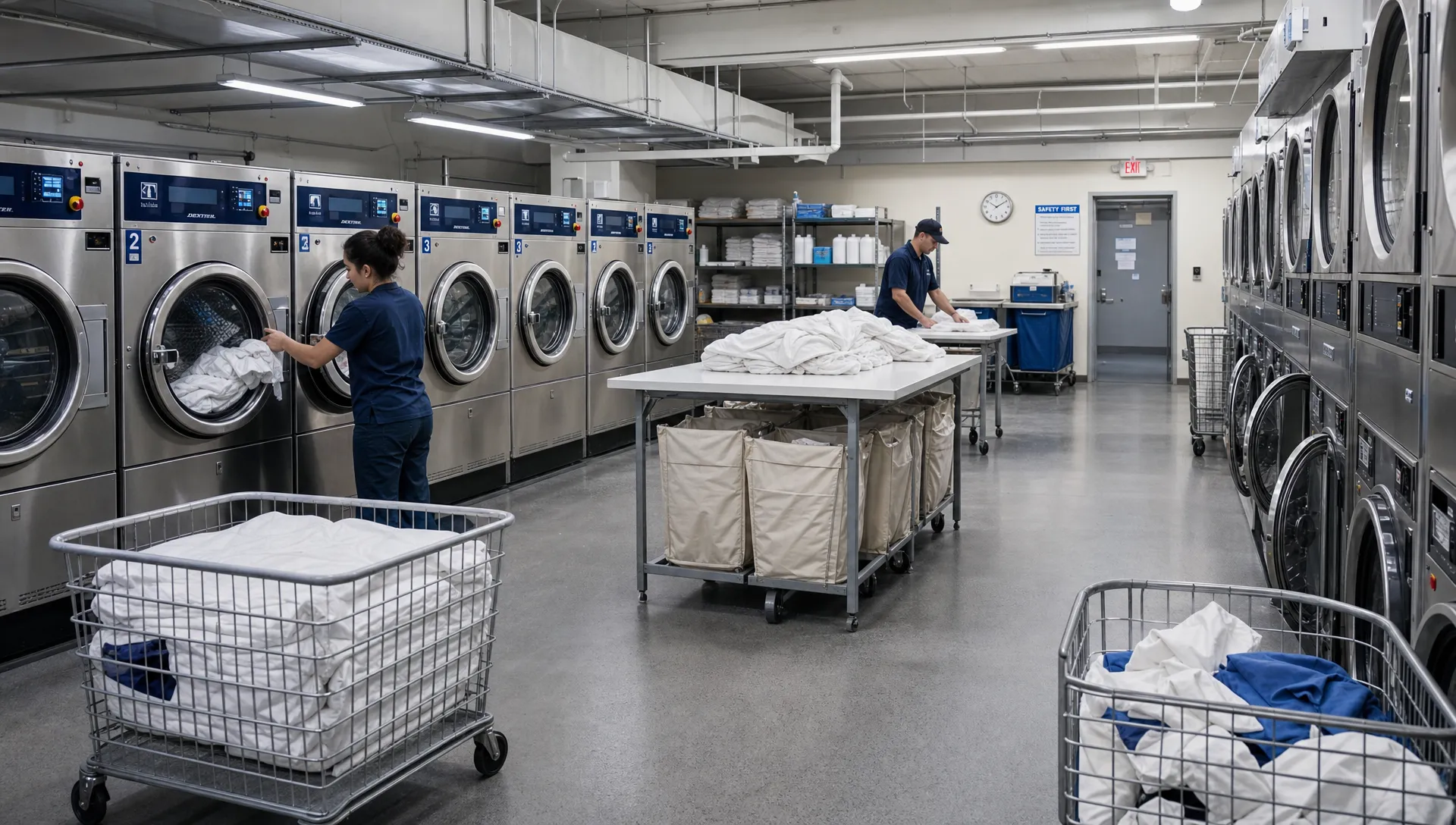
Even strong machines can perform poorly if installation is rushed. In commercial laundry rooms, installation affects vibration, cycle time, drying speed, safety, and service access. Even the best Speed Queen laundry equipment will underperform on an unlevel plinth, undersized breaker or restricted dryer duct.
Important site checks include water inlet sizing, drainage capacity, electrical load, gas line suitability, dryer exhaust design, floor strength, and clearance for technicians. In the UAE, ventilation deserves special attention because hot mechanical rooms can increase stress on equipment and reduce operator comfort.
A proper site survey should identify constraints before equipment arrives. It should also check whether the laundry room layout supports a logical flow from soiled intake to clean storage. Crossing clean and dirty workflows can create operational confusion, especially in healthcare, hospitality, and high-volume laundries.
Maintenance planning: the difference between durable and dependable
Durable equipment is built to work hard. Dependable equipment is kept in condition to work hard every day. The difference is maintenance.
Reactive maintenance waits for a breakdown. High-uptime operations use preventive maintenance to reduce surprise failures. This includes regular inspection, cleaning, adjustment, testing, and replacement of wear items before they create downtime.
A practical maintenance rhythm should include daily operator checks, scheduled technician visits, and clear reporting. Operators should know what is normal and what needs attention, such as unusual vibration, longer drying times, water leaks, abnormal noise, door seal wear, or repeated error messages.
Common uptime protectors include:
- Cleaning dryer lint filters and exhaust paths regularly
- Checking water hoses, drain flow, and visible leaks
- Avoiding overloading, which stresses motors, bearings, belts, and suspension parts
- Using correct detergent and chemical dosing for the textile type
- Keeping machine areas clean and accessible for service
- Recording faults early instead of waiting for failure
For UAE operators, an annual maintenance contract can be especially useful where downtime has a direct cost. Abelco offers maintenance, repair, after-sales support, spare parts, and AMC service plans, which helps operators move from emergency response to planned equipment care.
Spare parts availability should be part of the buying decision
A machine does not need to be down for long to disrupt operations. In a busy hotel, laundromat, or healthcare facility, even one unavailable washer can create delays across the day. Ask whether wear parts for your Speed Queen laundry equipment are stocked locally in the UAE before you sign.
That is why spare parts support should be discussed before buying Speed Queen laundry equipment. Ask what common parts are stocked or sourced locally, how service calls are handled, and what the expected response process looks like.
The goal is not to predict every failure. The goal is to reduce the impact of normal wear and tear. Belts, valves, seals, switches, filters, and electronic components all have a service life. High-uptime operators plan for this reality.
If you are comparing suppliers, Abelco’s guide on how to choose a laundry equipment company explains why technical support, parts access, and service capability are as important as the equipment brand.
Operator training protects machine life
Many laundry breakdowns begin with small usage mistakes. Overloading, underloading, incorrect cycle selection, poor sorting, excessive detergent, and skipped lint cleaning can all shorten equipment life or reduce performance.
Operator training is especially important in sites with rotating staff, outsourced teams, or multiple shifts. A simple training program should cover loading rules, textile sorting, cycle selection, detergent use, safety, cleaning tasks, and fault reporting.
Training also improves consistency. In hotels, consistent wash and dry practices help protect linen quality. In laundromats, clear user instructions reduce misuse. In healthcare environments, staff discipline supports hygiene protocols and separation of clean and soiled items.
The most reliable laundry rooms usually have visible standard operating procedures. These do not need to be complicated. They just need to be clear, practical, and followed every day.
Energy and water efficiency support uptime too
Efficiency is often treated as a cost issue, but it also affects uptime. Machines that use water, heat, and power efficiently can reduce strain on utilities and help maintain consistent cycle performance.
The ENERGY STAR commercial clothes washer program provides useful context on efficiency standards and water use considerations for commercial washers. While every site should verify equipment specifications directly, the broader principle is clear: utility performance matters in long-hour laundry operations.
In the UAE, this is especially relevant where air conditioning loads, hot weather, and utility infrastructure can affect the total operating environment. Dryer ventilation, heat rejection, and water heating should be considered alongside machine capacity.
When planning Speed Queen equipment, ask how each machine will affect total utility demand. The right answer depends on the building, laundry volume, and operating schedule.
A practical checklist before buying Speed Queen laundry equipment
Before selecting machines, gather real operating data. Guesswork leads to underbuilt laundry rooms or unnecessary overspending.
Use this checklist as a starting point:
- Daily laundry volume by textile type
- Peak-day volume, not just average volume
- Required turnaround time for each item category
- Available room dimensions and workflow constraints
- Electrical, water, drainage, gas, and ventilation capacity
- Staff skill level and shift pattern
- Current bottlenecks and recurring breakdown history
- Spare parts and service expectations
- Expansion plans for the next 2 to 5 years
Once this information is clear, equipment selection becomes much more accurate. You can decide whether you need multiple smaller machines for flexibility, larger units for bulk processing, stacked systems for space savings, or a different mix of washers and dryers.
When Speed Queen may not be the only answer
A useful equipment supplier should not force one brand or configuration into every site. Speed Queen laundry equipment can be an excellent fit for many commercial operations, but the right solution depends on the workload.
For example, a laundromat may prioritize user-friendly controls and multiple machine sizes. A hospital may need a more specialized workflow and strict separation practices. A large hotel may need higher-capacity washer-extractors, finishing equipment, and a layout designed around room turnover.
The best decision is based on operational fit, not brand familiarity alone. In some cases, Speed Queen may be part of the solution. In others, a mixed equipment plan may better support throughput, utility limits, or future growth.
Build a high-uptime laundry plan with local support
High uptime is not achieved by equipment alone. It requires correct planning, professional installation, preventive maintenance, parts support, and trained operators. This is especially true in the UAE, where commercial laundries often work long hours in demanding building conditions.
Abelco Equipment Trading supports commercial and industrial laundry projects with equipment supply, laundry room planning, expert installation, spare parts, after-sales support, maintenance, repair, AMC service plans, operator training, and free site surveys. For operators evaluating Speed Queen laundry equipment, that local support can make the difference between a machine purchase and a dependable laundry operation.
Frequently Asked Questions
Is Speed Queen laundry equipment suitable for commercial use? Yes, Speed Queen is widely used in commercial laundry environments such as laundromats, shared laundries, and on-premise laundry rooms. The right fit depends on daily volume, textile type, utilities, and service support.
How do I know what Speed Queen washer or dryer capacity I need? Start with peak-day laundry volume, required turnaround time, and textile categories. Capacity should be planned with dryer performance, staff workflow, and available utilities, not just the largest machine that fits the room.
What causes the most downtime in commercial laundry rooms? Common causes include poor sizing, overloading, blocked dryer lint systems, weak ventilation, utility limitations, delayed parts, and lack of preventive maintenance. Operator training can reduce many of these issues.
Should I choose equipment based on upfront price or lifetime uptime? For commercial operations, lifetime uptime is usually the better decision factor. A lower upfront price can become expensive if machines break down often, slow production, or lack local parts and service support.
Does Abelco support installation and maintenance for commercial laundry equipment? Abelco provides industrial and commercial laundry equipment supply in the UAE, along with installation, maintenance, repair, spare parts, after-sales support, AMC service plans, laundry setup planning, operator training, and free site surveys.
Plan your Speed Queen laundry setup with Abelco
If your laundry room needs to process more loads with fewer interruptions, start with a proper site and workload assessment. Abelco can help you evaluate Speed Queen laundry equipment within a complete uptime-focused plan, including machine selection, installation needs, utility checks, maintenance, and operator training.
Visit Abelco to request a quote on Speed Queen laundry equipment or arrange a free site survey for your commercial laundry project in the UAE.