
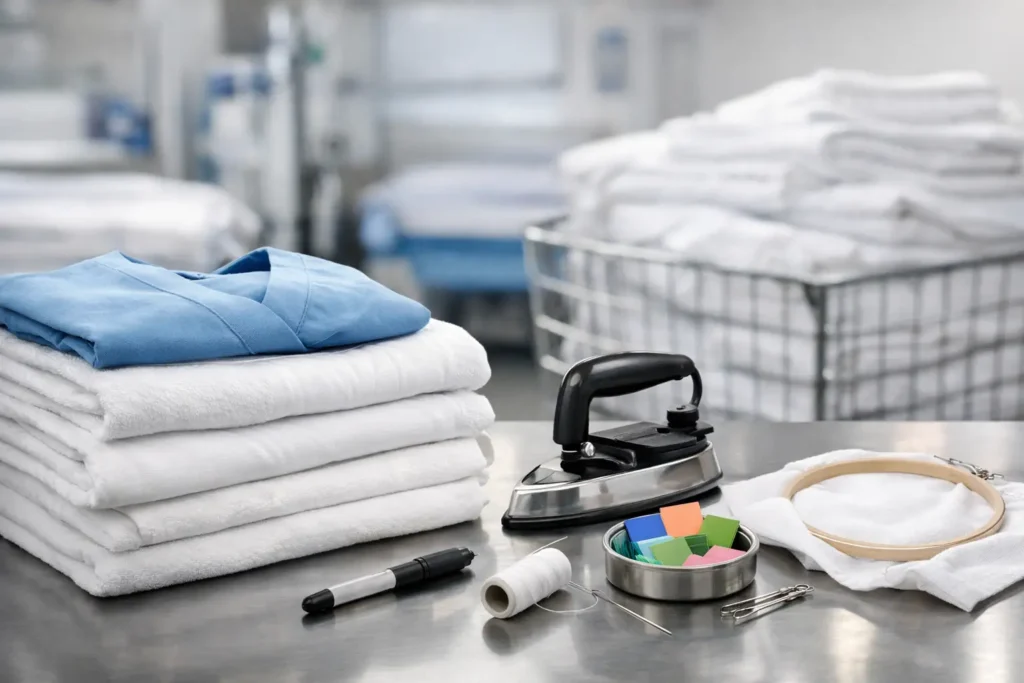
A missed linen ID does not stay a small problem for long. In healthcare laundry, one unreadable mark can turn into a sorting error, a replacement cost, a compliance concern, or a delay in getting the right items back into circulation. That is why buyers keep asking which marking method works for healthcare linens. The short answer is that the best option depends on wash conditions, linen type, reading needs, and how much control you need over tracking.
For most healthcare operations, there is no single marking method that fits every item. Flatwork, patient garments, scrubs, isolation items, and specialty textiles do not all move through the same abuse cycle. A marking system has to survive high temperatures, chemistry, repeated finishing, and constant handling. It also has to stay legible without slowing down production.
Which marking method works for healthcare linens in real operations?
In real-world laundry plants, the most reliable answer is usually sew-in identification products for long-life linens, supported by selected use of heat-seal labels, laundry pens, or RFID where the application justifies it. The reason is simple. Healthcare textiles go through aggressive wash formulas and frequent reprocessing. Any marking method that looks good on day one but degrades after repeated cycles creates more work than it saves.
Sew-in marking tapes remain a practical standard because they hold up well under industrial laundering and finishing. When attached correctly with compatible thread and needles, they provide stable identification through repeated use. They are especially useful when the item needs a permanent owner name, department code, resident name, or piece designation.
Heat-seal labels can also perform well, but only when fabric type, adhesive quality, and wash conditions are aligned. On paper, they offer speed. In production, results vary. If temperatures, extraction force, or finishing conditions exceed what the label system can tolerate, edge lift and loss can become a recurring issue.
Laundry pens are useful, but they are not usually the primary answer for healthcare linen programs with high rewash counts. They work best for short-term marking, quick internal coding, or backup identification. They are less dependable when the item faces repeated chlorine exposure, heavy mechanical action, or pressing that fades the mark.
RFID is the strongest option when the operation needs automated tracking, inventory visibility, and loss control across a large healthcare system. It is not always the cheapest starting point, but for some facilities it delivers value through labor savings and better linen accountability.
The main marking options and where each one fits
Sew-in marking tapes
For many healthcare laundries, sew-in tapes are the safest long-term choice. They are familiar, serviceable, and proven in high-volume environments. If a hospital linen item needs readable identification after repeated washing and drying, stitched labels usually outperform simpler surface-applied methods.
The trade-off is labor. Sewing takes more time than writing with a pen or applying a heat-seal label. Placement also matters. A well-sewn label in a low-stress area will outlast one attached at an edge that curls, rubs, or catches during handling. Procurement teams should look beyond the tape alone and consider the full attachment setup, including fasteners, needles, and thread compatibility.
This method is especially suitable for resident garments, staff uniforms, specialty patient items, and textiles where permanent identification matters more than application speed.
Heat-seal labels
Heat-seal systems are attractive because they speed up application and can reduce manual sewing. In facilities processing moderate volumes or mixed textile categories, they can be a useful option. They also create a neater profile on some items.
Still, heat-seal is not automatically the best answer to which marking method works for healthcare linens. Much depends on wash temperatures, chemical exposure, textile finish, and drying conditions. Some labels bond well at first and then fail after repeated thermal stress. Others perform better on specific fabric blends than on others.
For healthcare operators, the key question is not whether heat-seal works at all. It is whether it works after dozens or hundreds of industrial cycles. If the facility handles high-heat finishing or aggressive formulas, testing before standardization is essential.
Laundry pens
Laundry pens have a place, especially for temporary identification, overflow situations, and low-cost marking needs. They are easy to use and require no special equipment. For departments that need quick coding during intake or short-run labeling, they remain practical.
Their limitation is permanence. Ink legibility can decline with repeated washing, bleaching, and pressing. On dark or textured fabrics, readability may also be inconsistent. For a healthcare operation where traceability matters, laundry pens should be treated as a supporting method rather than the foundation of the system.
RFID tags
RFID is the most advanced option in this category. It allows healthcare operators to identify, count, and track linen without relying on visual checks alone. Large hospitals and centralized healthcare laundries often consider RFID when linen loss, stock imbalance, and manual counting are affecting cost control.
The strength of RFID is operational visibility. The trade-off is investment. Tags, readers, software, and process integration all add cost and require discipline in rollout. It makes sense where linen volumes are high enough to justify automation, or where management needs better data across multiple departments or sites.
What determines the right choice
The best marking method is rarely selected by preference alone. It should be selected by process conditions.
First, consider wash chemistry and temperature. Healthcare linen programs often include disinfecting formulas, bleach exposure, and elevated temperatures. A method that survives hospitality laundry may not hold up in healthcare processing.
Second, look at the textile itself. Cotton-rich items, blended fabrics, garments, flatwork, and specialty barrier products do not all accept marking in the same way. The same heat-seal label can behave differently on two items in the same plant.
Third, define the purpose of the mark. If the mark is only for internal sorting, a simpler method may be enough. If it needs to identify ownership, patient assignment, department use, or lifecycle data, durability becomes more critical. If it needs to support inventory analytics, visual labeling may not be enough at all.
Fourth, account for labor. Sewing is reliable, but labor-intensive. Heat-seal is faster, but less forgiving if material compatibility is poor. RFID reduces manual checking later, but requires a larger setup commitment upfront.
Which marking method works for healthcare linens when durability matters most?
When durability is the priority, sew-in identification usually leads. It offers the most stable performance across repeated industrial washing, tumble drying, and finishing. For operators who care more about consistent readability than the fastest application, it is the practical choice.
That does not mean every item should be sewn. A mixed strategy often works better. High-value garments and long-life pieces may justify sew-in labels. Temporary textiles or lower-cycle items may be fine with pen marking. Large systems with heavy loss control demands may add RFID on top of physical identification.
A good buying decision comes from matching the method to the linen category, not from forcing one method across everything.
Common mistakes that create relabeling costs
One common mistake is choosing based on application convenience instead of lifecycle performance. A label that saves seconds during attachment but fails early increases replacement work and sorting errors.
Another mistake is ignoring attachment materials. Marking tape, fasteners, needles, and the application method have to work together. Weak points usually show up at the connection, not just on the label face.
Facilities also run into trouble when they skip wash testing. A sample that looks acceptable after five cycles may not survive fifty. Before rolling out a marking method across a healthcare account, test it under actual production conditions.
A practical way to decide
Start by separating your textiles into groups by lifespan, wash severity, and tracking requirement. That usually makes the decision clearer. Long-life garments and reusable items with ownership or patient relevance generally need permanent sewn identification. Short-term or low-risk categories may allow a simpler approach.
If your operation is struggling with linen loss, inventory uncertainty, or multi-department movement, consider whether visual marking alone is still enough. At that point, RFID may move from optional to justified.
For procurement teams and plant managers, the right answer is the one that reduces remarking, supports throughput, and stays readable through the full service life of the item. That is where a specialized supplier matters. The marking product itself is only part of the result. Consistent supply, compatible accessories, and practical guidance make the system work on the floor.
Healthcare linen identification is not a place for guesswork. Choose the method that matches your wash reality, not just your budget line, and the operation runs cleaner from intake to return.
Healthcare laundries often coordinate marking with a broader plan; see our overview of laundry labeling methods for uniform programs. For infection-control context on textiles, the CDC guidance on healthcare laundry is a solid external reference.