
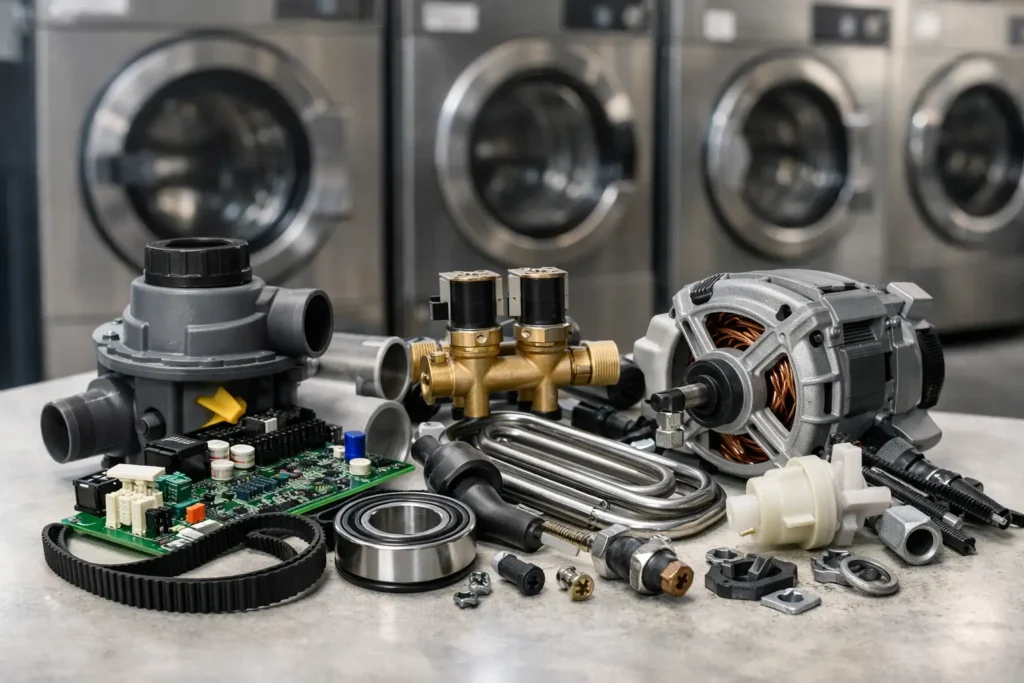
A washer down for half a day is an inconvenience. A washer down for three days during peak volume is lost revenue, staff pressure, and delayed delivery. That is why Wascomat parts sourcing for commercial washers should be handled as an operations decision, not a last-minute purchasing task.
In commercial laundry, the wrong part does more than fail to fix the problem. It can create repeat service calls, inconsistent machine performance, and avoidable wear on connected components. Buyers who source carefully protect uptime, control maintenance cost, and keep equipment life where it should be.
Why Wascomat parts sourcing for commercial washers needs a tighter process
Wascomat equipment is built for commercial duty, but every machine eventually needs replacement parts. Drain valves wear. Door components fatigue. Belts stretch. Sensors fail. Bearings, seals, contactors, and control-related parts all have service cycles that depend on usage, load type, water quality, and maintenance discipline.
The sourcing challenge is that not every part request is as simple as naming a model. Commercial washer lines change over time. Assemblies get revised. Similar-looking parts may have different electrical ratings, dimensions, or connector styles. A part that is close enough for a consumer machine can be a costly mistake in a commercial setting.
For operators, this means procurement has to be tied to machine identity and operating context. The part itself matters, but so does where it is being installed, what symptom it is meant to solve, and whether the failure points to a larger issue.
Start with machine identification, not the symptom
When a washer is showing a drain problem or a door lock error, many buyers start by asking for the likely failed part. That can work, but it also increases the chance of ordering based on guesswork. A stronger process starts with the machine details.
Get the exact model number, serial number, voltage configuration, and, when possible, the current part number from the installed component. This is the baseline for compatibility. In older fleets, it is also smart to confirm whether the machine has had previous field modifications. A replacement control board or latch assembly fitted years ago may change what is needed today.
Photos help. A clear image of the data plate, the failed part, the wiring connection, and the mounting points can prevent the kind of mismatch that only becomes obvious when the technician is already on site. That matters if you are trying to avoid a second shutdown window.
The real cost of buying the cheapest available part
Price matters. Every commercial laundry operation watches maintenance cost. But with critical washer components, the lowest unit price is not always the lowest operating cost.
If a part arrives without clear compatibility confirmation, or if it fails early, the real expense includes freight, technician time, machine downtime, and production disruption. In a hotel laundry, that may mean linen shortages. In a healthcare environment, it may mean scheduling pressure and backup processing decisions. In a laundromat, it can mean lost turns and frustrated customers.
A better approach is to treat parts sourcing as a balance of cost, fit, and continuity of supply. Some parts are low-risk and straightforward. Others are high-impact items where verified compatibility and dependable supply matter more than a small difference in purchase price.
Which Wascomat washer parts deserve the most attention
Not every part should be sourced with the same urgency or stocking strategy. High-failure and high-impact items deserve more planning.
Drain-related components, door locks, belts, valves, seals, and selected electrical parts often justify tighter purchasing control because they directly affect whether the machine can run. Bearings and major mechanical assemblies may be less frequent purchases, but when they are needed, lead time becomes more important because the repair scope is larger.
Controls and sensors require extra caution. These parts are more likely to create problems if the model match is off or if the root cause has not been confirmed. A failed sensor can be the issue, but so can wiring, moisture intrusion, or board-related faults. Good sourcing is not only about obtaining the part. It is about reducing the chance of replacing the wrong one.
What a dependable supplier should actually help you with
A commercial laundry supplier should do more than quote availability. The right partner helps you narrow the correct part, confirm compatibility, and move quickly enough to protect uptime.
That support matters most when you are dealing with older equipment, incomplete records, or recurring faults. A procurement-focused supplier with industry specialization understands that commercial laundry buyers are not looking for generic retail service. They need answers tied to machine usage, service conditions, and continuity.
This is where a specialized source adds value. Instead of forcing your team to sort through uncertain options, a knowledgeable supplier can help verify part selection using machine data, part images, and operating symptoms. That saves time before the order is placed, which is exactly when mistakes are cheapest to prevent.
Wascomat parts sourcing for commercial washers in mixed-brand laundries
Many facilities do not run a single-brand floor. They may have Wascomat washers alongside other commercial equipment, especially after phased upgrades or expansion. In that environment, parts sourcing becomes more complex because internal teams are managing different model families, different maintenance intervals, and different documentation standards.
Mixed-brand sites benefit from centralizing procurement with a supplier that already works across commercial laundry categories. That reduces search time and helps standardize how parts are identified and ordered. It also makes it easier to source consumables and supporting items through one channel instead of splitting urgent purchases across multiple vendors.
For managers trying to reduce admin time, this matters almost as much as the part itself. Procurement friction is still downtime, just in a different form.
Should you stock Wascomat spare parts on site?
It depends on your equipment count, service model, and tolerance for downtime. A small location with one or two machines may not need to stock many items. A larger operation with several Wascomat units, heavy daily throughput, or remote service coverage usually should.
The strongest stocking plan focuses on parts that fail often enough to justify carrying them and that can stop production when unavailable. Door lock components, belts, select valves, fuses, and commonly replaced electrical items are often good candidates. More expensive or model-specific assemblies may be better ordered as needed unless your history says otherwise.
Use your own maintenance records. If the same component has caused two service events in the last 12 to 18 months, that is a useful signal. If a part has long lead times and would disable a critical machine, that is another.
Avoiding common sourcing mistakes
The most common mistake is ordering from partial information. A model family is not the same as an exact machine match. The second is assuming the failed part is the root cause. Replacing a valve without checking pressure issues or replacing a board without ruling out wiring problems can waste both money and time.
Another mistake is waiting until failure to establish a source. Emergency buying narrows your options and increases the chance of compromise. Commercial operators are better served by identifying a dependable supplier before the urgent order happens.
Documentation is often the hidden problem. If your team does not keep machine records, previous repairs, and part histories organized, every new failure starts from zero. Even a simple internal log can make future sourcing faster and more accurate.
A practical buying standard for better uptime
If you want fewer delays and fewer wrong-part orders, set a basic standard for every Wascomat parts request. Require model and serial verification. Include photos when available. State the machine symptom, not just the guessed part name. Confirm whether the part is needed for immediate repair or stock. And work with a supplier that understands commercial laundry environments, not just general equipment sales.
That process is not complicated, but it is effective. It turns parts buying from reactive scrambling into controlled maintenance support.
For commercial laundries, uptime is built from small decisions made correctly. Wascomat parts sourcing for commercial washers is one of those decisions. Handle it with precision, and the payoff shows up where it matters most – fewer interruptions, better service continuity, and less wasted effort every time a machine needs attention.
For OEM vs aftermarket parts considerations, see this external maintenance and parts sourcing overview.