
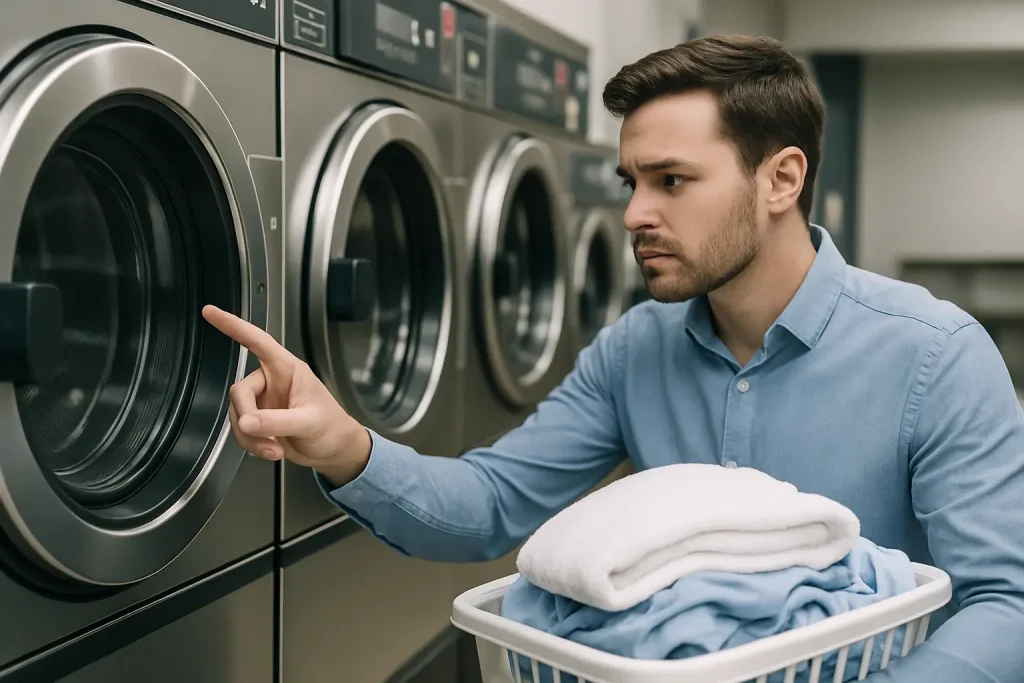
When a washer-extractor goes down on a Monday morning, “laundry equipment supplier near me” stops being a search phrase and becomes a production problem.
If you operate a laundromat, OPL room, hotel laundry, healthcare linen plant, or dry-cleaning backroom, you already know the real cost of downtime. It is not just a delayed order. It is overtime, missed service-level commitments, and customers who start looking elsewhere. So the right local supplier is not the one with the prettiest website. It is the one that keeps your floor running – with the right machines, the right parts, and the right follow-through.
What “near me” should actually mean
“Near me” is less about street distance and more about response distance.
A supplier can be ten miles away and still take two weeks to confirm parts compatibility. Another might be in a different region but have inventory discipline, accurate part identification, and shipping that lands what you need fast. For commercial laundry buyers, the best definition of “near” is: they can get you to uptime quickly and predictably.
That comes down to three realities:
First, they understand commercial laundry, not just retail appliances. Second, they can support both capital equipment and recurring operational supplies. Third, they treat compatibility as a core service, not an afterthought.
Start with specialization, not brand logos
Most suppliers can list brand names. Fewer can talk about what those brands do well in specific environments.
Commercial laundry purchasing is situational. A stacked washer/dryer system might be a smart footprint play in multifamily housing but a bottleneck in a high-turn laundromat. A heat-pump dryer can reduce energy load, but it changes maintenance expectations and may not fit every throughput profile. A washer-extractor can be a workhorse, but only if the installation, drain configuration, and service access are planned correctly.
So when you evaluate a “laundry equipment supplier near me,” listen for the questions they ask. A specialized supplier will get practical quickly: your daily pounds, peak-hour traffic, linen mix, utilities, venting constraints, and whether you are optimizing for speed, fabric care, or labor.
If the conversation stays vague, you are not buying expertise. You are buying a box.
The real test: parts and consumables availability
A commercial laundry operation does not run on machines alone. It runs on continuity.
Parts and consumables are where most “local” relationships either prove their value or create long-term pain. You want a supplier that can support the boring items without drama: marking tapes, fasteners, needles, laundry pens, and the recurring accessories that keep sorting, identification, and finishing consistent. These purchases are not glamorous, but they are how you avoid small process failures that turn into rewash, lost items, and customer disputes.
On the parts side, your goal is simple: fewer surprises.
A good supplier can help you match parts to the exact machine configuration. Not just “it fits a dryer,” but it fits your specific model series, voltage, and revision where it matters. They should also be able to tell you what they can get quickly versus what is special order, and what you can sensibly keep on-site as a small spares kit.
If a supplier cannot support you beyond the initial equipment sale, you end up managing multiple vendors and multiple lead times. That is how small issues become multi-day downtime.
Lead times, inventory, and the truth about “in stock”
“In stock” is one of the most abused phrases in equipment sales.
When you are buying commercial washers, washer-extractors, tumble dryers, or industrial systems, you need clarity. Is it physically in their warehouse? Is it in a partner warehouse? Is it a factory allocation? Is it available, or simply listed?
Ask for specifics. A serious supplier can tell you the expected ship date, what is included (controls, coin systems if relevant, stacking kits, drain hoses, etc.), and what is not.
There is also a trade-off here. A supplier with deep inventory can move faster, but they may carry a narrower range. A supplier with a broad catalog may rely more on lead times. Neither is automatically better. What matters is that the lead time is accurate and communicated early, so you can schedule installs, staffing, and contingency plans.
Installation coordination: where projects slip
Equipment selection is only half the job. Installation is where schedules break.
Even if your supplier is not your installer, they should think like someone who has seen a hundred installs go wrong. That means they can sanity-check site requirements: gas type and capacity, vent runs and make-up air, floor loading, electrical phase, water temperature, drainage, and service clearances.
If your supplier does not bring up these topics, you risk common failures: dryers that do not dry due to poor venting, machines that vibrate due to base issues, or a room layout that blocks service access. Those mistakes are expensive because they are discovered after delivery.
Near-me value is often the ability to prevent that kind of avoidable project friction.
Service support: what “support” should include
Commercial laundry buyers do not need friendly assurances. They need predictable next steps.
Support can mean different things depending on your market and your in-house capabilities. Some operations have maintenance staff and just need parts and correct documentation. Others need guidance on troubleshooting and fast access to common replacement items.
When you evaluate a supplier, confirm what happens after the sale. Who identifies parts? How do you submit a request? What information do they need from you to speed it up? Do they help you avoid ordering the wrong item?
Also ask how they handle warranty-related questions. Even if the manufacturer warranty is separate, you want a supplier who helps you navigate the process instead of passing you around.
Pricing: focus on total cost, not the first quote
If you are buying commercial laundry equipment based only on the lowest price, you are usually buying future costs.
Total cost includes energy use, water use, cycle time, repair frequency, and parts availability. It also includes the cost of waiting. A slightly higher-priced machine that is available now can be the better business decision if your current capacity is constraining revenue.
On the other hand, rushing into a mismatched machine can lock you into inefficiency for years. That is why the best suppliers sell with restraint. They will tell you when a cheaper option makes sense and when it will punish you later.
Brand selection: proven lines and the “fit” question
Recognized commercial brands like Speed Queen, UniMac, Wascomat, and LaPauw are common for a reason: serviceability, parts ecosystems, and real-world durability.
But brand is still only part of the decision. The fit depends on your load profile and operating rhythm. High-volume linens are different from customer-owned garments. A hotel’s OPL room has different staffing and peak cycles than a 24/7 laundromat. A healthcare environment may prioritize strict process control, identification, and consistency.
A supplier that knows the industry will help you match the equipment type to the environment: washers versus washer-extractors, single units versus stacked systems, conventional dryers versus heat-pump options. They will also talk about what changes operationally with each choice – not just the spec sheet.
A simple way to vet a supplier before you commit
You do not need a long RFP to find out if a supplier is operationally serious.
Give them a real scenario. Tell them one machine model you run now, one pain point you have (downtime, capacity, utilities, or quality), and what you are considering buying. Then measure how they respond.
A dependable supplier will narrow the conversation to specifics quickly. They will ask for model and serial details where needed, clarify utilities and constraints, and talk in terms of uptime and compatibility. They will also be honest about what they can and cannot deliver quickly.
If you get generic answers, you are not dealing with a commercial laundry specialist.
When you need one source for machines plus ongoing supplies
Many operations end up buying equipment from one place, then chasing consumables and small parts from another, then scrambling during breakdowns because no one owns the full picture.
A single-source approach is not about convenience for convenience’s sake. It reduces procurement time, reduces compatibility mistakes, and creates a relationship where the supplier has context for what you run and what you routinely need.
That is the value proposition behind specialized suppliers like ABELCO EQUIPMENT TRADING LLC: professional-grade machines across core categories, plus the ongoing consumables and spare parts that keep production moving. If your priority is fewer vendor touchpoints and more predictable uptime, that combination matters.
Closing thought
Treat “laundry equipment supplier near me” as a search for uptime, not a search for a zip code. The best supplier is the one that stays useful after the invoice – when you need the right part, the right answer, and the fastest path back to production.
For supplier vetting standards, see this external ISO 9001 quality management standard.