
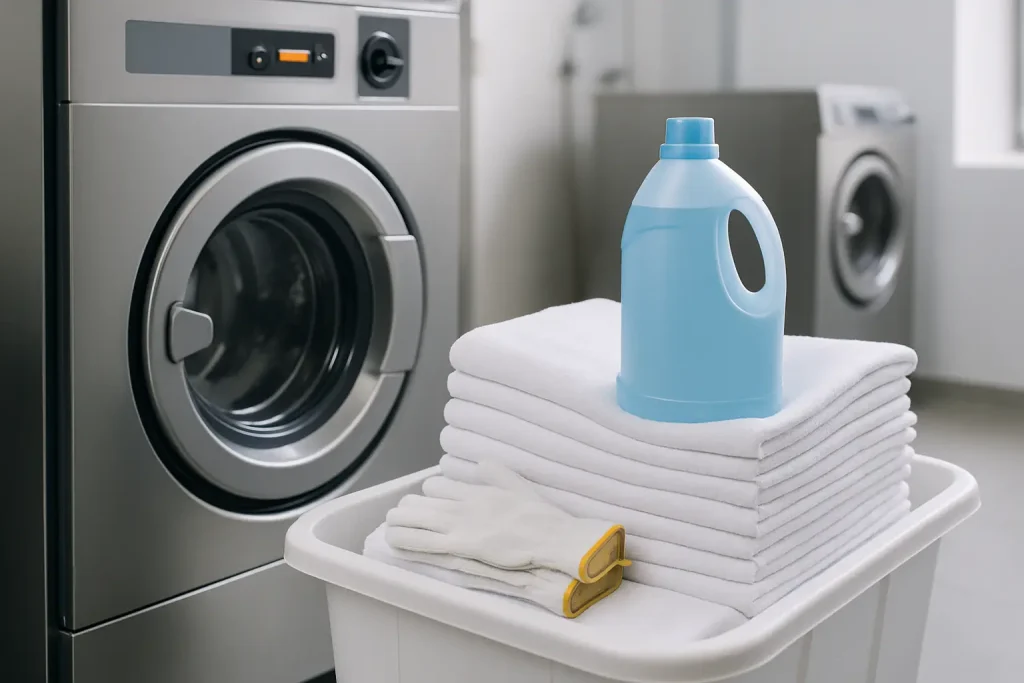
This guide to laundry suppliers in uae breaks down the decisions that matter most before you commit. A good approach to laundry suppliers in uae starts with verified references, clear pricing, and dependable after-sales support.
A hotel laundry falls behind for one reason more than any other: it can’t get what it needs fast enough. Not a new slogan, not a new “system” – just the right machine, the right part, or the right consumable on the day it’s needed. That’s why choosing laundry suppliers in uae is less about finding a vendor and more about building continuity: equipment that fits your throughput, parts that match your model, and repeat supplies that don’t suddenly disappear when you’re busy.
Below is a procurement-first way to evaluate suppliers in the UAE if you run a laundromat, dry cleaner, hospitality laundry, healthcare linen operation, or any on-premise laundry (OPL) site.
What “laundry supplier” should mean in a commercial operation
A real commercial laundry supplier does three jobs at once.
First, they supply core equipment that holds up under daily cycles: washers and washer-extractors, tumble dryers, stacked washer/dryer systems, finishing equipment where needed, and increasingly, heat-pump drying options when power or ventilation constraints matter.
Second, they keep your operation alive between equipment purchases with consumables and accessories: things like marking tapes, fasteners, needles, and laundry pens for identification and workflow control.
Third, they support uptime with compatible spare parts. This is where most procurement pain happens. A supplier can be excellent at selling a machine and still be weak at supporting it when a part fails and you need an exact match.
If your “supplier” only does the first job, you’ll eventually end up managing two or three separate vendors just to keep production stable. That’s not efficient in the UAE market, where lead times can shift quickly depending on shipping cycles and demand.
The categories you should source together (and why)
Most operators buy equipment and supplies separately because that’s how the market is organized. It’s also how downtime sneaks in.
Commercial washers and washer-extractors
For hotels and healthcare, stability and repeatability matter as much as raw capacity. You’re not just buying drum size – you’re buying extraction performance, cycle consistency, and serviceability.
A supplier should be able to talk in practical terms: how the machine behaves at high load factors, how often common wear parts get replaced, and what parts availability looks like after the sale. Brand matters here because parts ecosystems vary.
Tumble dryers, stacked systems, and heat-pump dryers
Drying is where utility costs and bottlenecks show up first. A supplier should help you match dryer capacity to washer output so you’re not “washing faster than you can dry.” Stacked washer/dryer systems can make sense when space is the constraint, but they can also concentrate downtime risk: one failure can impact two functions.
Heat-pump dryers are worth discussing when you have limited make-up air, strict ventilation limitations, or rising energy costs. The trade-off is that these systems can be more sensitive to maintenance discipline and airflow cleanliness. Your supplier should be honest about that.
Parts, consumables, and workflow items
Many buyers treat marking and identification products as an afterthought. Then they lose time to mis-sorted uniforms, missing linens, and manual rework.
Consumables like marking tapes, fasteners, needles, and laundry pens are small-ticket items, but they protect margin because they reduce avoidable handling. The right supplier keeps these stocked and consistent so you’re not constantly re-qualifying alternatives.
What to check when comparing laundry suppliers in UAE
Price matters, but commercial laundry procurement is a risk management exercise. The cheapest machine becomes expensive when it’s down, and the cheapest supplier becomes expensive when they can’t support the equipment they sold.
1) Brand portfolio and parts reality
If a supplier carries recognized commercial brands like Speed Queen, UniMac, Wascomat, and LaPauw, you’re typically buying into a proven service and parts ecosystem. That does not mean every model is the right fit for your site, but it does reduce the odds of “orphan equipment” that nobody in the region can support.
Ask one direct question: “What are the top five parts you sell for this model, and do you stock them?” A supplier who supports uptime will answer clearly. A supplier who mainly resells will give vague reassurance.
2) Compatibility discipline (model numbers, versions, and substitutions)
Commercial laundry parts are not a guessing game. One digit in a model code can change a valve, belt, board, or sensor. When suppliers don’t manage compatibility tightly, you end up with wrong parts, repeat orders, and more downtime.
A strong supplier will request specifics upfront: model and serial, photos of the data plate, and sometimes a part reference. That “extra step” is not bureaucracy – it’s how you avoid costly errors.
3) Stock, lead time, and the supplier’s truthfulness under pressure
Lead time is not just a number. It’s a promise that affects your staffing and customer commitments.
You want a supplier who will tell you when something is not available and offer realistic alternatives. Sometimes the right move is a temporary workaround: a different compatible consumable, a substitute assembly, or pulling forward a planned upgrade. It depends on your volume and your tolerance for downtime, but honesty is non-negotiable.
4) Service posture and after-sale support
Not every supplier is a service shop, and that’s fine. What you need is clarity: do they provide install coordination, start-up support, and troubleshooting help? Do they guide you to the right maintenance intervals and consumables? Can they supply the parts quickly when service technicians need them?
Even if you use your own technicians, you still benefit from a supplier who understands failure patterns and keeps the common items accessible.
5) Fit for your operation type (OPL vs. central laundry vs. laundromat)
A laundromat buyer and a hotel OPL buyer can look at the same equipment and make different choices.
A laundromat prioritizes durability, predictable coin/card system integration (where applicable), and fast turns per day. A hotel prioritizes consistent finishing and fewer guest-impacting disruptions. Healthcare and linen services prioritize process control and repeatable results.
A good supplier won’t push one-size-fits-all. They’ll ask about daily pounds, peak hours, linen mix, available power and ventilation, space constraints, and who maintains the equipment.
Common buying mistakes (and how to avoid them)
The most expensive mistakes are rarely “bad equipment.” They’re mismatches between what you bought and how your laundry actually runs.
One mistake is sizing only for average volume, not peak. If your plant runs fine Monday through Thursday and collapses on Friday, you don’t have a staffing problem – you have a capacity planning problem.
Another is ignoring extraction. Better extraction reduces dry time and utility cost. Buyers often compare washer prices without calculating what a few minutes saved per dry cycle does to total throughput.
A third is treating spare parts as a later problem. If you operate at high utilization, you should plan a minimum parts shelf from day one. It doesn’t need to be excessive, but it should be intentional.
Finally, many teams buy consumables ad hoc, switching products whenever a local shop is out. That creates hidden costs in training, quality control, and rework. Consistency beats improvisation.
A supplier relationship that reduces procurement complexity
Operators do best when one supplier can cover both the “big iron” and the day-to-day items that keep production moving. It reduces purchase orders, reduces compatibility issues, and speeds up recovery when something breaks.
That single-source approach only works if the supplier is truly specialized in the commercial laundry and dry-cleaning equipment industry, not a general trader who happens to sell machines.
If you want that specialized, catalog-driven approach – commercial equipment plus the supporting parts and consumables that protect uptime – ABELCO EQUIPMENT TRADING LLC is one option in the region, with a focused portfolio that includes professional-grade laundry machines and operational essentials like marking tapes, fasteners, needles, and laundry pens. You can review their offering at https://Www.abelco.me.
How to run a smarter RFQ for UAE laundry supply
If you’re issuing an RFQ or comparing quotes, keep it operational.
Define your target throughput (daily pounds or kilograms) and your peak-day expectation. State your utility constraints (power, ventilation, drain capacity) and your space limitations. Specify whether you need stacked configurations, and confirm whether you’re replacing existing brands that you want to keep consistent for parts commonality.
Then, require the supplier to quote not only the machines, but also the first-wave spares and the recurring consumables you know you’ll reorder. This is where you separate “equipment sellers” from “laundry suppliers.” The supplier who can quote and deliver the full basket is usually the one who can support you after the invoice.
A helpful closing thought: buy like you’re planning for the first breakdown, not like you’re planning for the first ribbon-cutting – because uptime is what your customers will remember.
A practical look at laundry suppliers in uae weighs lead time, warranty, and parts availability together, not in isolation. That is what separates a reliable laundry suppliers in uae decision from a costly one.
Laundry Suppliers In UAE: quick FAQ
Who should compare laundry suppliers in uae? Any operator weighing price, lead time, warranty, and service. How detailed should research into laundry suppliers in uae be? Detailed enough to build a shortlist you can request quotes against. The best take on laundry suppliers in uae ends with clear next steps.
For more on sourcing, see our guide to laundry equipment services in the UAE before you finalize a decision.
Use this overview of laundry suppliers in uae as a practical checklist: verify references, compare pricing and lead times, and confirm parts and service before you commit. A disciplined look at laundry suppliers in uae protects budgets and prevents costly mistakes. For independent efficiency benchmarks on commercial machines, the ENERGY STAR product database is a useful reference.