

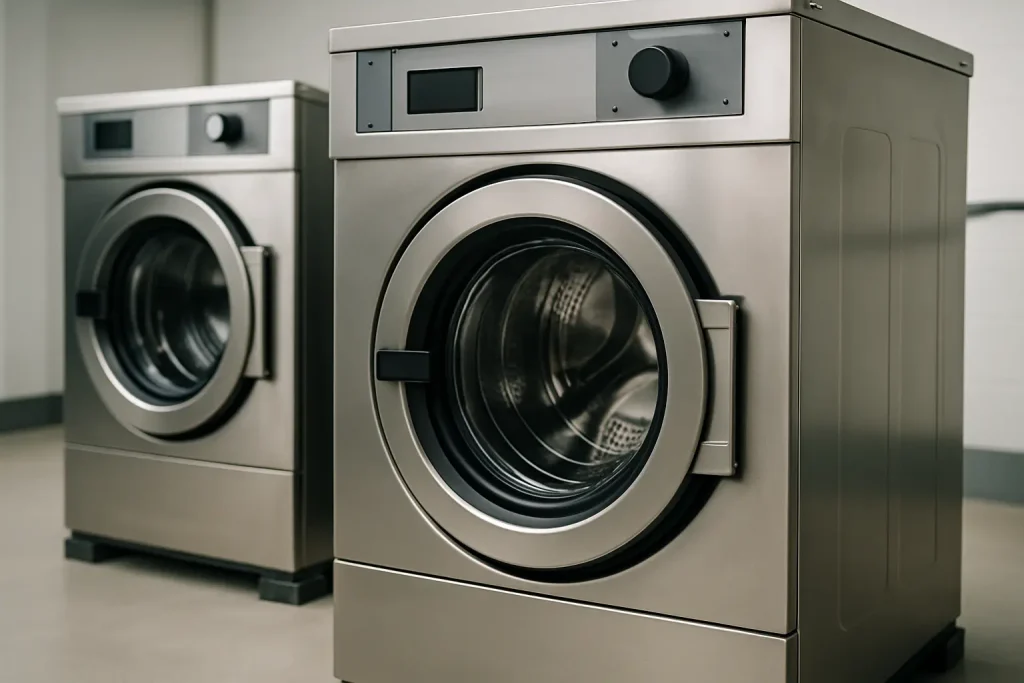
A commercial laundry doesn’t fail because the work disappears. It fails because the machines stop – mid-shift, mid-contract, mid-weekend rush.
That’s the real job of heavyduty laundry machines: not to look impressive on a spec sheet, but to keep throughput steady when staff is rotating, loads are unpredictable, and every hour of downtime has a dollar amount attached to it. If you’re buying for a laundromat, hotel, healthcare laundry, or an on-premise facility, the right decision is less about “best machine” and more about matching the machine to your workflow, utilities, and maintenance reality.
What “heavy-duty” should mean in your laundry
“Heavy-duty” gets used loosely. In a professional setting, it should mean three things: it can run multiple cycles per day for years, it is serviceable without heroic effort, and parts support is consistent so the machine isn’t sidelined for something small.
Durability is not just thicker metal. It’s also the quality of bearings and seals, the stability of the frame at high G-force extraction, and the electronics being protected from the heat, humidity, and vibration that destroy consumer-grade equipment early. Serviceability matters just as much. If a tech needs an afternoon to reach a wear item, your operating cost goes up even if the purchase price looked attractive.
The practical guide to choosing heavyduty laundry machines
Most buying mistakes come from skipping one question: what exactly is your production constraint? Some operations are washer-limited, others are dryer-limited, and some are labor-limited because staff can’t keep up with transfers and folding. Your machine choice should target the bottleneck first.
Start with the load profile, not the machine type
Two laundries can both claim “60 loads a day” and need completely different equipment. A hotel OPL often runs predictable loads like sheets and towels in defined time windows. A laundromat sees mixed goods, inconsistent soil, and customers who overload.
When you define your load profile, get specific: average pounds per load, peak hours, moisture retention expectations, and what percentage of goods are bulky items. Bulky goods are where under-sizing shows up fastest because they eat cylinder volume even when the weight is low.
Washer, washer-extractor, or stacked systems: pick the right architecture
Washer-extractors are the workhorses for many commercial operations because extraction performance directly reduces dryer time. Higher extraction means less retained water, which means shorter dry cycles, which means more capacity without adding dryers. The trade-off is that high-speed extraction increases mechanical stress and demands better installation, leveling, and maintenance discipline.
Traditional commercial washers can still be the right fit where cycles are gentler, utilities are constrained, or the business model relies on simple, repeatable service. In laundromats, stacked washer/dryer systems can be a smart footprint play, especially where floor space costs more than equipment. The trade-off is service access and flexibility: a stack can be efficient, but one issue can affect both functions and may force you into specific capacity pairings.
Don’t buy capacity – buy turns per day
Capacity decisions get distorted because buyers focus on the maximum rated pounds. The more operational metric is “turns per day,” meaning how many full cycles you can realistically run per pocket.
A 30 lb machine that reliably turns six times daily can outproduce a 40 lb machine that only turns four times because it’s waiting on transfers, heating, or staff. Look at your planned cycle times, not the brochure cycle time. Real cycle time includes loading, dosing, door time, and the human factor.
Utilities decide your operating cost for the next 10 years
With commercial laundry, utilities are not a footnote. They are a recurring expense that can outweigh small purchase-price differences.
Hot water availability, gas capacity, electrical service, venting, and make-up air all influence what machine lineup makes sense. If your hot water is limited, you may compensate with longer heat-up times, which slows production. If venting is constrained, dryer performance will suffer no matter how good the dryer is. This is also where industrial heat-pump dryers can be relevant, especially when you need lower energy use or you’re limited by building conditions. The trade-off is cycle time and upfront cost. Heat-pump drying is often a smart operational decision when the facility cannot support aggressive venting or when energy costs are a constant pressure.
Controls and programmability: only pay for what you will use
Advanced controls can improve consistency, reduce rewash, and protect textiles. They can also become expensive complexity if staff turnover is high or if programming is never maintained.
If you run standardized goods (linens, towels, uniforms), a tighter set of locked programs can be better than unlimited customization. If you run diverse goods with varying soil and fabric requirements, more flexible programming is worth it – as long as you assign ownership internally for settings, chemical dosing coordination, and basic training.
Where downtime actually comes from
Downtime is rarely dramatic. It’s usually a small part that turns into a long wait.
Wear items matter. Door gaskets, drain valves, belts, bearings, igniters, sensors, and simple fasteners can stop production. The best heavyduty laundry machines are the ones supported by a supply chain that can keep these items available and compatible with your model.
This is why procurement should include the unglamorous questions: What are the common failure points on this series? What’s the lead time for those parts? Can you standardize across the floor so you’re not stocking ten different belt types? Standardization is one of the easiest ways to reduce downtime, especially in multi-location operations.
Commercial brands and why recognition matters
Operators often ask whether brand names really matter once you’re in “commercial grade.” They do, mostly for consistency and parts support.
Recognized commercial lines like Speed Queen, UniMac, Wascomat, and LaPauw are commonly specified because they have established service ecosystems, documented parts, and predictable machine behavior across production runs. That predictability helps with training, maintenance routines, and reducing the learning curve for techs.
That doesn’t mean every model in every line is perfect for your site. It means you’re less likely to be stuck with an orphaned platform. If your operation cannot tolerate extended downtime, that risk reduction has real value.
Matching machine choices to your environment
Laundromats
Laundromats live or die on customer experience and uptime. Machines must tolerate misuse, overloading, and constant cycling. Speed of service matters, but so does predictability. A lineup that’s easy to keep running will outperform a lineup that looks good on day one but becomes inconsistent.
Stacked systems can maximize revenue per square foot, but plan for service access. If your floor is tight, the “cheapest” layout can become costly when tech time rises.
Hotels and hospitality OPL
Hotels usually want reliability, simplicity, and quick turns at peak hours. You may not need the most complex programmability, but you do need extraction and drying that doesn’t bottleneck housekeeping. If you constantly run out of towels, the issue is often dryer-limited or transfer-limited, not “not enough washers.”
Healthcare and linen services
Healthcare cares about process control and consistency. You may be managing specific temperature and chemical requirements, and rewash rates can become a hidden capacity killer. Equipment selection should prioritize repeatability and service support. If you’re running around the clock, redundancy planning matters: one larger machine is not always better than two mid-size machines if uptime is the priority.
Multi-family and institutional OPL
These sites are often constrained by building utilities, ventilation, and space. This is where choosing the correct drying technology and making sure installation details are right can matter more than squeezing in one extra pocket.
The purchasing checklist that protects uptime
Before you place an order, get clear on four areas: installation readiness, parts readiness, service readiness, and consumables readiness.
Installation readiness includes floor strength, drainage, venting, make-up air, and electrical. Many performance complaints are actually installation issues.
Parts readiness means you already know what you’ll stock on-site. At minimum, plan the first set of high-frequency wear items, because the first downtime event always happens at the wrong time.
Service readiness is about who will work on the equipment and how quickly. Even if you have internal maintenance, confirm access to documentation and expected service intervals.
Consumables readiness is overlooked but operationally critical. Marking tapes, fasteners, needles, and laundry pens are small items, but they keep workflow moving, especially in plants that sort, identify, and repair textiles. If the goal is production continuity, your procurement should cover the whole chain, not only the big machines.
If you want a single-source supplier approach – machines plus recurring operational supplies – ABELCO EQUIPMENT TRADING LLC is specialized in the commercial laundry and dry-cleaning equipment industry, with a focused portfolio that supports both long-term equipment needs and day-to-day uptime items. You can review the catalog and contact options at https://Www.abelco.me.
The trade-offs that matter most
A higher extraction washer-extractor can reduce drying cost and increase throughput, but it asks more from installation, leveling, and maintenance. A larger pocket can cut labor and speed transfers, but it can also create a single point of failure. Advanced controls can reduce rewash and improve textile life, but only if you actively manage programs and staff training.
So the right answer depends on your constraint: space, utilities, labor, or uptime tolerance. If you name that constraint first, equipment selection gets simpler and more defensible.
If you’re making a buying decision this quarter, don’t aim for the machine that sounds strongest. Aim for the lineup that keeps your plant producing on an average Tuesday and a worst-case Saturday – because that’s where heavyduty laundry machines pay for themselves.