

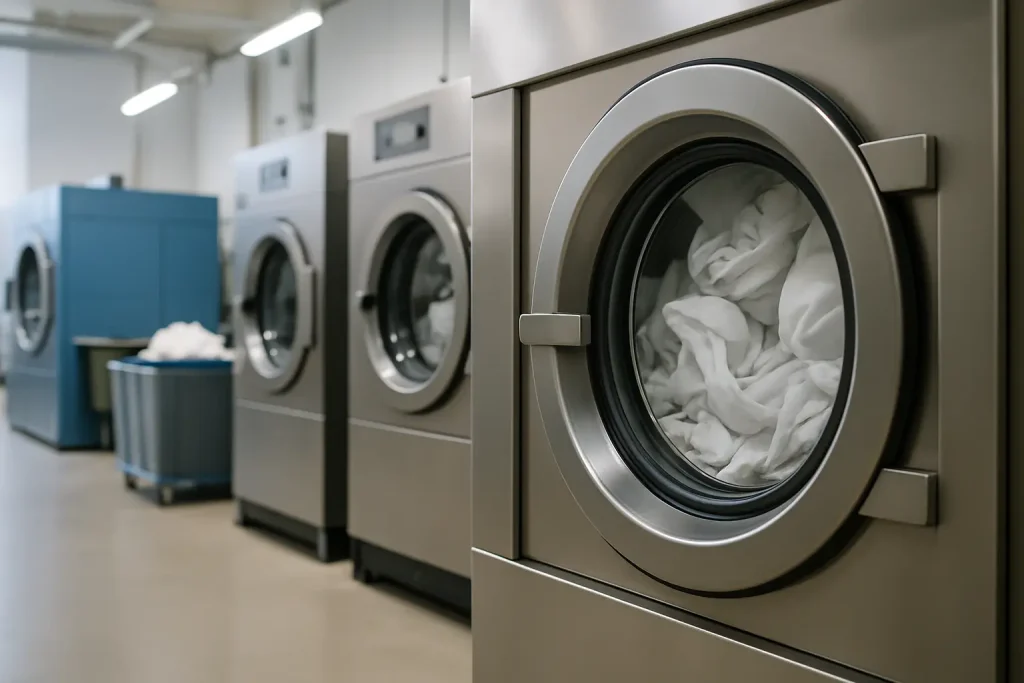
A laundry operation rarely “fails” in a dramatic way. It usually bleeds time: a washer that won’t reach extract speed, a dryer that won’t hold temperature, a door gasket that starts leaking, a small part you can’t get quickly. When you’re running a laundromat, hotel laundry, healthcare linen service, or OPL room, industrial laundry machines are not just equipment – they are your production schedule.
What buyers often miss is that the best machine on paper is not always the best machine for your floor. The right decision is the one that protects throughput, controls utilities, and stays serviceable with parts you can actually source.
What “industrial” really means in industrial laundry machines
In commercial settings, “industrial” is less about size and more about duty cycle and serviceability. These machines are built to run multiple turns per day, tolerate heavier soil loads, and hold alignment and balance under high-speed extraction. They also tend to be designed for quicker maintenance: accessible panels, standardized wear items, and controls that a technician can diagnose without guesswork.
The trade-off is that industrial machines demand better discipline. Water quality, chemical dosing, ventilation, and preventive maintenance matter more because you’re running closer to the edge of capacity. Push output without supporting infrastructure and you can shorten the life of even top-tier brands.
Start with your throughput math, not the brochure
Capacity planning is the difference between a calm day and a constant backlog. Before choosing models, get clear on three numbers: pounds per hour, turns per day, and peak-time demand.
A common mistake is sizing only for average volume. Hospitality and healthcare see spikes – check-in days, event weekends, flu season, or contract pickups. If you size for average and your peak hits, you’ll run extended hours, overheat dryers, and burn labor.
Also consider how your workflow moves. If you have plenty of washer capacity but you’re short on drying and finishing, you create wet-side congestion. If you have strong drying but slow wash throughput, you end up with idle dryers waiting for loads. The goal is balance across the full route: wash, extract, dry, fold/finish.
Washer-extractors: where quality and cycle time are won
Washer-extractors do two jobs: cleaning and water removal. Cleaning depends on mechanical action, time, temperature, and chemistry. Water removal depends on extraction G-force and drain performance. Both affect your total cost per pound.
High extract matters because it reduces dry time. That usually means lower gas or electric consumption and higher dryer availability. But higher extract speeds also increase the importance of good foundations, correct loading practices, and regular inspection of bearings, shock absorbers, and door seals.
If you process heavy goods (mats, thick cotton, microfiber mops), pay attention to load flexibility. Some operations do best with multiple mid-size machines instead of one large machine because it allows better sorting and avoids running partial loads. Others benefit from one large unit for bulk linens plus smaller machines for specialty items and rewash.
Controls are another practical decision. Advanced programming can help consistency and chemical control, but a simpler interface can be better if you have high staff turnover. The best control panel is the one your team will use correctly every shift.
Tumble dryers and heat options: speed, utilities, and fabric care
Dryers are where many operations lose money quietly. Overdrying wastes energy and damages textiles. Underdrying creates rework and complaints. A well-sized dryer lineup, properly vented, is one of the fastest ways to improve both output and linen life.
Gas dryers typically win on recovery time and operating cost where gas is available and priced well. Electric dryers can be the right choice when gas is not feasible or where electrical infrastructure is already strong. Either way, airflow is not optional. Poor make-up air and restricted exhaust increase dry times, drive up utility bills, and raise the risk of component failure.
Industrial heat-pump dryers are a different conversation. They can reduce energy use and can be useful where venting is limited or where you want lower heat for sensitive goods. The trade-off is cycle time and the need for correct sizing and maintenance. They are not a universal replacement for high-output tumble dryers, but they can be a strong fit in specific applications.
Stacked systems: when space matters more than perfect flexibility
Stacked washer/dryer systems can be a smart move for laundromats, multi-family housing, and smaller OPL rooms. You get more stations per square foot, and installation can be simpler.
The trade-off is flexibility. When one component is down, you may lose a full stack position. For some operators, that’s acceptable because the space savings outweighs the risk. For higher-volume sites where uptime is everything, separate machines can be easier to service without disrupting the whole lane.
Don’t ignore “small” supplies – they protect your big investment
Operators tend to budget for machines and then treat consumables as an afterthought. In reality, recurring supplies can make or break efficiency. Marking tapes, laundry pens, fasteners, needles, and identification tools reduce loss, sorting errors, and rewash. They also support accountability – especially in healthcare, hospitality, and multi-tenant settings.
Spare parts strategy is the same story. A $40 wear item can stop a $14,000 machine. If uptime is your business model, you need a plan for the high-failure and high-impact parts: belts, door gaskets, drain valves, ignition components, sensors, bearings (where appropriate), and control-related items. Exactly which parts to stock depends on your machine mix and service access, but the principle is consistent: plan for downtime before downtime plans for you.
Brands and build quality: what to look for beyond the nameplate
Commercial buyers recognize names like Speed Queen, UniMac, Wascomat, and LaPauw for a reason: these lines are designed for real duty cycles, and the industry knows how to service them.
Still, the brand alone doesn’t solve compatibility or supply continuity. When you evaluate industrial laundry machines, ask practical questions:
Do parts match across your fleet, or are you creating a one-off that will be harder to support? Are service points accessible, or will basic maintenance require long labor hours? Are manuals, diagnostics, and replacement components straightforward to obtain?
Standardization is not glamorous, but it improves your life. Fewer machine families typically means fewer part types, fewer training issues, and faster troubleshooting.
Installation and infrastructure: the hidden performance limit
Many “machine problems” are actually site problems. Water pressure and temperature stability affect wash results. Drain capacity affects cycle time and overflow risk. Electrical quality affects controls and motor performance. Venting affects drying speed and safety.
If you’re upgrading capacity, verify that your infrastructure can handle the increase. A new high-extract washer may need a stronger foundation or improved anchoring. Adding dryers may require make-up air changes or duct redesign. These costs are real, but they’re also where long-term reliability is won.
For operators in the Gulf region, high ambient temperatures and certain water conditions can make airflow, filtration, and water treatment even more important. It’s not about geography for its own sake – it’s about aligning the room conditions with the machine’s intended operating range.
Preventive maintenance: keep it simple, keep it scheduled
Preventive maintenance is not a binder that sits on a shelf. It’s small, repeatable checks that stop avoidable failures. Clean lint systems and confirm airflow. Inspect door gaskets and hinges. Watch for vibration changes at extract. Listen for bearing noise. Verify burner ignition and temperature stability. Keep chemical systems calibrated so you’re not compensating for bad dosing with longer cycles.
If you operate multiple sites or shifts, consistency matters more than sophistication. Assign ownership, track dates, and keep a short list of parts you replace often. That short list becomes your “never out of stock” kit.
Buying approach: match the machine to the reality of your floor
Procurement-friendly decisions come from being honest about how the laundry actually runs. If you run high volume with limited technical staff, prioritize proven models with straightforward service and ready parts. If you run premium garments or specialty textiles, prioritize controls, temperature management, and fabric care. If your utility rates are high, focus on extract performance, airflow, and energy-efficient drying where it fits.
For many operators, the best move is building a relationship with a specialized supplier that can provide both the machines and the ongoing operational supplies that keep production moving. If you want one place to source professional machines plus the consumables and spare parts that prevent downtime, ABELCO EQUIPMENT TRADING LLC is specialized in the laundry and dry-cleaning equipment industry and keeps a focused catalog for working operators at https://Www.abelco.me.
The most profitable laundry rooms are not the ones with the flashiest equipment. They are the ones that keep pace on busy days – and have a parts shelf, a maintenance habit, and a machine mix that matches reality.