
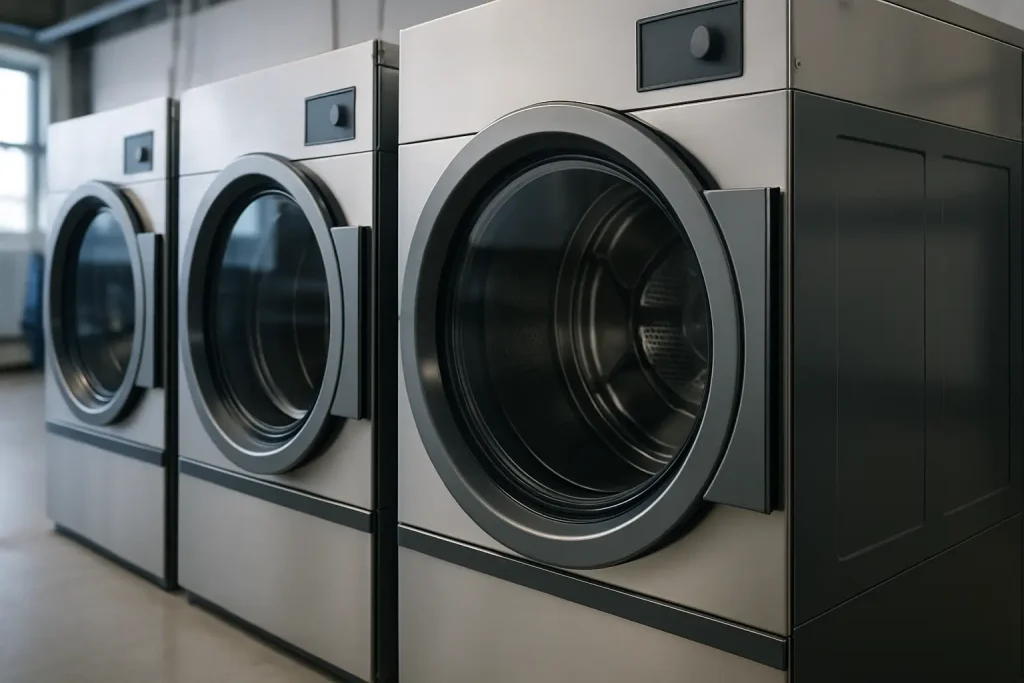
A high-throughput laundry rarely gets in trouble because it can’t wash fast enough. It gets in trouble because it can’t dry fast enough. Wet goods pile up, carts block aisles, staff starts re-handling loads, and suddenly your “capacity” is theoretical.
If you’re shopping for the best industrial tumble dryers for high throughput, you’re not really buying a drum with heat. You’re buying airflow, recovery time, and a machine you can keep running without waiting on parts. That’s the practical lens that matters for laundromats, hotels, healthcare linen, and any on-premise laundry that lives or dies by turns-per-day.
What “high throughput” actually means for a dryer
Throughput isn’t just rated pounds. It’s finished pounds per hour, at your actual moisture levels, with your operators and your utility costs.
If your washer-extractors are leaving goods at high residual moisture, your dryers will look “slow” even if the nameplate capacity is big. If your dryers have weak airflow or restrictive ducting, cycle times climb even with perfect extraction. And if your team is stopping to clean lint, chase ignition faults, or reset temperature limits, your advertised capacity never shows up on the floor.
High throughput, in real terms, means repeatable dry times, minimal babysitting, and quick recovery between loads – especially during peak hours.
The non-negotiables that separate fast dryers from “big” dryers
Airflow and exhaust design are the real horsepower
Operators tend to focus on BTUs or kilowatts. That matters, but airflow is what carries moisture out. A high-throughput tumble dryer needs strong, consistent airflow through the basket, and an exhaust path that doesn’t choke as lint builds.
If you’re comparing machines, ask directly about the airflow design and lint filtration. A poor lint screen or awkward access point turns into operator shortcuts, and shortcuts turn into longer dry times and nuisance shutdowns.
Heat source: gas is usually the throughput king, but it depends
In most commercial setups, gas heat gives you faster recovery and strong performance on towels, denim, and heavy goods. Electric can still be a solid choice where gas availability is limited or where electrical rates and infrastructure make sense.
For higher-volume sites, don’t treat heat source as a preference. Treat it as a math problem: available utilities, peak-hour demand, and cycle-time targets.
Controls that protect quality without slowing production
High throughput doesn’t mean scorching loads. Good controls should let you set clear programs for common goods – towels, sheets, mixed loads – and keep results consistent across shifts.
Look for straightforward programmability, accurate temperature sensing, cool-down that’s long enough to prevent re-wrinkling, and diagnostics that help a tech isolate issues quickly. Fancy screens are optional. Useful fault codes are not.
Serviceability and parts continuity
A dryer that’s “fast” on day one but difficult to service is not a high-throughput dryer. You want accessible burners or heating banks, straightforward belt and bearing service, and common-wear items that can be sourced without drama.
If your business depends on daily uptime, serviceability is part of throughput.
Picking the right class of industrial tumble dryer
Hard-mount vs soft-mount: don’t overcomplicate it
For tumble dryers, the mount style is usually less of a deciding factor than for washers. What matters more is stability, access, and how the machine handles continuous operation.
If you’re building for non-stop production, prioritize commercial construction, proven drive systems, and an installation plan that keeps ducting short and smooth.
Single dryers vs stacked dryers: throughput vs footprint
Stacked units can be the right answer when floor space is your limiting factor. They let you add drying pockets without expanding the room, and they can work well for laundromats and tight back-of-house operations.
Single large dryers win when your workflow is bulk oriented: sheet loads, towel loads, and continuous cart movement. They’re also easier for staff when you’re moving heavy goods all day.
It comes down to your constraints. If you’re space-limited, stacks often increase total daily output per square foot. If you’re labor-limited, larger single pockets can reduce handling.
Best industrial tumble dryers for high throughput: what to look for by brand category
There is no one “best” model for every site, but there are commercial brands that consistently show up in serious laundry operations because they’re built for volume and service.
Speed Queen commercial tumble dryers
Speed Queen is a common choice in laundromats and on-premise laundries because the platform is designed for steady commercial use and straightforward operation. For throughput, the value is predictable cycle behavior, simple controls, and a design that’s typically friendly for routine maintenance.
Where Speed Queen often fits best is high-turn environments that need repeatability and quick operator training. If your team is rotating or you have multiple shifts, that consistency matters.
UniMac commercial tumble dryers
UniMac is frequently specified for on-premise laundry where uptime and durability are the purchase drivers. In high-throughput contexts, operators like equipment that can run long hours without constant adjustment and with service access that doesn’t require heroic effort.
UniMac can be a strong option for hotels, healthcare, and institutional sites that want a commercial platform with a long service life and predictable parts support.
Wascomat commercial tumble dryers
Wascomat is a recognized name in professional laundry, particularly where operators want commercial performance with a focus on dependable daily operation. The practical angle for high throughput is consistent drying across load types and a platform that can be maintained on schedule.
Wascomat tends to make sense for operators who want commercial credibility and stable performance without getting into overly complex machine management.
LaPauw industrial systems (when you’re beyond “commercial”)
If you’re processing serious volumes – think production laundry scale – you may be looking at industrial approaches that go beyond typical on-premise stacks and small pocket dryers. LaPauw is known for heavy-duty laundry equipment in professional environments.
This category becomes relevant when your bottleneck is no longer a single machine but the entire line: feeding, drying, finishing, and material flow. For high-throughput buyers, the right move is often system thinking rather than pocket-by-pocket shopping.
Sizing for throughput: stop buying “capacity,” start buying turns
A common mistake is buying a dryer based on the washer’s rated capacity only. In practice, you want the drying side to stay ahead of the washing side.
Two rules that hold up in real operations:
First, plan your drying capacity to handle your peak hour, not your average hour. If your busiest period is 4 to 6 hours a day, that is where bottlenecks form.
Second, think in turns per day per pocket. A slightly smaller dryer that turns faster can outperform a larger dryer with longer cycles. This is why airflow, heat recovery, and lint management matter more than the headline number.
If you’re unsure, use your own data. Track typical load weights, washer extraction settings, and average dry times for your top three goods categories. That becomes your buying spec.
Installation details that directly affect throughput
Ducting can quietly kill your dry times
Long duct runs, too many elbows, undersized duct diameter, or shared exhaust that wasn’t engineered for volume will slow any dryer down. You will feel it as “the dryers are weak,” but it’s often the duct.
If you’re investing in high-throughput machines, treat ducting as part of the machine. Short runs, smooth transitions, correct sizing, and proper make-up air are not optional if you want fast cycles.
Make-up air and room pressure
Dryers need air to move air. Starve the room and you’ll see longer cycles, hotter surfaces, and more nuisance trips. A high-output dryer room should not feel like it’s fighting to breathe.
Gas and electrical supply stability
Gas pressure issues and voltage inconsistencies show up as inconsistent cycle performance. If you’re chasing throughput, you want stable utilities so the machine can do the same thing every load.
Operating practices that keep high-throughput dryers fast
Even the best equipment slows down if the process is sloppy.
Clean lint screens on a schedule that matches your goods type. Towels and flannels load lint fast. Don’t leave it to “when someone remembers.”
Don’t overload in the name of efficiency. Overloading reduces airflow through the goods and almost always increases minutes per pound.
Match your washer extraction to your drying goals. A small change in final spin or extraction time can save a meaningful amount of dryer time across the day.
Buying approach: how to choose with confidence
If you’re comparing options, you’ll get better answers by asking the questions that tie directly to throughput: What is the expected dry time for my actual goods mix? What are the airflow and exhaust requirements? How accessible are wear parts? What’s the realistic maintenance routine for a busy site?
A specialized supplier can help you align dryer selection with your washers, your utilities, and your parts strategy. ABELCO EQUIPMENT TRADING LLC is specialized in the laundry and dry-cleaning equipment industry and supports operators with commercial equipment, parts, and consumables through a single catalog at https://Www.abelco.me.
The closing thought that matters: if drying is your bottleneck, don’t shop for a dryer that looks impressive on paper – shop for the one that keeps carts moving at 2:00 p.m. on your busiest day, with the staff you actually have and the ducting you can actually install.
For airflow and thermal efficiency fundamentals, see this external efficiency benchmark guidance.