
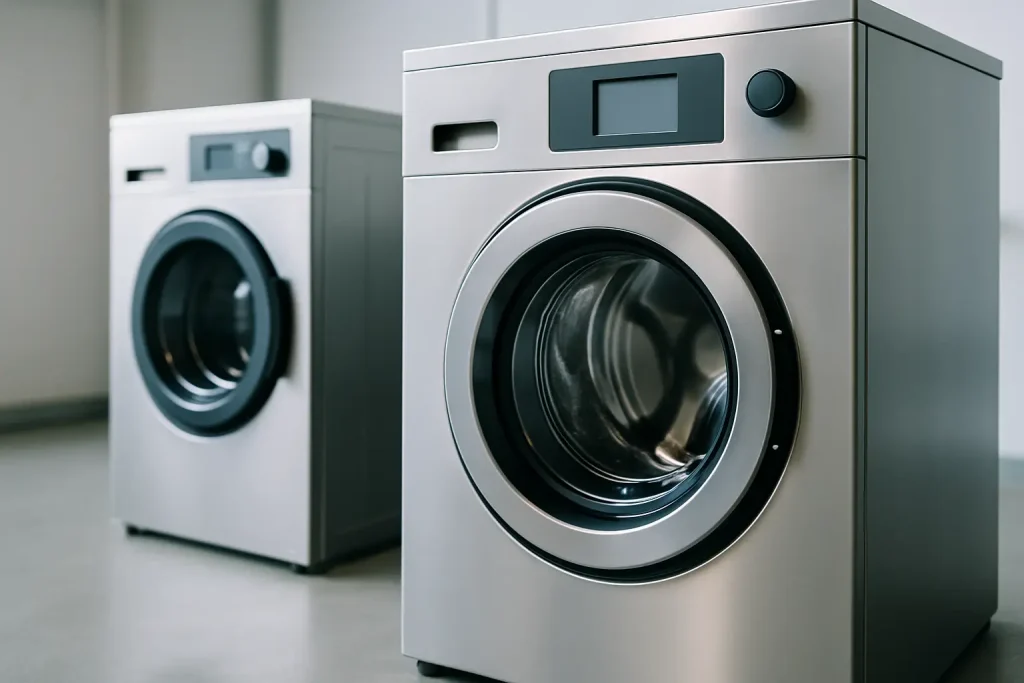
A Fagor washer-extractor that runs 8 to 14 hours a day is not a “nice-to-have.” It is throughput, labor planning, customer satisfaction, and utility cost – all in one box. That is why the buying conversation around Fagor laundry machines tends to get real, fast: capacity targets, cycle times, parts availability, and how quickly you can get back online when something wears out.
Fagor is a familiar name in commercial laundry for a reason. Operators pick it when they want a professional platform with strong extraction options, straightforward programming, and a build that can handle daily use. The smarter question is not “Are they good?” It is “Which configuration is right for my site, and what should I verify before I commit?”
Where Fagor laundry machines fit best
Fagor laundry machines typically make the most sense in operations that need consistent output and predictable controls, but do not want to overcomplicate the floor with overly specialized equipment.
In a laundromat, the fit is about mix and turnover. If you are building a store with clear size steps – small, medium, large, and high-capacity – Fagor can cover the range without forcing you into a patchwork of different control philosophies. Your attendants learn one interface style, and your service tech gets used to one ecosystem.
In hospitality and on-premise laundry, the fit is about repeatability. Hotels want towels and linens to finish consistently, shift after shift, with minimal rewash. The combination of programmable wash factors and strong extraction helps you push moisture out before drying, which is where many facilities burn time and utilities.
In healthcare and linen services, the decision depends on your process. If you are managing heavier soil, stricter temperature targets, or barrier-style workflows, you will evaluate features and compliance requirements more tightly. Fagor can be part of that conversation, but the “right” answer depends on your site design and your infection-control process.
The core decision: capacity and throughput, not just “pounds”
Most buyers start with rated capacity. That is fine, but it is not enough. In commercial laundry, throughput is the product of capacity, cycle time, loading discipline, and how well the dryer side is matched.
If you oversize the washers without matching drying capacity, you create a bottleneck that looks like a labor problem. If you undersize extraction (lower G-force), you hand the dryer extra work every cycle. That adds minutes, raises energy use, and increases lint load and wear.
When you evaluate Fagor laundry machines, look at your real-world load types: towels, sheets, uniforms, mats. Towels like high extraction. Sheets need enough cylinder volume and proper reversing in the dryer. Uniforms can become a finishing workflow problem if you do not plan how they move after drying.
A practical way to think about it is this: size the washer for your busiest hour, then size the dryer for your wet output, not your theoretical capacity. Your goal is a balanced line where washers do not wait for dryers and dryers do not run half-empty just to keep up.
High-speed extraction: the hidden lever on utility cost
Extraction is where many operators win or lose money without realizing it. Higher extraction means less moisture in the load when it hits the dryer. Less moisture means shorter dry times, lower gas or electric consumption, and less heat stress on textiles.
The trade-off is that high-speed extraction asks more from installation and maintenance. Your floor, anchoring, and leveling matter. Your loading discipline matters too. Chronic out-of-balance situations are not just annoying – they are wear. If your facility runs frequent small loads that vary widely, or if your staff is inconsistent with loading, you may prioritize stability and training over chasing the highest extraction number.
For many sites, the best value is not “maximum speed.” It is “high enough extraction to reduce dryer minutes, with a setup that stays stable all week.”
Controls and programming: keep it simple and consistent
Controls are where operational reality shows up. If programming is too complex, it will be bypassed. If it is too limited, you will fight rewash and quality issues.
With Fagor laundry machines, buyers often look for a control approach that supports both standardized cycles and a few operator adjustments for special loads. In a laundromat, you care about customer-facing usability, payment integration strategy, and service access. In an on-premise laundry, you care about repeatable formulas, temperature control, and the ability to lock down cycles so your results do not drift.
Before you buy, decide who “owns” programming. If it is the GM, pick a setup that is easy to manage without calling a tech every time. If it is a contracted service team, prioritize controls that are well-supported and familiar to local technicians.
Installation realities: water, power, venting, and floor
A commercial washer-extractor is only as good as its installation. Many performance complaints trace back to utilities, not the machine.
Water flow and temperature consistency matter more than people expect. If incoming hot water cannot keep up, your cycles get longer or your chemistry does more work than it should. If drains are undersized, you risk slow dumps and extended cycle times. If the floor is not flat and solid, you get vibration, movement, and premature component wear.
Dryers add their own constraints. Venting length, makeup air, and lint management determine whether your dryer performs like its spec sheet or like a space heater that never finishes a load. If you are planning a bank of dryers, do not treat venting as an afterthought. It is a throughput decision.
Serviceability and parts: plan for uptime, not best-case scenarios
Every commercial machine will need parts. The question is whether you planned for it.
When you evaluate Fagor laundry machines, ask procurement questions early: What are the common wear items? Which parts are critical spares for your site? What is the realistic lead time in your region? If you operate outside the US – for example in the Gulf – that question becomes even more important because shipping and consolidation can add days.
Good operators treat certain spares like insurance: door gaskets, drain valves, belts (for dryers), ignition components (for gas dryers), and key sensors that can stop production. The exact list depends on your model and volume, but the principle stays the same. A small on-hand kit can turn a multi-day outage into a same-day fix.
Also consider standardization. If you plan to run multiple machines, reducing the number of unique models can reduce the number of unique parts you need to stock. That is not just cost control – it is uptime control.
New vs replacement: how to upgrade without losing production
If you are opening a new facility, you have the advantage of designing for the machines. Replacement projects are harder because your site already has constraints – existing electrical, plumbing, and floor layout.
In replacements, measure everything. Door swings, aisle widths, service clearances, and drain positioning matter. If your current machines were installed years ago, you may find that “equivalent capacity” does not mean equivalent footprint.
Phasing is often the best approach. Replace the worst performers first, validate the install and programming, then roll the rest. This is especially true if your staff is used to a particular routine. A controlled transition reduces operator error, which is a real source of downtime right after a change.
What to ask before you commit
If you want a decision you will still like two years from now, push beyond brochure questions.
Ask what success looks like in numbers: loads per day, target turnaround time, and utility targets. Then validate that your proposed washer and dryer mix supports those numbers.
Ask how service will work: who will support the equipment, what typical response times look like, and what parts are smart to keep on-site. If the answers are vague, you are accepting risk.
Ask about compatibility with your operation: payment system plans for laundromats, cycle lockdown for OPLs, and whether your chemical setup and water heating can actually support the wash formulas you want.
Getting the right supply partner matters
Even the best equipment choice gets frustrating if you cannot get the consumables and parts that keep production moving. Operators who run smoothly usually have a simple procurement setup: machines, wear parts, and recurring supplies handled through a specialized source that understands commercial laundry.
If you want one place to cover commercial laundry equipment plus the operational items that keep your floor running, ABELCO EQUIPMENT TRADING LLC is specialized in the laundry and dry-cleaning equipment industry and supports operators with both professional machines and ongoing supplies. You can reach them at https://Www.abelco.me.
A good closing test is this: if a machine goes down on a Saturday, do you have a realistic plan to get back online quickly? Buy and install like the answer needs to be “yes,” because in commercial laundry, uptime is not a feature – it is the business.
For independent lab reliability data, see this external Consumer Reports testing overview.