
A commercial laundry doesn’t fall behind because someone made a bad marketing decision. It falls behind because a washer is down, a dryer can’t keep up, or a part is sitting on the wrong shelf – and the day’s production doesn’t wait.
That’s the lens most operators bring to UniMac: not “Is it a good brand?” but “Will it keep my floor moving, and can I support it for years?” If you’re evaluating unimac equipment for a laundromat, hotel laundry, healthcare linen room, or any on-premise setup, the right answer depends on your mix, your utilities, and your tolerance for downtime.
Why unimac is often the shortlist brand
UniMac shows up in serious commercial conversations because it’s built for duty cycles that punish light-duty machines. The value is not just in capacity. It’s in serviceability, repeatable results, and a parts ecosystem that operators can live with over time.
In practical terms, unimac tends to make sense when your priorities are consistent finishing quality, predictable extraction, and equipment that isn’t temperamental about being run all day. That said, it’s not automatically the best fit for every site. If your operation is low-volume or your utility infrastructure is limited, you may be better served by a smaller footprint or a different machine style. The goal is to match the machine to the workflow, not to chase a brand name.
Start with the decision that drives everything: your workflow
The most expensive mismatch we see is pairing the wrong washer style to the actual linen mix. A machine can be “commercial” and still be wrong for your operation.
If you run a laundromat or multi-family laundry room, your workflow is customer-driven. You want simple, durable machines that handle varied loads without constant staff intervention. Throughput matters, but so does ease of use and predictable turnaround.
If you run hospitality, you’re managing peaks. Linen volume comes in waves, and you need equipment that can recover quickly after check-out rushes. You’ll feel any bottleneck immediately at the dryer line or at finishing.
If you run healthcare or a linen service environment, you’re balancing quality, process control, and compliance-driven consistency. Extraction performance and cycle control matter because rewash rates are expensive and finishing standards are tight.
Once you’re clear on the workflow, unimac selection becomes simpler. You’re choosing between categories that solve different problems.
UniMac washers vs washer-extractors: which one you actually need
Operators sometimes use the terms interchangeably, but the decision impacts installation, utilities, and the rest of your production line.
A traditional commercial washer is often the practical choice when you want straightforward washing performance, a familiar user experience, and a machine that can be placed into an existing laundry layout with fewer surprises. These tend to work well for many laundromat and on-premise needs where the goal is reliable washing, not maximum extraction.
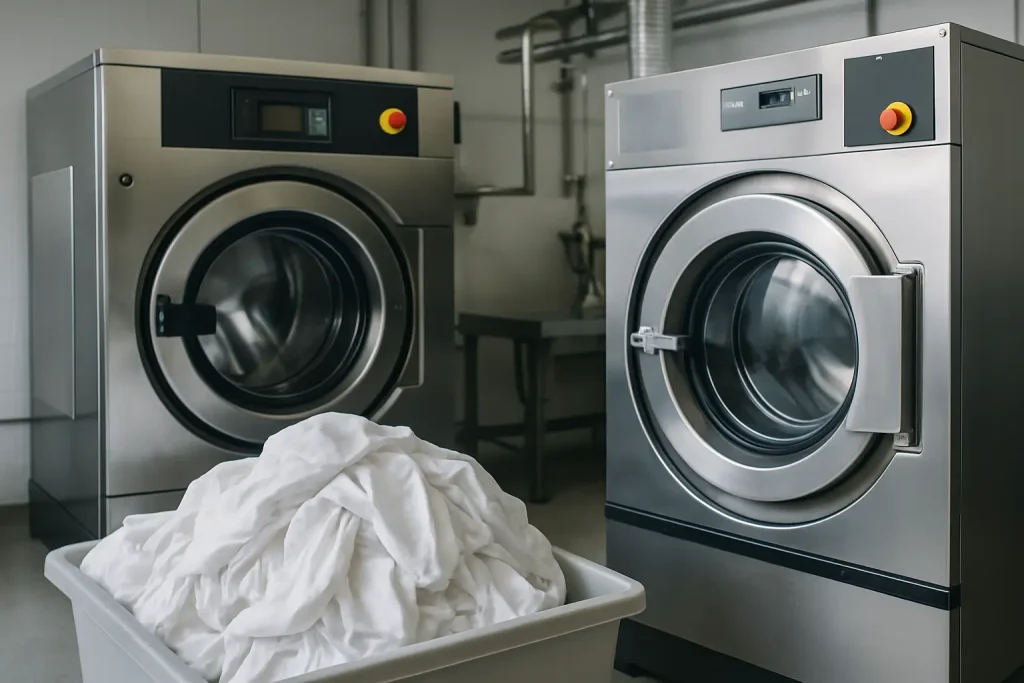
A washer-extractor is where unimac often earns its keep in production environments. Higher extraction reduces moisture left in the load, which can cut dryer time materially. That’s not a small benefit – drying is frequently your most expensive step in terms of energy and time. If your dryers are the bottleneck, better extraction is one of the cleanest ways to increase throughput without adding dryer capacity.
The trade-off is that higher-performance extraction can demand more from the install. Floor, anchoring, and utility expectations can be different depending on model type and site conditions. If you’re retrofitting into a tight space or an older building, the “best” machine on paper might create real-world complications. It depends on what your site can support.
Tumble dryers: where production either flows or stalls
Dryers are the quiet deciders of laundry uptime. If washing outpaces drying, your operation doesn’t “run behind” – it clogs.
With unimac tumble dryers, the practical evaluation is less about brand and more about matching heat source and airflow to your load profile. If you’re drying heavy cotton terry, your dryer spec needs to reflect that reality. If your loads are mixed, your controls and cycle flexibility matter.
When operators complain that dryers “don’t dry,” the root cause is often not the drum. It’s venting, airflow restrictions, or an install that doesn’t match the machine’s requirements. UniMac equipment is designed to perform, but it won’t overcome poor ducting. If you want predictable dry times, treat venting as part of the equipment decision, not an afterthought.
Stacked washer/dryer systems: when space is the real constraint
Stacked systems are not a compromise when space is your limiting factor and your volume is steady. They can be a smart, procurement-friendly way to get more turns per square foot.
Where stacked setups can become limiting is in production environments with uneven demand. If washer demand and dryer demand don’t rise together, stacking can lock you into a ratio that doesn’t match reality. In hospitality peaks, for example, you might want more dryer capacity relative to wash capacity, or vice versa depending on your mix. Stacked systems are excellent when you’re confident the ratio stays stable.
Sizing unimac equipment: think in bottlenecks, not in pounds
Capacity numbers are useful, but they don’t tell you where your line will choke. For practical planning, think in terms of “What step is slowest today?” and “What step will be slowest after I upgrade?”
If your washers are old and slow, adding a high-performance washer-extractor can make you feel like you doubled your plant – until you realize your dryers can’t absorb the faster output.
If your dryers are already tight, upgrading extraction or adding dryer capacity might produce a bigger result than adding more washers.
If finishing is your bottleneck (folding, ironing, packaging), faster wash and dry times won’t help unless you also address downstream constraints.
This is why unimac equipment planning works best when you treat it as a line, not as isolated purchases. You’re buying uptime across the system.
Utilities and site conditions: where “it depends” is honest
Two facilities can buy the same unimac models and get different results because the infrastructure isn’t equal.
Gas availability, electrical capacity, water quality, drain sizing, and ventilation all affect performance and maintenance. Hard water, for example, can accelerate scale and reduce heating efficiency. Poor drain design can slow cycle times. Inadequate makeup air can make dryer performance look like a machine issue when it’s actually a room issue.
If you’re installing in the Gulf region – UAE, Oman, Qatar, Bahrain, Kuwait, or Saudi Arabia – the climate and building conditions can make ventilation and heat management even more important. Drying performance and comfort in the laundry room depend on how well the site handles heat and airflow.
The simple way to protect your purchase is to treat utilities as part of the spec. If you’re unsure, ask for a site-based recommendation before you commit.
Parts, consumables, and serviceability: the ownership cost most buyers miss
The purchase price is easy to compare. The operating reality is harder.
With unimac, long-term value shows up when parts are available, maintenance is straightforward, and your team can keep the machines working without long delays. That doesn’t mean every part is always on hand everywhere. It means you should plan for continuity.
A practical approach is to keep common wear items and operational consumables in stock so minor issues don’t turn into multi-day downtime. For many operations, that includes the basics your floor depends on daily: identification and marking items, small fastening accessories, and the kinds of consumables that keep goods moving through receiving and sorting without confusion. When you’re processing volume, losing track of linen or misidentifying goods creates rework that feels like “labor problems” but is really a supply problem.
If you want a single-source purchasing relationship that covers both equipment and the day-to-day supporting items, that’s where a specialized supplier earns their keep. ABELCO EQUIPMENT TRADING LLC is specialized in the laundry and dry-cleaning equipment industry and supports operators with commercial machines plus recurring accessories and spare parts through https://Www.abelco.me.
What to ask before you buy UniMac
If you want a purchase that holds up under real production, ask questions that force clarity.
Start with what you process most: towels, sheets, uniforms, mats, mixed retail goods. Then confirm your peak day volume and how many hours you realistically run.
Next, validate the constraints: space, utilities, venting path, drain setup, and whether you’re replacing existing equipment or building new.
Finally, ask how you’ll support uptime: what parts are commonly needed, what you’ll keep in-house, and how quickly you can get what you don’t stock. The best equipment choice is the one you can keep running.
Choosing unimac the procurement-friendly way
UniMac is a strong fit when your operation values repeatable cycles, dependable extraction, and equipment built for commercial duty. The smart buy is not “the biggest machine you can afford.” It’s the machine that balances your line, matches your site, and can be supported without drama.
If you make the decision with bottlenecks and support in mind, you end up with something better than a new machine. You end up with a calmer plant – and that’s usually the most profitable upgrade you can make.