

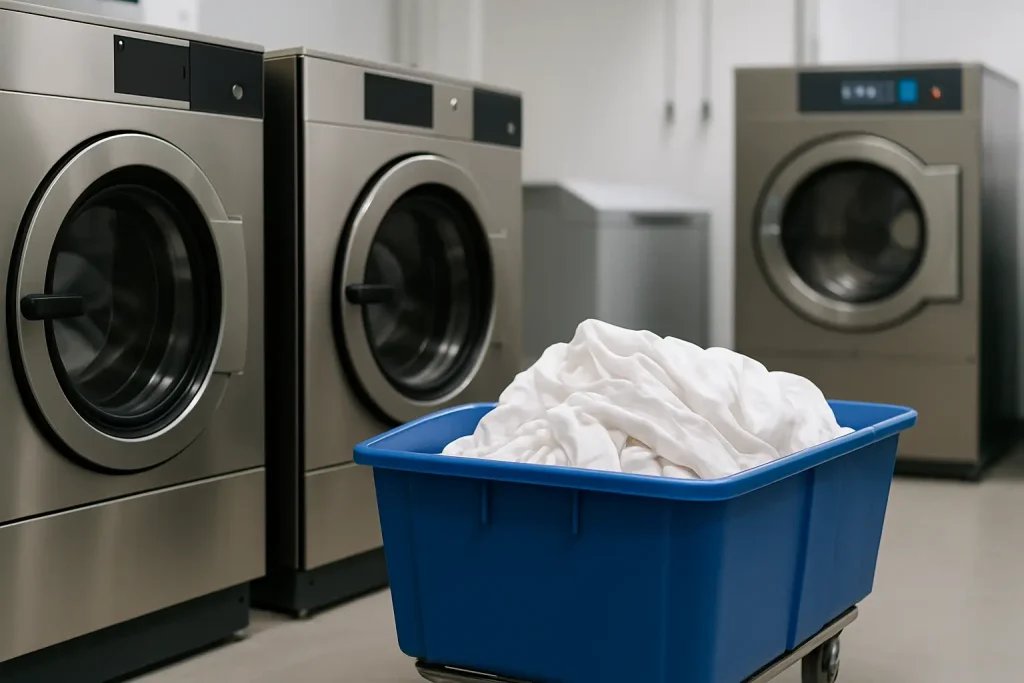
A dryer sitting idle because a $10 wearable part failed is the kind of problem that doesn’t show up on a spec sheet – but it shows up fast in your production numbers. Commercial laundry runs on consistency: predictable cycle times, repeatable quality, and equipment that can be serviced without drama. If you’re buying laundry equipments for a laundromat, hotel, healthcare linen room, or dry-cleaning support operation, the smartest approach is to plan around throughput and downtime, not just sticker price.
What “laundry equipments” really includes
When buyers say “laundry equipments,” they usually mean washers and dryers. In real operations, the equipment set is a system: washing, extraction, drying, finishing or handling, and the small supplies that keep garments sorted and traceable.
On the heavy-duty side, you’re typically looking at commercial washers, washer-extractors, tumble dryers, stacked washer/dryer systems, and newer efficiency plays like industrial heat-pump dryers. On the day-to-day side, you’re looking at the consumables and spare parts that stop a minor issue from becoming a shutdown: marking tapes, needles, fasteners, laundry pens, and other basics you go through constantly.
If your procurement process separates “machines” from “supplies,” it’s worth rethinking. Your uptime is tied to both.
Start with capacity math, not brand preferences
Capacity planning sounds simple until you factor in peak load, linen type, and how operators actually use the room. The cleanest way to start is to work backward from your daily pounds (or pieces) and your time window.
If your laundry room must process a known volume between shift start and shift end, your bottleneck will be either wash/extract or dry. Wash is usually more predictable. Drying varies widely with fabric weight, moisture retention, and whether operators are tempted to overload.
The trade-off is straightforward: oversize the wash side and you can still get stuck waiting on dryers; oversize drying and you may end up with unused capacity while you wait on wash. In many on-premise laundry rooms, the dryer becomes the limiter. In self-serve laundromats, customer behavior makes it even more pronounced.
A practical rule: match your washer-extractor capacity to dryer capacity in a way that reflects your real mix, not your “average.” If you do a lot of towels, mats, or heavy cotton, plan for more drying capacity than your wash capacity suggests.
Washers vs washer-extractors: why extraction matters
A standard commercial washer gets garments clean. A washer-extractor is about both cleanliness and how much water you can remove before the load ever reaches a dryer.
Higher G-force extraction reduces remaining moisture and reduces dry time. That means lower energy use and more turns per dryer per shift. The trade-off is that higher-speed extraction can be harder on some textiles if your programs and loading discipline are sloppy. In healthcare and hospitality, the time savings usually wins because the load is standardized and the process is controlled.
If you’re replacing older equipment, pay attention to two details that affect day-to-day serviceability: drain configuration and door seal wear. These aren’t glamorous topics, but they are frequent causes of “mystery leaks” and repeated callouts.
Tumble dryers: the real throughput engine
Dryers are where production schedules either hold steady or fall apart. In a commercial setting, the dryer isn’t just a heater with a drum. It’s an airflow machine.
If airflow is restricted (lint path, ducting, make-up air), you can have a “working” dryer that never performs. You’ll see extended cycles, overheated components, and inconsistent dryness that drives rewashes or customer complaints.
Two buying realities matter here:
First, gas vs electric is an operating cost decision, but it’s also a site-constraint decision. If gas is available and ventilation is designed correctly, you typically get faster recovery. If electric is the only practical option, size your electrical service conservatively and don’t assume nameplate performance equals real throughput.
Second, controls matter more than most buyers expect. A simple timer is easy, but it’s also wasteful. Moisture sensing can help – if it’s tuned for your textiles and maintained. The trade-off is that sensors can be neglected; then operators switch to timed cycles and you lose the benefit.
Stacked washer/dryer systems: space efficiency with constraints
Stacked systems are a straightforward answer when footprint is limited: multifamily housing, small hotels, compact OPL rooms, or tight laundromat layouts.
They save space and simplify installation planning, but there’s a real operational constraint: if either the washer or dryer side is down, you may lose the whole stack’s utility depending on how your workflow is set up. Service access can also be tighter.
If you’re building with stacked systems, plan your redundancy. A single stacked unit can be fine; an entire room of only stacks can become fragile if you don’t hold key spare parts or have fast supply access.
Industrial heat-pump dryers: when efficiency is the point
Heat-pump drying has moved from niche to a real option in commercial environments where energy costs, ventilation limitations, or sustainability targets matter.
These systems can reduce energy use and may reduce the need for aggressive exhaust configurations, depending on the model. The trade-offs: higher upfront cost, different maintenance routines (filters and heat exchange surfaces), and the need to confirm performance against your actual linen mix. If your business model requires maximum turns per hour at all times, verify cycle time under your heaviest typical loads.
Heat-pump is not “better” by default. It’s better when your constraints make it better.
Don’t ignore the small stuff: consumables that protect uptime
Many downtime events start small: an identification process breaks, a fastener wears out, a marking method fails, or a simple component isn’t available when the operator needs it.
In commercial laundry and dry-cleaning operations, consumables and identification accessories are part of production control. Marking tapes and laundry pens keep sorting clean and reduce loss. Needles and fasteners support repair and finishing workflows and prevent a minor garment issue from turning into a reject or rewash.
If you run healthcare or hospitality, traceability and sorting discipline are not optional. If you run a laundromat, the “small stuff” still matters – customers remember when machines are out of order, but they also remember when your operation looks organized and reliable.
Parts compatibility and serviceability: buy for the life cycle
The lowest-cost machine can be the most expensive asset if parts availability is inconsistent. Operators usually feel this in three places: door seals and gaskets, belts and wear components, and control-related failures that take longer to diagnose.
A procurement-friendly way to think about it is to separate:
- Wear items you expect to replace on a schedule
- Failure items you want quick access to
- Long-lead components you want to avoid being dependent on
You don’t need to stock everything. You do need a plan that matches how painful downtime is for your operation.
This is why recognized commercial brands continue to dominate serious laundry rooms: they’re built for service, and the ecosystem of parts and field experience is mature. Brands such as Speed Queen, UniMac, Wascomat, and LaPauw are commonly specified because operators know what they’re getting and technicians know how to keep them running.
Buying laundry equipments for different facilities: what changes
The same equipment category can be the right choice for two sites and still be purchased for totally different reasons.
Laundromats optimize for customer turns, payment integration, and predictable maintenance cycles. Your equipment has to take abuse and still feel “simple.” Hotels and hospitality OPL rooms optimize for quiet reliability, staff ease-of-use, and handling towels and sheets all day without drama.
Healthcare and linen services care about process control, disinfection protocols, and consistency. Multi-family and institutional sites often care most about space, noise, and limiting service calls.
The point is not to overcomplicate it. It’s to avoid copying someone else’s equipment list when your bottleneck is different.
Supplier strategy: one relationship, fewer gaps
If you’re juggling one vendor for machines, another for consumables, and a third for parts, you’re accepting procurement friction that will eventually show up as downtime.
A specialized supplier relationship reduces gaps: you’re not re-explaining your equipment mix every time you need a compatible item, and you’re less likely to “make it work” with the wrong part.
If you want a single-source partner that covers commercial laundry machines plus the ongoing accessories and spare parts that keep operations moving, ABELCO EQUIPMENT TRADING LLC is specialized in the laundry and dry-cleaning equipment industry and supports operators with a curated, practical catalog at https://Www.abelco.me.
The simplest maintenance habit that saves the most money
Most operators expect a maintenance plan to be complicated. The highest-return habit is basic: treat airflow and lint management like a production KPI.
Lint isn’t just housekeeping. It affects dry time, energy cost, safety, and component life. When drying performance drifts, teams often blame the machine first. Start with the lint path, ducting, and make-up air. Then look at loading discipline. Only then assume you need major repair.
A facility that keeps airflow stable will often “feel” like it has better equipment, even when it’s simply operating the equipment correctly.
If you’re buying laundry equipments right now, buy for the week you’re busiest, stock the small consumables you burn through, and set up your supply chain so a minor part never becomes a shutdown. That’s how you keep uptime high without paying for capacity you can’t actually use.