
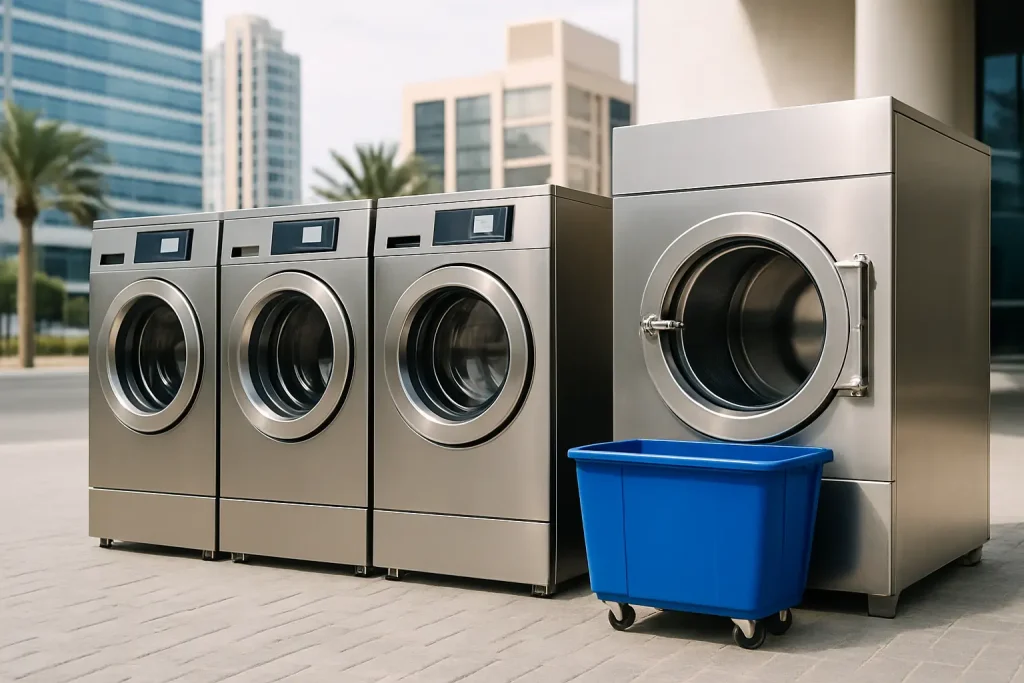
Buying industrial laundry equipment UAE facilities can rely on starts with matching capacity to real demand. A hotel laundry hits peak check-out time, the flatwork is stacking up, and one dryer starts throwing a heat fault. That is the moment you find out whether your equipment plan was built for real production – or built for a brochure.
If you are sourcing industrial laundry equipments UAE operators rely on, your real target is uptime. Capacity matters, but so do heat type, drain and vent constraints, install support, and the boring stuff that keeps production moving: belts, filters, needles, marking tapes, fasteners, and the small consumables that stop a shift when you run out.
What “industrial” actually means in UAE laundry ops
In commercial laundry, “industrial” is less about size and more about duty cycle. A machine that looks fine for a small shop can fail fast when it is loaded hard, run back-to-back, and maintained by a team that needs parts now, not next month.
For on-premise laundry (OPL) in hospitality, staff housing, gyms, and multi-family housing, the typical pressure point is predictable daily volume with hard deadlines. For healthcare and linen services, the pressure point is process control and consistency – plus the need to keep equipment sanitized and stable under constant use.
That is why procurement decisions should start with three questions: What is your daily throughput target, what is your peak-hour bottleneck, and what is your downtime tolerance? If the answer to the last one is “almost zero,” you should buy like it.
Industrial laundry equipments UAE buyers usually need first
Most facilities build their core around washers or washer-extractors and tumble dryers. Then they add specialty pieces based on workflow.
Commercial washers vs washer-extractors
A washer-extractor is the workhorse in most professional environments because extraction force is productivity. Higher G-force means more water removed before drying, which means shorter dry times and lower energy use. The trade-off is that high-speed extraction puts more demand on foundations, leveling, and load discipline. If your staff frequently overloads or mixes heavy and light goods, a machine capable of high extraction can still underperform in practice.
If your site has structural or vibration limits, or you are working in a constrained retrofit, a smaller or softer-mount approach might fit better. It depends on your building, not just the spec sheet.
Tumble dryers and drying strategy
Drying is where most laundries lose time and margin. A dryer is not just a drum and a burner. Airflow, lint management, and vent design determine whether you get consistent dry times or constant re-runs.
A key decision in the region is heat source and infrastructure. Gas is efficient where supply and approvals are straightforward. Electric can simplify installation but may raise operating cost depending on your tariff and peak usage. If venting is difficult or you are trying to manage heat load in the space, industrial heat-pump dryers are worth a serious look. They can reduce exhaust requirements and energy draw in certain scenarios, but the economics depend on your cycle mix, ambient conditions, and whether you have the maintenance discipline to keep airflow and filters clean.
Stacked washer/dryer systems
Stacked systems are a space play. They help when your square footage is expensive or fixed, especially in back-of-house areas where footprint matters more than walk-around access. The trade-off is service access and redundancy. If one stacked unit is down, you lose both functions in that stack. In a high-uptime facility, many operators prefer multiple independent machines so a single failure does not take out a whole lane of production.
Dry-cleaning and finishing support
Dry-cleaning operations often need a different mix: reliable washing for wet-side items plus consistent drying and handling for finishing. If your business relies on garment presentation, the hidden cost is rework. Equipment that holds temperature and cycle consistency reduces returns, reduces operator time, and keeps quality stable.
Sizing equipment for throughput, not wishful thinking
A practical way to size is to map your linen and garment flow by category: towels, sheets, duvet covers, uniforms, mats, and mixed smalls. Each category behaves differently in wash absorption and dry time.
If your dryers are always the bottleneck, adding washer capacity will not help. If your washers are waiting on dryers, your extraction and dryer capacity are mismatched. If you see a backlog in folding or staging, the fix might be workflow space and carts, not another machine.
Also be honest about your peak window. A hotel can have the same total daily volume as another property but a tighter peak after checkout. That changes the value of faster extraction and consistent dry times.
Utility realities in the UAE and Gulf region
Site conditions drive equipment decisions more than many buyers expect.
Water quality and temperature impact wash performance and chemical dosing. If you have hard water, scaling and valve issues show up faster, and you should plan for maintenance cycles and compatible parts.
Drain capacity and floor slope determine whether high-speed extraction and rapid discharge causes flooding or backups. Vent runs and make-up air determine whether dryers actually perform at rated capacity. Many “slow dryer” complaints are airflow problems, not dryer problems.
Electrical supply planning matters for stacked systems, electric dryers, and heat-pump units. The cheapest purchase price can turn into the most expensive install when you factor panels, breakers, and ducting rework.
Brands, compatibility, and serviceability matter more than features
Commercial laundry is not a hobby. Buyers do not win by chasing the longest feature list. They win by choosing equipment that their team can run consistently, that technicians can diagnose quickly, and that has predictable parts availability.
Recognized commercial lines like Speed Queen, UniMac, Wascomat, and LaPauw tend to show up in professional settings for a reason: proven duty cycles and established service ecosystems. That does not mean every facility needs the same model. It means you should prioritize compatibility, documentation, and practical maintainability.
Ask direct questions before you buy: Which wear parts are most common? What is the expected maintenance interval for belts, seals, and bearings? What is the lead time risk on control boards? How fast can you get consumables that your operation cannot pause without?
Don’t overlook the supplies that keep production moving
Many shutdowns are not caused by a major failure. They come from small gaps: you cannot tag linen, you cannot secure items, you cannot mark garments reliably, or you run out of needles and fasteners needed for routine handling.
If you are running a professional operation, recurring consumables are part of your uptime strategy. Marking tapes, laundry pens, needles, and compatible fasteners are not glamorous, but they prevent mis-sorts, customer complaints, and avoidable rewash.
The smart move is to align your equipment purchase with a supply plan. When you bring in new machines, you often change cycle times and volumes. That changes how quickly you burn through identification and handling supplies.
A procurement approach that avoids expensive mistakes
Industrial laundry buying goes smoother when you treat it as an operations project, not a shopping exercise.
Start with your process map: receiving, sorting, washing, drying, finishing, staging, and dispatch. Identify where items queue up. Then size machines to remove the bottleneck, not just to add more capacity in the wrong place.
Next, lock down site constraints early. Measure door widths, pathways, floor loading, drain positions, vent runs, gas access, and electrical capacity. A machine that cannot be installed cleanly will cost you time and money before it ever runs a load.
Finally, set a parts-and-consumables baseline. Decide what you will keep on hand for the first 6 to 12 months of operation: common wear parts, filters, belts, and the identification supplies your team uses daily. If you do not stock the basics, you are choosing downtime by default.
Where a specialized supplier helps
When you are buying industrial laundry equipments UAE facilities depend on, the value of a specialized supplier is not just selling a washer or dryer. It is helping you match equipment types, confirming compatibility of parts and consumables, and keeping your reorder cycle simple.
If you want one source for commercial machines plus the day-to-day accessories that keep work moving, ABELCO EQUIPMENT TRADING LLC is specialized in the laundry and dry-cleaning equipment industry and supports operators across the Gulf with professional equipment lines and ongoing supplies. You can review their focus areas at https://Www.abelco.me.
The trade-offs that are worth being honest about
Every laundry has constraints, so the “best” setup depends.
Higher extraction saves dryer time, but it can raise vibration risk if installation is rushed or floors are weak. Heat-pump drying can cut certain energy and venting burdens, but it rewards disciplined cleaning and airflow maintenance. Stacked systems can solve space, but they can concentrate risk if a single unit failure removes both functions.
If your operation is expanding, leave room for growth. Buying at exactly today’s volume often forces a rushed second purchase later, typically at the worst possible time.
A practical closing thought: buy for the shift you cannot afford to lose, then keep the small essentials stocked so your team is never waiting on a missing part or a missing marker when the bins are full and the clock is ticking.
For efficiency benchmarks, see this external efficiency guidance.