
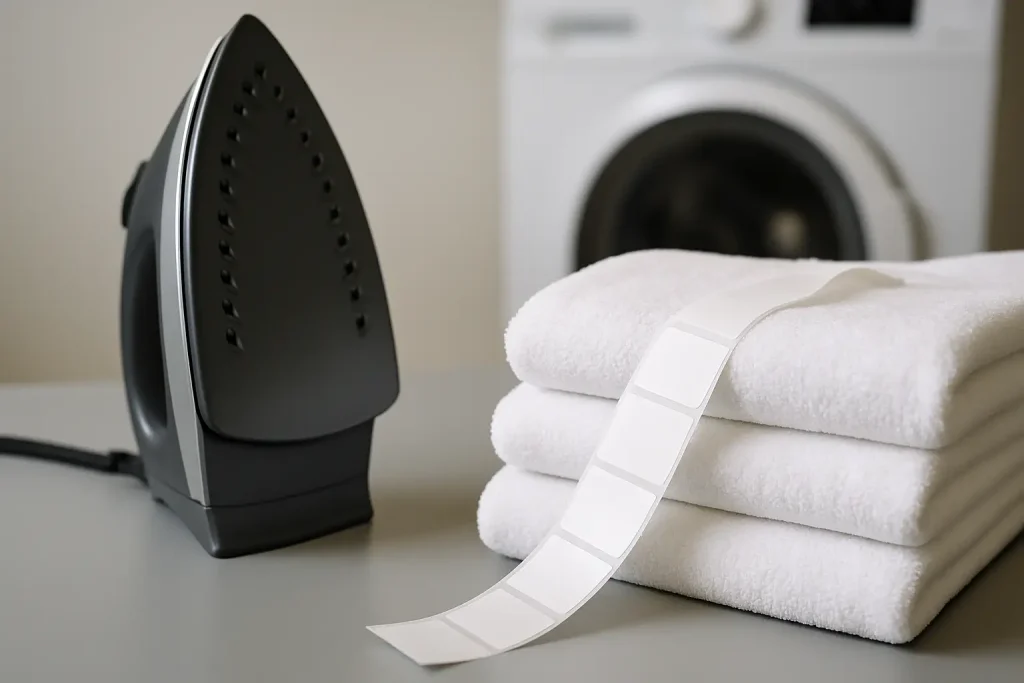
A missing name tag costs more than the tape.
If you run a commercial laundry, you already know how it plays out: a blanket goes out on the wrong route, a resident’s clothing comes back “not ours,” or a hotel robe ends up in a different property’s pile. The rewash, the call-backs, the credits, and the staff time add up fast. That is why marking is not a nice-to-have. It is throughput protection.
Thermopatch marking tapes for laundry are built for exactly this job: permanent identification that stays readable through wash formulas, heat cycles, finishing, and daily handling. When they are selected and applied correctly, they reduce lost-linen claims and make sorting faster. When they are chosen wrong, you get curling edges, ghosted text, and labels that fall off right when you need them.
Why thermopatch marking tapes for laundry work
A thermopatch marking tape is a heat-applied label system, typically a polyester or nylon-based tape with an adhesive layer designed to bond to textile fibers under controlled heat, pressure, and dwell time. You print or write the ID, apply it with a heat press, and it becomes part of the garment or linen workflow.
The value is not just “a label that sticks.” It is a label that stays stable while the textile expands and contracts, and while the wash process attacks everything with alkalinity, oxidizers, heat, and mechanical action. In other words, it is engineered around the realities of commercial laundry instead of home laundry.
The key point is compatibility. The tape material, adhesive, and the way you mark the tape must match your textile types and your process. If your plant runs high-heat drying and aggressive chemistry, you need a tape and marking method that is rated for that environment. If you handle delicate fabrics or heat-sensitive items, you need a lower-temperature solution or a different placement strategy.
Where marking tapes actually pay off
Most operations do not lose money because they cannot wash. They lose money because they cannot control inventory movement. Marking tape is a simple control layer that improves accuracy in three high-impact areas.
First is sorting speed. When the tag is consistent and readable, your team does not need to “guess” ownership, and you cut decision time per item. Second is claims reduction. Clear ID prevents the “wrong customer” scenario, especially in healthcare, multi-family, and uniform programs. Third is life-cycle tracking. Once items are consistently marked, it becomes easier to spot abnormal loss, theft patterns, or specific item categories that churn too quickly.
That is why laundromats serving wash-dry-fold accounts, hotel on-premise laundries, dry cleaners handling uniforms, and institutional plants all benefit. The use case changes, but the driver is the same: fewer exceptions.
Choosing the right tape: what matters in production
“Marking tape” sounds simple, but you are buying performance under stress. Focus on a few practical variables.
Textile type and surface
Cotton terry behaves differently than a poly-cotton shirt. Microfiber and performance knits can be more heat-sensitive, while heavier woven items can take more pressure and dwell. The tape must bond reliably without stiffening the fabric in a way that annoys end users.
If you label high-pile terry, you typically want a tape that can bond through texture without lifting at the edges. For smooth woven garments, you can prioritize thinness and comfort. For stretchy knits, you want a label that flexes and does not crack.
Wash chemistry and temperature profile
Your wash formula matters. High-alkaline steps, chlorine bleach, peroxide systems, and high-temp finishing all stress adhesives and ink. The tape is only half the system – the marking method (thermal transfer print, stamp, pen, or woven) has to hold up too.
If your plant uses high heat, do not assume a low-cost label will survive. A tape that looks fine after three cycles can start curling after 20, and by 50 it becomes unreadable. In commercial laundry, “good enough for now” becomes “rework forever.”
Readability requirements
Decide what has to be readable and by whom. Human-readable names are common in resident laundry. Barcode or QR-coded labels support scanning workflows and higher automation. If you plan to scan, the surface and contrast have to be consistent. A tape that wrinkles or glosses over can make scanners unreliable.
Comfort and placement
You can win durability and still lose the customer if the label is scratchy or placed wrong. For garments, inside seams or care-label areas are common. For flatwork and terry, corners or hems are typical. The goal is always the same: a spot that avoids direct abrasion points and does not interfere with folding or finishing.
Application is where most failures start
A lot of “bad tape” is actually bad application. Thermopatch marking tapes (and Thermopatch-style labels in general) need consistent heat, pressure, and time. If any one is off, the adhesive may partially bond and then fail later.
Heat presses drift. Platens get uneven. Staff rush a cycle or press over seams. Even the best tape cannot compensate for a press that is not set or maintained correctly.
You also need a clean, dry surface. Residual softener, finishing chemicals, or moisture can reduce bond strength. In some operations, applying labels after washing and drying is more reliable than applying to new items that may have finishing residues.
Industry guidance from the Textile Rental Services Association (TRSA) echoes this: for volume programs, standardize the process when applying Thermopatch marking tapes. Same placement, same press settings, same pre-check. Consistency beats heroics.
Common problems and what they usually mean
Curling edges typically point to insufficient pressure, too short a dwell time, or placement on a high-abrasion fold line. It can also happen if the tape is too stiff for a stretchy fabric and the garment movement works the edges loose.
Faded or smeared text is often a marking method issue more than a tape issue. Some inks wash out, some stamps are not chemistry-resistant, and some printers are not set up with the right ribbon for the wash environment.
Labels that “feel” too hard usually mean the tape is too thick for the garment category, or it is placed where it constantly rubs skin. In hospitality, guest comfort matters. In healthcare resident laundry, complaints create staff workload.
And when labels fall off cleanly, with little residue, that usually signals under-pressing or applying to a surface with contamination. When they tear but the adhesive stays, it is more likely mechanical abuse or placement too close to a stress point.
Setting up a marking program that stays stable
If you are starting from scratch or cleaning up a messy labeling situation, keep it simple and operational.
Start by defining the minimum data you need on the label. Many operations do better with a short code that maps to a customer or location instead of long names that invite spelling variations. If you need names, standardize formatting.
Next, test on your real process. A one-day test is not enough. Run sample-labeled items through your standard wash formulas and finishing for a meaningful number of cycles. Watch for edge lift, cracking, and readability loss. If you have multiple goods categories (terry, flatwork, garments), test each.
Then lock the process. Train one method and enforce it. If three employees label three different ways, your failure rate climbs and you will blame the tape.
Finally, keep labeling supplies in your normal procurement rhythm. Marking is not a one-time purchase. When tape or ribbons run out, teams improvise, and the program breaks. Stocking the right consumables is part of uptime.
Tape vs. other identification methods: the trade-offs
Thermopatch marking tapes for laundry are a strong middle ground among identification methods, but they are not the only option. When you choose Thermopatch marking tapes, you choose repeatability over improvisation.
Sewn-in labels are durable and can be ideal for some uniform programs, but they take more labor and require sewing capability. Direct stamping is fast and low-cost, but many stamps fade under aggressive chemistry and heat, and the result can look unprofessional on guest-facing items. Laundry pens are convenient for exceptions and quick fixes, but they are rarely consistent enough for a production identification system.
If your operation is heavy on rework and claims, tape-based labeling often provides the best balance of speed, durability, and standardization. If you run highly specialized items or extreme conditions, it may be worth mixing methods by item category.
What commercial operators should ask before buying
Procurement is easier when the questions are clear. Before you commit to a tape type, confirm the expected wash temperature tolerance, chemical resistance, and recommended press settings. Verify how the label is meant to be marked and whether that marking method matches your workflow and durability expectations.
Also confirm lead time and continuity of supply. A labeling program only works if you can buy the same compatible tape and related consumables consistently. Switching materials midstream introduces variability and increases failures.
If you want one supplier relationship for equipment, parts, and day-to-day consumables like marking tapes, that is exactly how we position our catalog at ABELCO EQUIPMENT TRADING LLC – specialized for commercial laundry and dry-cleaning operators who want fewer purchasing headaches and more uptime.
Practical placement guidance by item type
For garments, place labels where they are protected and consistent, usually near existing care labels or inside seams. Avoid spots that take direct friction like waistbands or collar edges unless the tape is specifically comfortable and flexible.
For towels and terry, corners can work well because they are easy to find during sorting, but avoid the highest-abrasion fold points where repeated bending can lift edges. For sheets and flatwork, hems and corners are common, but make sure finishing equipment does not repeatedly clamp or rub the label location.
The “best” placement is the one that survives your equipment path. If a label sits right where folders grab or where ironers apply constant friction, you will see early wear no matter how good the tape is.
Closing thought
If you treat labeling as a controlled production step instead of a side task, thermopatch marking tapes for laundry stop being a consumable and start being a loss-prevention tool – and that is where they earn their keep, cycle after cycle.