

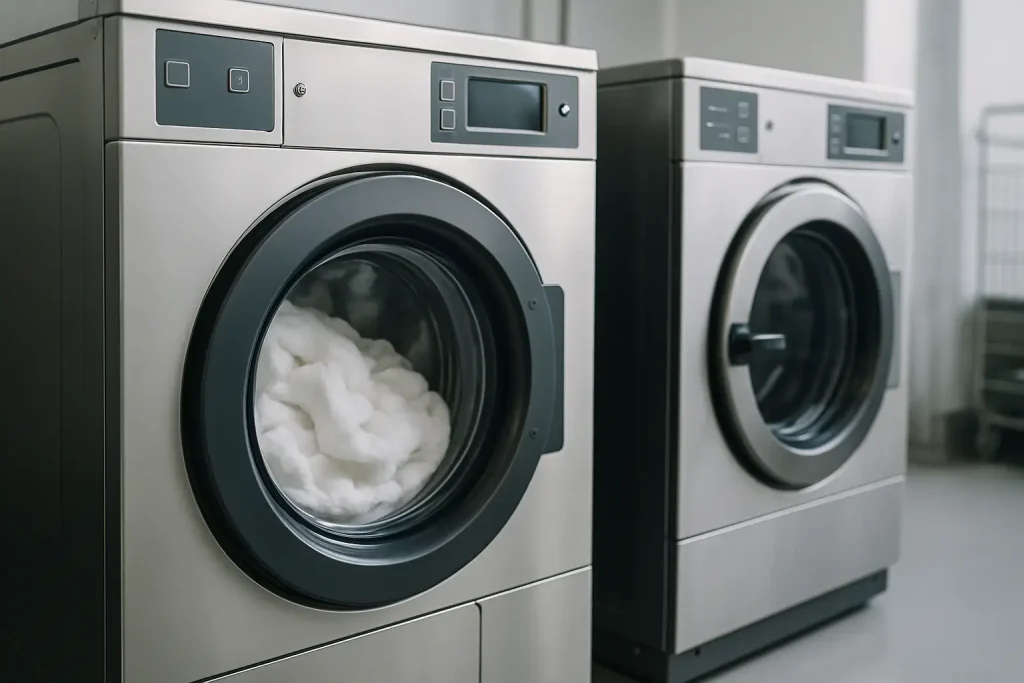
If you run a commercial laundry operation in the Gulf, you already know the real cost is not the machine – it is the hour your line is down, carts are backing up, and the next delivery window is getting missed. That is why “laundry equipments uae” is not a casual search term. It is usually a response to a capacity problem, an aging machine fleet, or a parts issue that is killing throughput.
This article is written for operators who buy equipment like they buy production insurance: for uptime, repeatable results, and parts compatibility. We will stay practical, because that is how procurement decisions actually get made.
Laundry equipments UAE: start with your production reality
Before you compare brands or price tags, get specific about the work your equipment must do. A hotel OPL room processing towels all day has a different load profile than a healthcare linen service with strict wash formulas, or a neighborhood laundromat that lives on quick turns and customer experience.
Three numbers matter more than any brochure feature. First is pounds per hour (or kilograms per hour) you must reliably process, not on your best day, but on your busiest day. Second is your peak-time constraint: when do loads hit the floor, and how many hours do you have to clear them? Third is your utility reality – electrical service, gas availability, ventilation, water pressure, and drainage. In the UAE and nearby markets, the answer often includes high ambient heat, tight plant rooms, and a need to control operating cost without sacrificing dry times.
If you size equipment only by “number of machines,” you end up with a room full of metal and a workflow that still bottlenecks at extraction or drying.
The core equipment categories that drive throughput
Commercial laundry is a line, not a collection of machines. Each category below affects the next one, and mismatches are where most “why are we behind again?” problems start.
Commercial washers and washer-extractors
For most operations, washer-extractors are the engine. Capacity is important, but so is extraction performance because it directly reduces dryer time. Higher G-force extraction generally means less moisture carried into the dryer, which is often the fastest path to higher throughput without adding more dryers.
The trade-off is that higher performance equipment can demand better installation, balancing, and maintenance discipline. If your floor, anchoring, and operating practices are not ready, you may not get the full benefit. For laundromats, cycle time and user-proof controls matter. For OPL and healthcare, programmability and repeatability matter, because inconsistency creates rewash – and rewash is hidden capacity loss.
Tumble dryers and stacked washer/dryer systems
Drying is where schedules get lost. Operators typically feel “we need more dryers” before they realize the upstream extraction or airflow is the real issue. Dryer selection should match three realities: textile mix, desired finish level, and ventilation constraints.
Stacked washer/dryer systems can be a smart choice when floor space is limited and you need more points of service. The trade-off is access and maintenance – stacked setups can be less convenient to service in tight rooms, and your layout has to allow safe access without slowing your team down.
Industrial heat-pump dryers
Heat-pump dryers are gaining attention in the region because they can reduce energy consumption and reduce the need for traditional exhaust ducting in certain setups. They are not a universal answer. They can be a strong fit where energy cost and ventilation limitations are the main pain points, or where you want a more controlled drying environment.
The “it depends” factor is load type and expectations around dry time. If you are processing heavy terry at high volume with strict dispatch windows, you need to evaluate whether cycle time aligns with your throughput targets. Heat-pump systems are worth considering, but they must be sized and specified to your production requirement, not selected because they are trendy.
Dry-cleaning equipment and finishing (when it applies)
If you run a mixed operation, finishing equipment can be the difference between a profitable garment workflow and a backlog that never clears. Even when your main search is “laundry equipments uae,” many buyers are really trying to solve end-to-end turnaround time. If garments are part of your service, think beyond wash and dry and plan the line so finishing does not become the choke point.
Don’t ignore the small stuff: consumables and spares keep the line moving
Most downtime is not caused by “major failure.” It is caused by a small part you did not stock, or a daily-use item you ran out of at the wrong time.
Marking tapes, fasteners, needles, laundry pens, and similar operational supplies sound minor until you are reworking identification, misrouting linen, or delaying delivery because sorting and labeling fell apart. In hospitality and healthcare, misidentification is not just an annoyance – it becomes a customer complaint and sometimes a compliance problem.
Spare parts are the same story. Belts, seals, valves, drain components, and wear items are predictable needs. If you can’t get compatible parts quickly, your “cost per cycle” turns into “cost per downtime hour.” Smart operators align their equipment purchases with a supply plan for the parts that keep those machines producing.
How to evaluate commercial brands without wasting time
Recognized commercial brands matter because they bring proven designs, known maintenance patterns, and established parts ecosystems. Names like Speed Queen, UniMac, Wascomat, and LaPauw are familiar in professional environments for a reason: operators want machines that are serviceable, not just impressive on day one.
When you compare options, ask direct questions that map to your operation:
Does the machine have controls your team will actually use correctly? A sophisticated control panel is only valuable if it reduces errors and rewash.
How accessible are common service points? Your maintenance team or technician should be able to reach what fails most often without turning a small repair into a half-day event.
What is the realistic lead time for common spare parts in your market? A strong machine with weak parts availability is not a strong solution.
What is the warranty support path and service expectation? You are not buying a consumer appliance. You are buying production capacity.
Sizing and layout: where many UAE installations win or lose
In the UAE and neighboring markets, laundry rooms often compete with other building priorities. That creates two common problems: equipment is placed where airflow is compromised, and service access is treated as optional.
A practical layout keeps clean and soiled flow separated, prevents carts from blocking machine doors, and gives technicians space to work. For dryers, airflow is non-negotiable. Poor ducting, restricted make-up air, and heat build-up will punish your dry times and increase wear.
Utilities planning is equally important. Underpowered electrical supply, undersized gas lines, or marginal drainage will show up as “machine issues” when the real problem is infrastructure. If you want predictable uptime, specify the room like a production area, not like a closet that happens to contain machines.
Buying strategy: new build, replacement, or capacity expansion
Most purchases fall into one of three situations, and each one should be approached differently.
If you are building a new operation, prioritize a balanced line. It is easy to overbuy washers because they are the most visible part of the process. Plan extraction and drying so the whole line moves at the same pace, and leave room for service access and future growth.
If you are replacing aging machines, focus on the real reason the old fleet is failing you. Is it breakdown frequency, inconsistent results, rising utility cost, or lack of parts? Replacement is your chance to standardize models, simplify parts inventory, and reduce operator error.
If you are expanding capacity, don’t default to “add one more of everything.” Sometimes the smartest move is upgrading extraction performance or adding drying capacity only, because that is where the bottleneck lives. A targeted expansion often costs less and improves throughput more.
Choosing a supplier: the single-source advantage
The most useful supplier is not the one who can sell a machine. It is the one who can keep your operation supplied across the full lifecycle: equipment, compatible spares, and the consumables that keep daily workflow clean and organized.
That is why specialized suppliers matter. A general equipment trader may quote a machine, but commercial laundry operators need continuity. When a belt fails, a latch breaks, or your team needs marking supplies today, you want one relationship that understands your environment and can support repeat purchasing without confusion.
If you want a procurement-friendly single-source approach for commercial laundry and dry-cleaning equipment plus recurring operational supplies, ABELCO EQUIPMENT TRADING LLC is built around that specialization – washers, washer-extractors, tumble dryers, stacked systems, heat-pump dryers, and the consumables and spare parts that protect uptime. You can see the product focus at https://Www.abelco.me.
What “good” looks like after the purchase
A smart equipment buy shows results in the first weeks, not the first year. Your team should see fewer rewash loads, faster dry times, smoother peak-hour flow, and less improvisation to keep up.
To keep those gains, treat your laundry equipment like a production system. Set basic preventive maintenance routines, stock the parts that fail predictably, and keep your consumables consistent so staff are not substituting “whatever is available.” If you manage uptime on purpose, your equipment stops being a constant problem and becomes what it should be: dependable capacity you can schedule against.
If you are searching “laundry equipments uae,” use that moment to buy for the outcome you actually need – not just the machine you can install the fastest. The right choice is the one that keeps your line moving on the days you cannot afford to fall behind.