

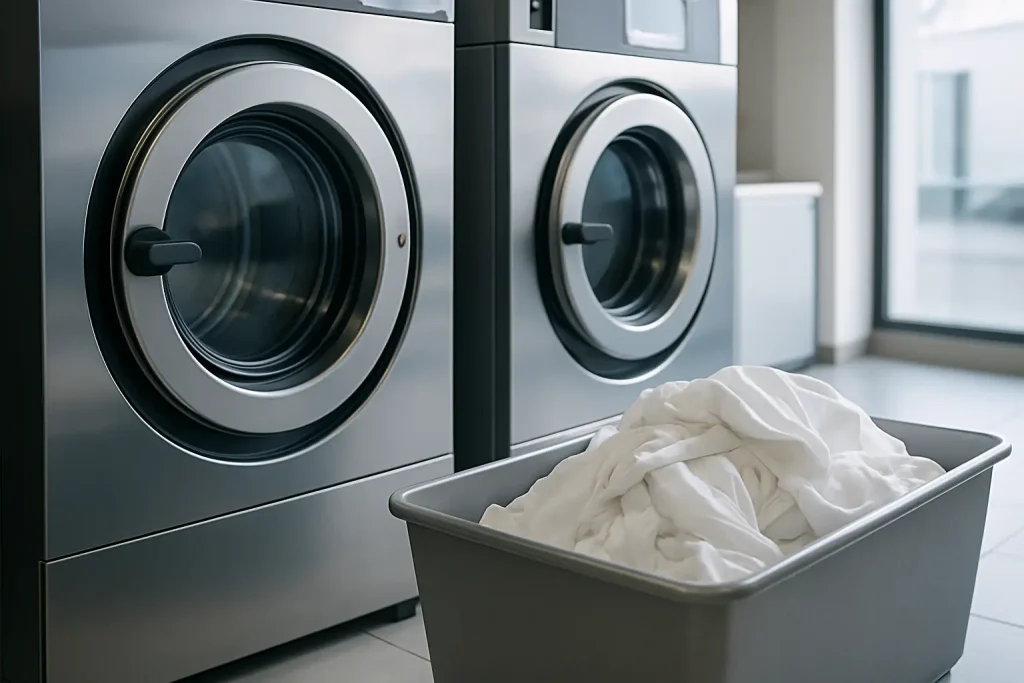
A hotel laundry hits a full stop at 6:30 p.m. because a door gasket fails. You can have staff, linen, and demand lined up perfectly and still lose the night on one small part. That is the real job of sourcing laundry equipments Qatar operations depend on: not just buying machines, but protecting throughput and uptime.
Qatar is a high-demand market for on-premise laundry – hospitality, staff housing, healthcare, and uniform programs all push consistent daily volume. When volume is consistent, “good enough” equipment decisions show up fast in labor hours, rewash rates, utility bills, and breakdowns. Below is the procurement-focused way to choose machines and the recurring supplies that keep production moving.
What “commercial-grade” needs to mean in Qatar
Commercial laundry isn’t defined by a stainless finish or a bigger door. It is defined by duty cycle, serviceability, and predictable results across hundreds of loads a week. In Qatar, the practical considerations tend to cluster into three areas.
First is operating temperature and ventilation. Equipment rooms can run hot, and poor airflow punishes dryers and any heat-sensitive electronics. You want units designed for continuous use, with sensible access to lint paths, filters, and service panels.
Second is linen mix. Hotels run a high percentage of flatwork plus towels. Healthcare leans into contamination control, higher water temperatures, and process consistency. Staff housing and multi-family sites see mixed, sometimes heavily soiled loads. Your machine selection should follow your dominant linen mix, not the other way around.
Third is continuity of parts and consumables. If you can’t get common wear items quickly, your “cheaper” purchase becomes expensive. Think door gaskets, drain valves, belts, ignition parts, bearings, and the small operational items like marking tapes and fasteners that keep identification and sorting clean.
Equipment categories that matter (and what to watch)
Commercial washers and washer-extractors
For most sites, washers are where quality is won or lost. The key decision is typically between lighter-duty commercial washers and true washer-extractors built for high G-force extraction. Higher extraction reduces dryer time, which reduces energy use and increases capacity without adding more dryers.
Capacity planning is where many buyers miss. A bigger machine is not automatically better if your workflow is built around batch sizes and carts. A balanced mix often works best: one or two larger units for sheets and bulky items, paired with mid-size units for towels and mixed loads. That mix keeps the day moving when one machine is down or when your linen profile changes by season.
Ask directly about: programmable controls for repeatability, chemical injection readiness if you automate dosing, and access for routine maintenance. If your operation runs multiple shifts, you are buying service access as much as you are buying wash performance.
Tumble dryers and stacked washer/dryer systems
Drying is where time disappears. If you are constantly waiting on dryers, it does not matter how fast your washers are. The procurement lens is simple: match dryer capacity to your washer extraction level and your expected moisture retention. High extraction typically allows you to dry faster and at lower heat, extending linen life.
Stacked washer/dryer systems can be a smart footprint play in staff housing, small on-premise rooms, or facilities where space is more expensive than equipment. The trade-off is flexibility: if one side goes down, you may lose a full stack position. In higher-volume commercial rooms, separate units can reduce bottlenecks and simplify maintenance scheduling.
Also treat lint management as a performance issue, not housekeeping. Easy-access lint screens, clear ducting layout, and a routine cleaning schedule will keep drying times stable and reduce fire risk.
Industrial heat-pump dryers
Heat-pump drying is a serious option when energy efficiency is a major priority or when venting is difficult. These systems can reduce heat loss and can be easier to place in certain building constraints. The trade-offs are real: higher upfront cost, more complex components, and the need for proper maintenance discipline to keep performance consistent.
If your operation runs long hours and energy is a meaningful line item, the payback can make sense. If your facility struggles to maintain basic lint and filter schedules, you may not get the efficiency you are paying for.
Finishing and specialty equipment
Not every operation needs the same finishing line. A hotel handling high volumes of sheets will evaluate finishing equipment differently than a dry cleaner or a uniform program. If you are considering finishing equipment, start with labor: how many hands are currently tied up folding or pressing, and what is your rewash or appearance rejection rate?
In many sites, upgrading wash quality and extraction first produces a cleaner, flatter dry that reduces finishing time. That can delay or reduce the scope of finishing purchases.
Specs that actually reduce downtime
When buyers ask for “the best machine,” the right response is, “Best for what constraint?” Uptime is usually constrained by a few predictable points.
Service access: You want easy front or side access to common components, clear diagnostic indicators, and controls that a technician can work with quickly. If every minor repair requires long disassembly, your downtime cost increases.
Parts commonality: If you standardize on a small set of models, you reduce the spare parts you must stock and the training burden for your team or service partner.
Controls and repeatability: Consistent results lower rewash. Lower rewash means fewer loads, less labor, less energy, and less mechanical wear.
Extraction and drying balance: Under-extracting forces dryers to work harder. Overloading dryers creates long cycles and inconsistent dryness that triggers rewashes or linen odor complaints.
Don’t ignore the “small” supplies: they protect throughput
Operators who run tight plants understand that accessories and consumables are not side purchases. They are the items that prevent sorting errors, lost garments, and stop-start production.
Marking tapes, fasteners, needles, and laundry marking pens support identification and tracking. If you serve uniforms, staff housing, or any program where garment ownership matters, misidentification becomes a hidden labor tax. It also becomes a customer satisfaction problem.
Spare parts are the other category that gets treated as optional until the first breakdown. The practical way to approach it is to identify your most common failure points and stock accordingly. For many operations, that means maintaining a small shelf of wear items that can turn a multi-day stop into a same-day fix.
How to plan capacity without overspending
Capacity planning is not a spreadsheet exercise alone. You are planning around peaks, labor, and the reality that equipment will be down sometimes.
Start with the peak day. Hotels have occupancy-driven spikes and event-driven surges. Healthcare can be steady but non-negotiable. Staff housing sees weekend surges. Build around your peak, then decide what you can buffer with scheduling.
Next, look at your labor flow. If your team can only load and unload at certain times, adding machines may not increase throughput. In that case, higher extraction, better programming, and fewer rewash cycles can do more than adding another washer.
Finally, accept that redundancy is not waste in commercial laundry. One extra mid-size machine can protect an entire operation when a primary unit is down. The cost of one machine is often lower than the cost of recurring downtime.
Brand selection: proven commercial lines beat “similar specs”
In commercial laundry, “similar specs” on paper can hide differences in bearings, frame strength, door assemblies, and control durability. This is where recognized commercial brands earn their keep. Names like Speed Queen, UniMac, Wascomat, and LaPauw are common in professional environments because they are built for repeat cycles and supported service networks.
That does not mean every premium option is right for every site. If your usage is moderate and your maintenance discipline is strong, you may not need the highest tier in every category. But if you run multiple shifts or you cannot tolerate downtime, paying for proven durability is often cheaper than paying for repeated repairs and disruptions.
Choosing a supplier: what procurement should demand
A supplier should reduce your procurement complexity, not add to it. The questions are straightforward.
Can they supply both equipment and the ongoing items that keep you running? Do they understand compatibility, so you are not stuck with the wrong part when time matters? Can they help you select models that match your linen mix and constraints rather than pushing what is easiest to sell?
If you want a single-source approach for commercial laundry and dry-cleaning equipment plus recurring operational items, ABELCO EQUIPMENT TRADING LLC is specialized in this space and supports operators across the Gulf – you can review their catalog at https://Www.abelco.me.
A practical buying approach for laundry equipments Qatar operations
If you are making a near-term purchase decision, keep it simple and operational.
Define your top constraint (space, energy, peak volume, labor, or downtime tolerance). Match washer extraction to dryer capacity so you are not creating a bottleneck. Standardize models where possible so parts and training stay manageable. Then build a small, intentional inventory of consumables and wear parts so minor failures do not become production stoppages.
The best laundry room is not the one with the most equipment. It is the one that runs predictably on the hardest day of the week – and keeps running when one part fails.