

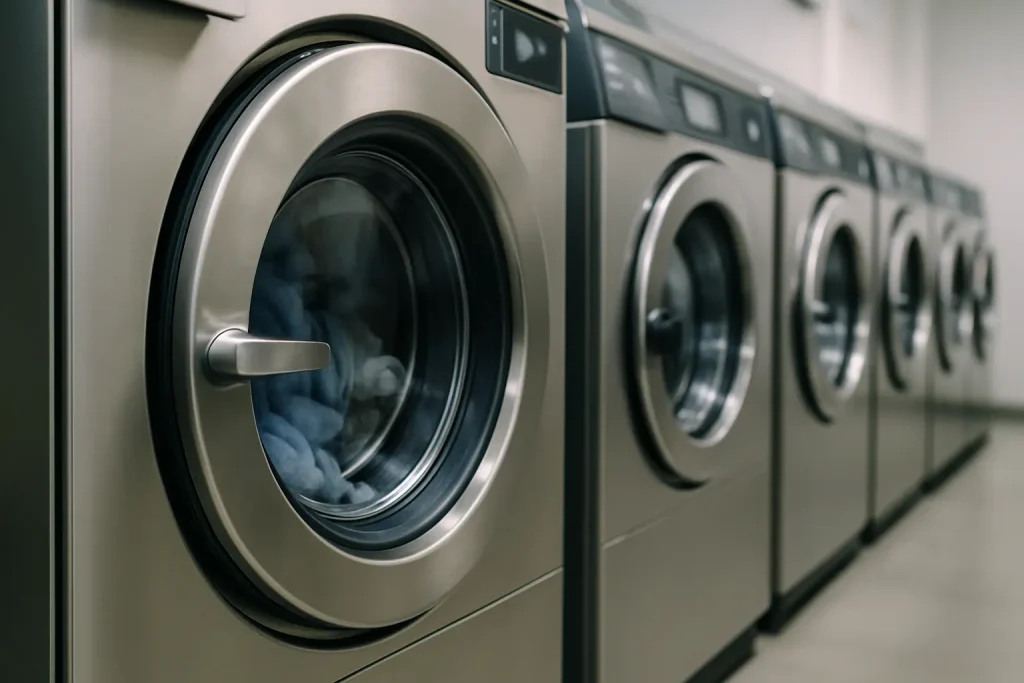
A washer that looks great on a spec sheet can still be the wrong choice once it hits a real floor – peak-hour queues, mixed soil loads, rushed attendants, and a maintenance log that never stays empty for long. Commercial laundry lives and dies by uptime. So when you’re shopping for machine washers, the question is not “What’s the best washer?” It’s “What washer keeps producing with my load mix, my staffing, my space, and my parts reality?”
What “machine washers” really means in commercial laundry
In professional settings, “machine washers” usually covers several categories that behave very differently once you start pushing volume.
A hard-mount washer-extractor is typically the productivity play. It’s built to anchor to a concrete base and run high-speed extraction, which reduces dryer time and helps throughput. A soft-mount (suspended) washer-extractor can be a better fit when your floor can’t support the same install requirements, or when vibration control is a priority.
Then there are traditional commercial top-load and front-load washers used in lighter-duty or smaller on-premise laundry rooms. They can be perfectly appropriate for a small hospitality backroom or a multi-family setup, but they won’t solve the same throughput problem as a true washer-extractor.
The mistake we see most often is buying by category name instead of by production requirement. If you’re handling sheets, towels, uniforms, spa items, or healthcare linen, your “washer” is part of a system. Wash speed, extraction, dryer match, and chemical compatibility all stack up.
Start with your throughput, not your budget
Budget matters, but if you begin with purchase price you usually pay later in labor, rewash, and downtime.
A practical way to think about sizing is pounds per hour, not pounds per load. If your operation peaks hard – weekends in a laundromat, morning turnover in a hotel, late-day rush in a dry cleaner – your washer needs to clear that peak without creating a permanent backlog. That usually means looking at (1) cycle time consistency, (2) extraction performance, and (3) how quickly loads can be staged and moved.
Capacity is only useful if you can actually fill it with the right goods. Oversizing a washer because “bigger is better” can hurt you when loads are small or mixed. Underloading large cylinders often leads to poor mechanical action and inconsistent results. On the other side, undersizing forces more starts per day, and starts per day are what grind components down.
If you’re expanding, think about future mix. Many laundromats add more bulky items over time. Many hospitality rooms shift from low occupancy to high occupancy seasonally. If that’s you, build in margin, but do it intentionally.
The machine washer specs that affect real operating cost
You can compare any two machines by price and capacity. The better comparison is what they cost to run when they’re doing your actual work.
Extraction speed and dryer impact
Higher extraction (higher G-force) pulls out more water. That does not just “save energy.” It reduces dryer cycle time and increases dryer availability. In busy operations, dryer availability is often the real bottleneck.
The trade-off is mechanical stress. Higher extraction can be harder on certain textiles and puts more demand on bearings, shocks, and balance. If you process delicate items or have highly variable loading, you want extraction you can control, not just maximize.
Water levels and chemical compatibility
Water consumption is a cost line, but it’s also a wash-quality variable. If your goods require strong flushing (think heavy soil, certain healthcare items, or anything where residual chemistry matters), ultra-low water approaches can backfire.
Chemical systems matter too. If you use on-premise dosing, confirm the washer’s injection ports and programming support your chemical supplier’s requirements. Compatibility problems show up as staining, odor retention, and increased rewash, which is the most expensive “cycle” you’ll ever run.
Cycle programming and controls
Controls affect training and consistency. A washer with flexible programming can be a major advantage if you run multiple goods types, but only if your team can actually use it.
If your turnover is high, simpler controls with locked programs may protect consistency. If you have a skilled operator or a disciplined process, advanced programmability can reduce rewash and improve finish quality.
Service access and parts continuity
This is where procurement-minded operators win. The cost of a machine washer is not just the unit. It’s the days you lose when a common component is unavailable.
Look for designs with straightforward access panels, common wear parts, and clear service documentation. Ask what parts are typically replaced in the first 12-24 months of heavy use and what the supply chain looks like. A machine that’s “efficient” but sits idle waiting on a component is not efficient.
Match the washer to the install reality
A machine washer can be perfect technically and still fail operationally if the install is wrong.
Hard-mount units demand a proper foundation. If your slab is not right, vibration increases, components wear faster, and customers notice the noise. Soft-mount units can reduce those issues, but they also have their own maintenance expectations.
Utilities are another common blind spot. Confirm your electrical, water flow, and drainage can support the planned equipment count at peak. Undersized drains and inconsistent water pressure cause slow fills and extended cycles, which quietly cuts capacity every hour of the day.
Space planning matters too. Door swing clearance, cart staging, and a clean route from washer to dryer can add or subtract loads per shift. If your staff is taking extra steps all day, you pay for that forever.
Picking machine washers by business type
Different sites fail in different ways. The “right” washer is the one that avoids your most likely failure mode.
Laundromats
Your priorities are cycle speed, customer perception, and ruggedness under unpredictable loading. Controls should be intuitive. Abuse tolerance matters. So does a supportable parts plan, because downtime shows up immediately as lost turns.
If you’re pairing with stacked dryer systems, make sure the extraction level and load sizes match what your dryers can clear without extending dry times.
Hospitality and on-premise laundry
Consistency and textile care rise to the top. A hotel laundry room that rewashes because towels smell “off” will burn labor and utilities fast.
Here, programmability and chemical integration can matter more than raw speed. You also want predictable maintenance intervals because you can’t afford a surprise shutdown during high occupancy.
Healthcare and linen services
Quality and process control are non-negotiable. You need reliable flushing, repeatable programs, and equipment designed for the load intensity. The wrong machine can increase rewash and create compliance headaches.
Also pay attention to door seal integrity, drain performance, and the ability to run the exact formulas you need without operator improvisation.
Brands and build quality: what to look for without overthinking it
Recognized commercial lines like Speed Queen, UniMac, Wascomat, and LaPauw are popular for a reason: they’re engineered for duty cycles that would destroy light-commercial equipment.
That said, brand alone is not a plan. Even within a brand, model families vary by controls, extraction capability, and service layout. The questions to ask are simple: What’s the duty rating? What does the warranty really cover? What are the common wear items, and how quickly can you get them?
If you’re building a store or upgrading a plant, standardizing across fewer model types can reduce training time and simplify your spare parts shelf. Variety feels flexible until the first time you’re down and realize each machine needs a different part.
Don’t forget the “small” items that protect uptime
A machine washer doesn’t operate alone. Marking tapes, fasteners, needles, and laundry pens sound minor until you’re losing items, misrouting linen, or slowing finishing because identification is inconsistent.
The same goes for keeping critical spares on hand. If your operation runs at high utilization, basic items like door gaskets, drain valves, belts (where applicable), and commonly replaced sensors can be the difference between a 30-minute fix and a multi-day disruption.
This is where a single-source supply approach simplifies life. If you’re already buying equipment, consumables, and compatible spare parts through one specialized partner, you reduce the back-and-forth that causes delays. ABELCO EQUIPMENT TRADING LLC focuses specifically on commercial laundry and dry-cleaning equipment and supporting supplies, which is why many operators use one supplier relationship for both machines and the items that keep them running day to day: https://Www.abelco.me
A practical buying process that avoids costly surprises
When you’re comparing machine washers, bring it back to operations.
First, define your load mix and peak-hour requirement. If you can’t state your throughput goal, you can’t verify a machine meets it.
Next, map the system. Washer extraction affects dryer capacity. If you upgrade washers without considering dryers, you can move the bottleneck and feel disappointed even after spending money.
Then verify install constraints early – floor, utilities, drainage, and access. This is where projects get delayed.
Finally, plan serviceability. Ask what the expected maintenance points are and what parts you should stock. A serious operation treats spare parts the way it treats detergent: as a continuity item, not an emergency purchase.
A helpful closing thought: buy machine washers the way you schedule production – for the worst day you regularly face, not the average day you wish you had.