

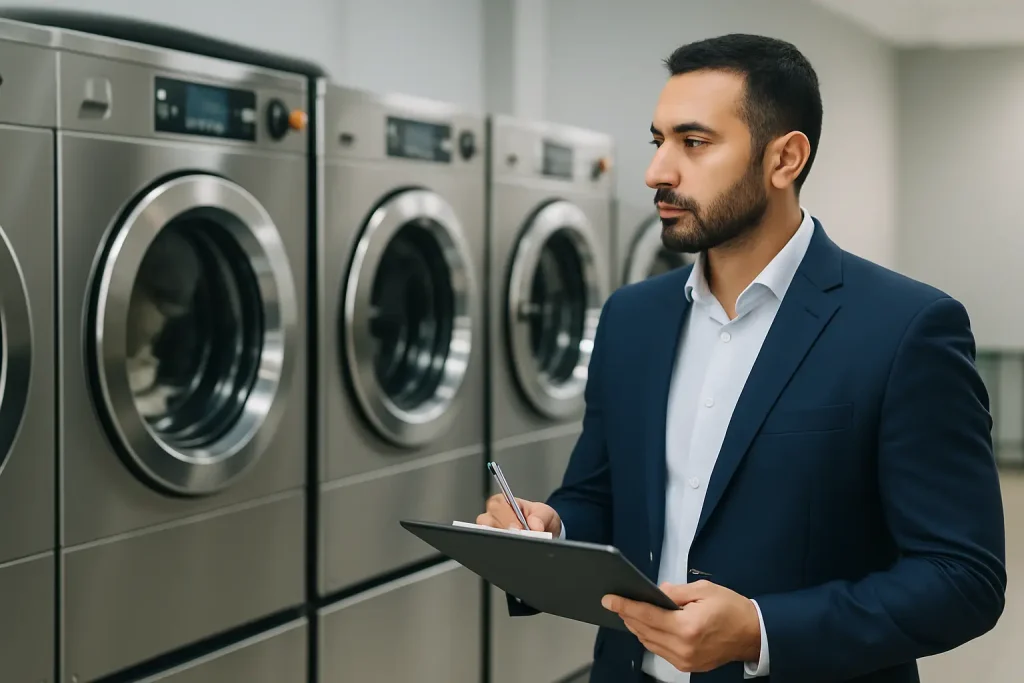
A commercial laundry doesn’t fall behind because the team forgets how to wash linen. It falls behind because a dryer goes down on a Thursday, a belt or valve isn’t available, and your whole weekend throughput turns into a backlog.
That’s why choosing among commercial laundry equipment suppliers in uae is less about who has a glossy brochure and more about who can keep your operation moving – with the right machines, the right parts, and a supply chain that holds up when the pressure is real.
What “supplier” should mean in a working laundry
In a professional environment – hotel OPL, healthcare linen, uniform service, multi-housing laundry room, or a busy laundromat – your “equipment supplier” is effectively part of your uptime plan.
A supplier worth keeping is one that helps you match equipment to your load mix (towels vs. sheets vs. uniforms), your utility realities (power, ventilation, gas availability), and your staffing. They also keep you out of compatibility trouble later by steering you toward machines and parts you can actually maintain. The cheapest quote can become the most expensive decision if it leads to slow cycles, constant stoppages, or parts that take weeks.
In the UAE and wider Gulf region, another layer is lead time certainty. Your cost of downtime is immediate. Your replacement machine delivery might not be.
Start with your throughput, not the model number
Most purchasing mistakes happen when someone buys by capacity on paper instead of production per hour in real life. A washer-extractor that looks right in kilograms can still bottleneck you if cycle times are long, if it can’t hit extraction speeds consistently, or if the dryer side can’t keep up.
A practical supplier conversation starts with three numbers: pounds or kilograms per day, peak-day surge, and your required turnaround window. From there, the supplier should work backward into a layout that balances washer capacity, extraction performance, drying capacity, and finishing or folding flow (even if you don’t buy finishing equipment today).
This is where “it depends” matters. A hotel with recurring towel loads may be better served by multiple smaller machines that keep staff moving and reduce single-point failure risk. A plant doing mixed linen with batch sorting may favor larger washer-extractors that reduce handling.
Equipment categories that matter for UAE buyers
Most commercial laundries evaluating suppliers are really choosing a long-term platform of equipment types. If your supplier can’t support the platform, the brand label alone won’t save you.
Commercial washers and washer-extractors
You’re buying three things: mechanical durability, programmability that matches your chemistry and textiles, and extraction that reduces dry time. Better extraction often costs more upfront, but it can lower drying time and reduce heat exposure to linen.
Ask suppliers how they size extraction for your operation and what failure points they see most often in the field. You’re listening for practical answers: seals, bearings, drain valves, door locks, and control components.
Tumble dryers and stacked washer-dryer systems
Dryers are where utility and installation details become expensive. Venting, make-up air, gas type and availability, and maintenance access all matter. Stacked systems can be a smart footprint play for laundromats or space-limited OPL rooms, but stacking also concentrates production into fewer physical units – great for space, not great if you’re running at the edge of capacity and one stack goes down.
A good supplier will ask about your peak-hour loads and whether you need redundancy.
Industrial heat-pump dryers
Heat-pump drying is often considered when energy costs or ventilation constraints are significant, or when operators want gentler drying for specific textiles. The trade-off is that heat-pump systems can be more sensitive to maintenance and operating conditions. They can be a strong fit, but only when the supplier can support the technology with parts, filters, and service guidance.
The real differentiator: parts and consumables continuity
Here’s the blunt truth: every commercial laundry becomes a parts buyer.
So when you evaluate commercial laundry equipment suppliers in uae, don’t treat spare parts as a “later” problem. Treat them as a contract you’re signing with your future self.
A capable supplier should be able to support fast-moving parts and common wear items, and they should understand brand compatibility. If you’re running recognized commercial lines, you want a supplier that can speak clearly about what is stocked, what is ordered, and what the typical replenishment lead times look like.
Consumables matter just as much, especially for facilities that mark, sort, and track large volumes. Items like marking tapes, fasteners, needles, and laundry pens are small, but they keep identification systems consistent and reduce loss. If you’re forced to source these separately every month, procurement becomes noisy, and operators start improvising.
The operational win is a single-source supply relationship where machines, consumables, and the parts that keep them running are aligned.
Brand lines: why recognized commercial platforms help
Many buyers already have a preference – or a painful history. Recognized commercial platforms like Speed Queen, UniMac, Wascomat, and LaPauw are often chosen because operators can find knowledge, parts pathways, and predictable performance.
That does not mean every site needs the same brand. It means you should choose a platform your supplier can truly support. If a supplier can sell a machine but can’t support the control board, door gasket, drain valve, or critical safety components quickly, you’re not buying a solution – you’re buying a future delay.
When comparing brands, don’t just ask “what’s best?” Ask “what can you keep running without drama for the next five to ten years?” In a production environment, that’s the question that matters.
Questions that quickly reveal supplier quality
You don’t need a long RFP to separate strong suppliers from weak ones. You need a few operational questions, answered directly.
Ask what they stock locally versus what they order. Ask which parts fail most often on the equipment you’re considering and whether those are regularly available. Ask what information they need from you to avoid mis-sizing – and see if they request basics like load type, turnover times, utility constraints, and space.
Also ask how they handle compatibility. If you’re adding machines to an existing fleet, you want programming and parts pathways that don’t create a maintenance split-brain. Mixed fleets can work, but they require more discipline, more training, and more inventory.
Lead time, installation realities, and serviceability
In the UAE, the “buy” decision is frequently constrained by what can be delivered and installed on schedule.
A supplier should talk plainly about lead times and what can change them. They should also ask about access to your laundry room – door widths, elevator limitations, floor loading, drainage, and ventilation routes. These details are not glamorous, but they decide whether your installation is smooth or painful.
Serviceability is another area where experienced suppliers think differently. If a dryer is wedged into a corner with no access panels reachable, routine maintenance becomes neglected maintenance. Neglected maintenance becomes failure. A supplier that understands laundry environments will push for layouts that allow cleaning, inspection, and safe servicing.
Procurement math: purchase price vs. cost per processed pound
If your operation is busy, the purchase price is rarely the biggest number over the life of the equipment. Utilities, labor time per load, chemical efficiency, and downtime typically decide your true cost.
Higher extraction can cut drying time. Faster, consistent cycle programming can reduce rewash and operator intervention. Better parts availability can reduce downtime from days to hours. Those savings don’t always show up in the initial quote, but they show up on your production board.
At the same time, not every facility needs premium specs. If you run moderate volume with flexible turnaround, a simpler configuration can be the smart buy. The right supplier will match the spec to the reality, not oversell you into complexity.
When a “single-source” supplier is worth it
Some operators prefer to split purchasing: one vendor for equipment, another for parts, another for consumables. It can work, but it adds friction – more invoices, more compatibility risk, and more time spent chasing items when you should be running production.
Single-source makes sense when uptime matters and when your team needs a consistent stream of consumables and spares without procurement delays. It also simplifies accountability: one supplier relationship, one set of product knowledge, one place to call when a machine is down and you need the right part fast.
If you’re looking for a specialized supplier that supports both heavy-duty machines and the day-to-day operational items that keep a plant organized, ABELCO EQUIPMENT TRADING LLC is built around that exact reality – commercial laundry and dry-cleaning equipment, plus the consumables and spare parts laundries reorder constantly. You can see the product categories at https://Www.abelco.me.
Closing thought
Choose a supplier the same way you choose a machine: by what it does on your hardest day. The right supplier keeps your laundry predictable – not perfect, but controlled – with equipment you can maintain, parts you can get, and consumables that never become a weekly scramble.