

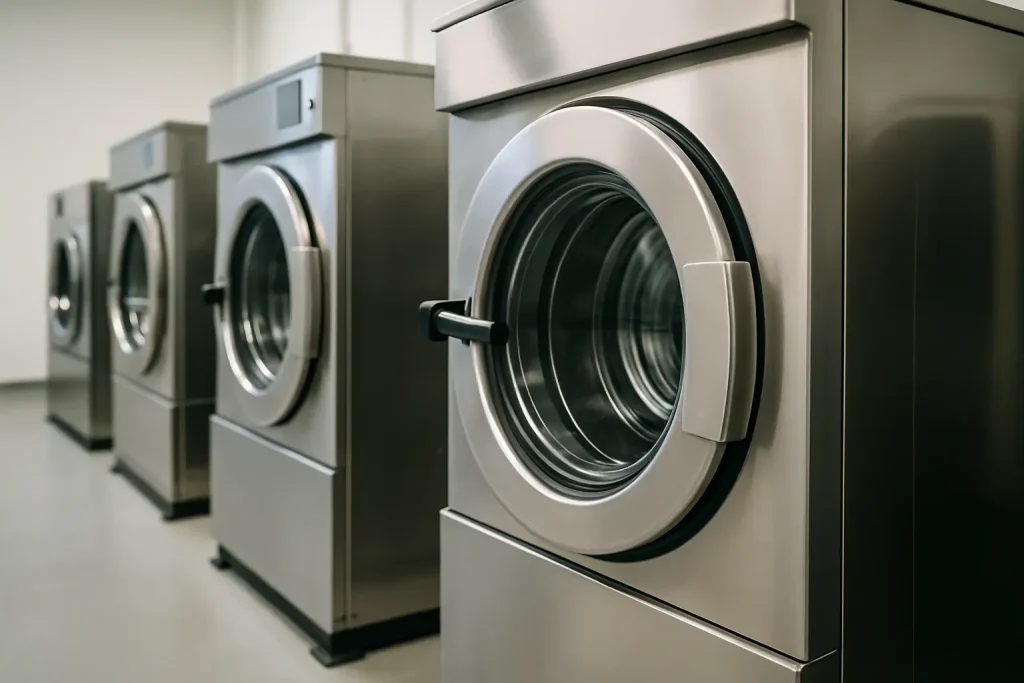
A Milnor machine usually shows up on your radar when your laundry stops being “a room with washers” and starts being a production line. If you are running hotel linen, healthcare goods, uniforms, or a serious on-premise operation, the conversation changes fast: cycle consistency, water heating, extract G-force, and serviceability start to matter more than brochure features.
Milnor is one of the names that comes up in that stage because the brand is built around industrial throughput. But “milnor” is not automatically the right answer for every plant. The right answer depends on your load profiles, staffing, utilities, and how you plan to maintain equipment over years, not months.
What people mean when they say “milnor”
Most buyers are talking about Milnor washer-extractors and related industrial laundry equipment designed for continuous, high-volume work. In practical terms, that often means larger-capacity washer-extractors with heavier frames, strong extraction performance, and controls intended for repeatable results across multiple shifts.
Operators tend to consider Milnor when they have one or more of these realities:
You run a central laundry with scheduled pickups and drop-offs, and missed turns create a backlog that lasts all week. You process high soil goods that need consistent chemistry and mechanical action. Or you are trying to consolidate multiple smaller machines into fewer, larger units to reduce labor touch points.
Where Milnor fits best (and where it does not)
Milnor typically makes the most sense when your operation is throughput-driven and your cost of downtime is high. If one machine going down forces overtime, rental linens, or missed SLA windows, industrial-grade builds start paying for themselves.
You also see Milnor in facilities that want predictable outcomes. When you are processing similar goods repeatedly – sheets, towels, patient gowns, food and beverage napery – repeatability is not just “nice.” It is how you control rewash, drying time, and customer complaints.
Where Milnor may be less compelling is in environments that need extreme flexibility in small batches or where utility constraints are tight. A small dry cleaner with highly varied loads or a micro-laundromat focused on customer-facing equipment may be better served by other commercial platforms that optimize for mixed use, footprint, and simpler in-house maintenance.
It also depends on who will service the equipment. Industrial machines are maintainable, but they reward planned maintenance. If your operation is set up to react, not schedule, you will want to factor that into the purchase decision.
The practical benefits operators actually feel
The best reason to buy any industrial washer-extractor is not a logo. It is what the machine changes about your day.
Higher extraction can shorten drying times, which means dryers become less of a bottleneck. But this only helps if your goods can tolerate the mechanical action and if your finishing area can keep up. If your ironer, folder, or press stations are the true constraint, extraction improvements may not move the needle as much as you expect.
A heavier-duty build can reduce vibration-related issues and premature wear. Over the long run, that can translate to fewer “mystery” shutdowns and less time chasing leaks, imbalance faults, and loosening hardware.
Controls and programmability matter when you are scaling shifts or training new staff. The value is not fancy screens. The value is having the right formulas saved, locked, and repeatable so outcomes do not depend on which operator is working that day.
The trade-offs to be honest about
Industrial equipment tends to be more demanding on planning. Installation requirements can be stricter, especially around foundations, anchoring, drainage, and utilities. If you are retrofitting an older building, you may need to validate floor loading and utility capacity before you commit.
Parts strategy also becomes more important. With lighter commercial machines, some operators gamble on “we’ll get parts when we need them.” With industrial production, that approach can get expensive quickly. Even if parts are available, shipping time and technician scheduling can turn a minor issue into real downtime.
Finally, capacity cuts both ways. A larger machine is efficient when you can fill it properly. If your workflow produces partial loads all day, a big cylinder can cost you in water, chemical consumption, and labor handling without delivering the throughput you expected.
What to check before you buy Milnor
Start with your goods mix and your peak day. Do not average your volume across the week. Size equipment for the day that breaks you, because that is the day that drives overtime and customer complaints.
Then validate your utilities. Water pressure, water heating capacity, gas supply (if applicable), electrical service, and drainage are not details. They are often the difference between the performance you were sold and the performance you live with.
If you are comparing Milnor to other commercial platforms, ask for clarity on real-world cycle times for your goods type, not generic cycle charts. A “45-minute cycle” can become 60+ minutes if your water heating cannot keep up or if your drain configuration slows down steps.
Also clarify service expectations. Who will be responsible for routine maintenance? Do you have staff that can handle belts, seals, valves, and basic troubleshooting, or will you rely on outside technicians? Neither answer is wrong, but it changes how you plan spares and how you budget.
New vs. used Milnor: a procurement decision, not a gamble
Used Milnor equipment can make sense when you have a strong inspection process and you are realistic about refurbishment costs. In high-volume operations, a used machine that is down two days a month is not “a deal.” It is a production problem.
If you consider used, focus on the components that drive downtime: bearing condition, basket and shell integrity, door seal condition, drain valves, motor and inverter health, and control reliability. Cosmetic condition matters far less than evidence of leaks, vibration, and intermittent faults.
New equipment can be the safer path when uptime is mission-critical or when you are building a plant that must perform immediately. The extra cost is often justified by reduced uncertainty and a cleaner maintenance baseline.
Planning for uptime: parts, consumables, and the small stuff
Milnor machines are industrial, but your uptime is often decided by non-industrial details. A missing seal, a worn gasket, the wrong marking tape, or inconsistent load identification can create rewash and sorting errors that look like “equipment problems” on the dashboard.
Operators who run reliable plants treat parts and consumables as a system. That includes critical spares for the machines, but also day-to-day items like marking and identification supplies that keep goods routed correctly. When you are processing multiple customers or departments, labeling discipline is an uptime strategy.
If you want one supplier relationship that covers both heavy equipment and the recurring operational items that keep production steady, ABELCO EQUIPMENT TRADING LLC focuses specifically on commercial laundry and dry-cleaning operations, including professional machines and the consumables and spare parts operators reorder to protect uptime.
How to compare Milnor to other commercial brands
If you are putting Milnor side-by-side with other recognized commercial laundry brands, keep your evaluation grounded in your workflow.
Ask which platform is easiest to keep running in your environment. That includes access to parts, technician familiarity, and how tolerant the machines are of real operator behavior like occasional overloads or uneven loading. Some operations have excellent discipline and training; others have turnover and variable skill levels. Your equipment choice should match reality.
Pay attention to extract performance relative to your dryer capacity. If you improve extraction but your dryers are older or undersized, you will still bottleneck. Sometimes the best investment is a balanced system: washers, dryers, and finishing equipment that move at compatible speeds.
Finally, consider controls and recipe management. The goal is not complexity. The goal is repeatability with minimal operator judgment calls.
Making the decision with confidence
Milnor is a serious option when you are managing laundry as production. If your priority is consistent results, strong throughput, and equipment that is built to work, it belongs in the conversation.
The smartest buyers do not start with a brand. They start with a constraint: where time is lost, where rewashes happen, where labor is touched too many times, where utilities cap performance, and where downtime costs the most. Once you name that constraint clearly, the right Milnor configuration – or a different commercial platform – becomes much easier to justify.
If you want a simple rule to keep your decision honest, use this: buy the machine that you can support. The best capacity on paper is not the best capacity in your plant if parts, maintenance habits, or utilities cannot keep up. Make the support plan first, then the equipment choice becomes straightforward.