

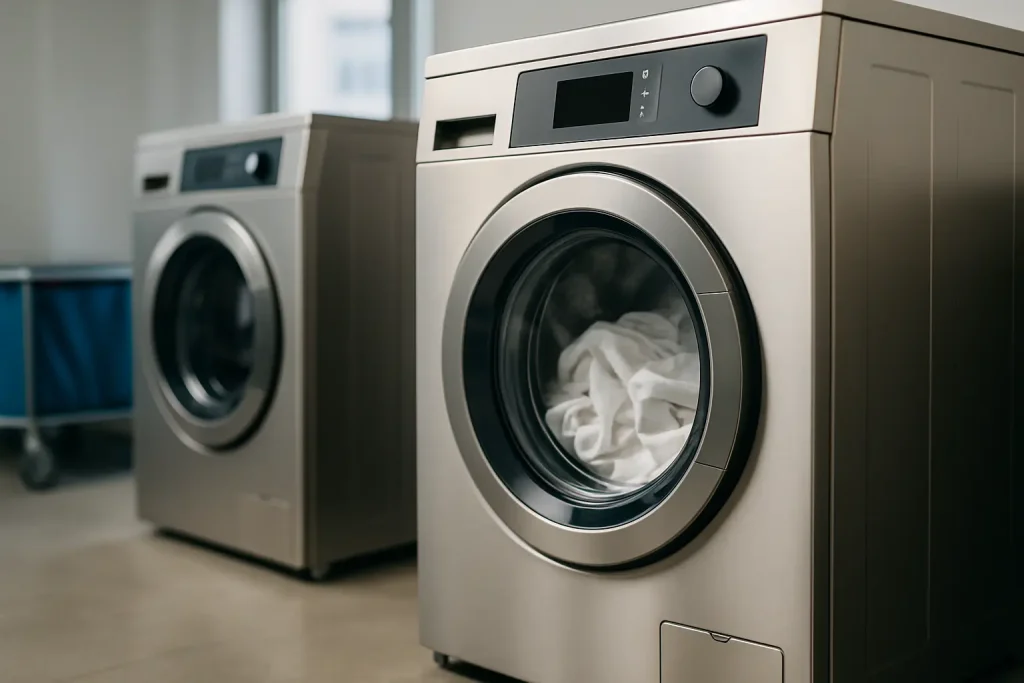
A laundry washing machine that looks “fine on paper” can still cost you money every day it’s on the floor. The giveaway is usually not the purchase price – it’s the bottlenecks: slow turns, wet loads waiting on dryers, nuisance faults, hard-to-source parts, or a drum size that never matches what you actually wash.
Commercial laundry operators don’t need hype. They need predictable throughput, manageable utility costs, and equipment that can be serviced without turning the plant into a troubleshooting project. Here’s how to think about choosing, sizing, and supporting a laundry washing machine in a way that protects uptime.
What “commercial” means in a laundry washing machine
In professional environments, “commercial” is not just heavier steel. It’s a mix of duty cycle, control flexibility, and serviceability. A true commercial washer or washer-extractor is built to run all day with consistent mechanical action, repeatable programming, and components that are meant to be replaced, not treated as disposable.
If your operation is a laundromat, you’re balancing vend price, cycle time, and customer experience. In hospitality or healthcare, you’re balancing turnover, rewash prevention, and textile life. In all cases, you’re buying outcomes: pounds per hour, water and energy per pound, and minutes of downtime per month.
Washer vs washer-extractor: the decision that affects your dryers
A standard commercial washer cleans. A washer-extractor cleans and then pulls more water out at high G-force. That extraction step is where many operations win or lose capacity.
Higher extraction reduces dryer time, and dryer time is often the true constraint in a plant. If you regularly see carts queuing at dryers, you can sometimes increase total production more by improving extraction than by adding a washer.
The trade-off is that higher-speed extraction increases demands on installation. Floor and anchoring matter, and the machine has to be matched to the building. If you’re retrofitting a site with questionable slab thickness or vibration concerns, you may choose a lower-G configuration or a soft-mount design and accept slightly longer drying times. It depends on your building and your mix of goods.
Sizing: stop buying “capacity,” buy pounds per hour
Rated capacity is easy to compare and easy to misuse. What you want is a realistic pounds-per-hour target based on your operating window.
Start with the goods you process most: sheets, towels, uniforms, mop heads, healthcare linen, or mixed loads. Dense goods behave differently than bulky goods. A machine that is technically “bigger” may not turn faster if your load type limits fill level or requires extra flushes.
A practical way to think about sizing is to map three realities:
- Your true average load weight, not the maximum.
- Your average cycle time for the goods that matter.
- Your extraction level and how it influences dryer minutes.
When those three align, the plant flows. When they don’t, you end up with underloaded washers (wasted utilities) or overloaded washers (rewash, poor mechanical action, and longer cycles).
Utilities: water, heat, and drain capacity decide operating cost
Utilities are where “cheap” equipment becomes expensive.
Water consumption is not just a sustainability line item – it’s a direct cost, plus chemical use, plus time to fill and drain. In many regions, water is manageable but heat is not. If your incoming water is cold or your hot water system is undersized, cycle times stretch and chemistry drifts.
Drain capacity is a common hidden constraint, especially in retrofits. If multiple machines dump at once and the drain cannot keep up, you see slow drains, faults, and extended cycle times. That’s not a “bad machine” problem. It’s an infrastructure mismatch.
If you’re making decisions across sites in the Gulf region (UAE, Oman, Qatar, Bahrain, Kuwait, Saudi Arabia), utility profiles can vary sharply by building and by local cost structure. The right answer in a hotel basement is not always the right answer in a stand-alone laundromat.
Controls and programming: consistency beats complexity
Modern commercial controls can store multiple formulas, manage water levels, control chemical injection signals, and log faults. That’s valuable – if it supports repeatability.
If your staff turnover is high, overly complex programming can create variability. You want a control interface that operators can run correctly every shift. Consistent wash quality reduces rewash, and rewash destroys throughput.
For laundromats, the “programming” conversation is different. You care about vend options, cycle appeal, and reliability of coin or card integration. You also care about how fast the machine returns to ready state and how cleanly it handles out-of-balance events.
Match the machine type to the job
The biggest operational wins usually come from matching machine style to the workload, not from chasing the newest feature.
Front-load washers and washer-extractors
Front-load platforms dominate professional use because they support high extraction and predictable mechanical action. They’re a strong fit for OPL (on-premise laundry) in hospitality, multi-family housing laundry rooms, and most commercial facilities that want controlled wash quality.
Hard-mount vs soft-mount
Hard-mount machines can be very stable and efficient when installed on the right foundation. Soft-mount machines help when you don’t have the ideal slab or when vibration isolation matters. The correct choice is usually building-driven. If you guess wrong, you pay for it in vibration complaints, premature wear, and service calls.
Stacked washer/dryer systems
Stacked systems can be a smart way to add capacity in tight spaces. They are not a magic solution if your operation is already dryer-limited, but in many laundromats and small OPL sites, stacking improves revenue per square foot and keeps the floor plan simple.
Tumble dryers and heat-pump dryers
Dryers don’t wash, but they decide your finishing speed. If energy costs are a concern or venting is a constraint, commercial heat-pump dryers can be worth evaluating. They are not ideal for every textile mix, and they can change cycle expectations, but for certain facilities they deliver meaningful cost control.
Brands and parts: the uptime question buyers forget to ask
A commercial laundry washing machine is only as profitable as its parts pipeline.
Operators tend to focus on the machine itself and treat parts as an afterthought. In reality, your best maintenance plan assumes you will replace wear items on schedule: belts, bearings, seals, door gaskets, valves, and sensors. When those parts are hard to source or compatibility is unclear, downtime stretches.
This is where working with recognized commercial lines helps. Brands like Speed Queen, UniMac, Wascomat, and LaPauw have established service ecosystems, and technicians are familiar with them. Familiarity reduces diagnostic time. Availability reduces idle time.
Just as important: standardizing across your floor can reduce your spare parts inventory. If you run three different control families and four different valve types, you’ll either overstock or you’ll be waiting on shipments. Neither one is good for production.
Consumables that keep production moving (and reduce rework)
Professional laundry performance is not only equipment. A lot of downtime is self-inflicted through missing small items.
Marking and identification supplies matter in dry cleaning and uniform programs. When garments can’t be identified cleanly, you burn labor on sorting and you risk claims. Items like marking tapes, fasteners, needles, and laundry pens are inexpensive, but they protect workflow.
The procurement advantage is simple: buying machines without lining up ongoing consumables creates avoidable friction. A single-source approach can reduce the number of vendors your team has to chase when something runs out midweek.
A practical buying checklist for the next machine
Before you sign off on the next unit, make the conversation operational. You’re not buying a box. You’re buying capacity.
Ask what your real constraint is today: washer turns, dryer minutes, operator handling time, or finishing. Then look at the machine through four lenses: capacity match to load type, extraction match to dryers, utility match to building, and service support match to your maintenance reality.
If you’re replacing an existing unit, look at why the old one disappointed. If it failed mechanically, ask what caused it: out-of-balance abuse, chemical overfeed, poor drain, scale, overheating, or simply end-of-life. If it didn’t fail but never met output, the issue was likely cycle design, load discipline, or a mismatch between rated and real capacity.
Where Abelco fits for commercial operators
If you want a single supplier that understands professional laundry environments – not just equipment, but also the recurring accessories and spare parts that protect uptime – ABELCO EQUIPMENT TRADING LLC focuses specifically on commercial laundry and dry-cleaning operations with a curated mix of machines and day-to-day operational supplies.
The point is not to “shop around forever.” The point is to keep your floor producing, with equipment that can be supported and consumables that don’t surprise you.
Closing thought
The best laundry washing machine is the one your team can run consistently, your building can support comfortably, and your maintenance plan can keep in motion without heroic effort. Buy for the week your plant is busiest, not the week it’s quiet.