

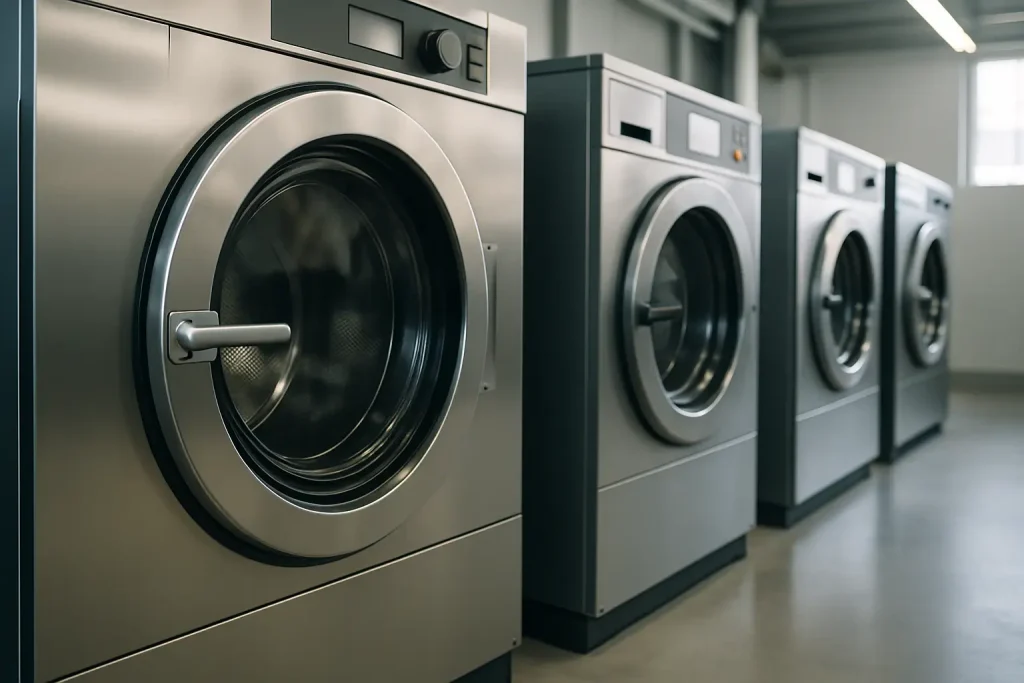
A machine that’s down for half a day doesn’t just “miss cycles.” It backs up carts, delays room turns, burns labor, and forces bad decisions like running smaller loads just to catch up. That’s why buying an industrial laundry machine is rarely about the sticker price. It’s about predictable throughput, serviceability, and getting the right parts fast when something wears out.
This practical guide is written for operators who run laundry for a living – laundromats, hospitality, healthcare, multi-family, and on-premise plants. The goal is simple: help you choose equipment that keeps production moving and avoids the common mismatches that cause chronic bottlenecks.
What “industrial laundry machine” should mean in your facility
In commercial laundry, “industrial” isn’t a vibe. It’s a set of expectations: higher duty cycle, heavier components, better extract performance, and designs meant to be maintained instead of replaced. The right machine for you depends on your workflow and fabric mix.
A laundromat with steady walk-in traffic typically needs fast turns, durable door systems, and controls that are easy for customers and attendants. A hotel OPL cares about consistent finish quality, simple programming, and utilities cost. A healthcare linen operation cares about soil separation, high extract G-force, and process control.
If you’re buying “industrial” but still treating it like light commercial, you’ll feel it in two places first: labor and downtime.
Start with your bottleneck: wash capacity or dry capacity
Most facilities think they need “a bigger washer.” Often they actually need balanced drying. Washers create wet pounds. Dryers need time and heat to remove moisture, and the dryer is frequently the limiter.
A useful way to think about it: if your washers can finish loads faster than your dryers can clear them, you’ll build a wet-linen queue. That increases handling, raises rewash risk, and invites shortcuts like overdrying one load while another waits.
Match your mix so washer-extractor output has a clear path to drying. High-extract machines can let you reduce dryer time, but only if your dryers can handle the airflow and your staff loads them correctly.
Types of industrial laundry machines and when each fits
Commercial washers vs. washer-extractors
For professional operations, washer-extractors are the workhorse. They’re designed for frequent cycling and higher extraction speeds, which reduces dryer time and lowers gas or electric consumption. They also tend to be easier to service over the long run because they’re built around wear parts you expect to replace.
A conventional commercial washer can still make sense in small OPL settings with lighter use, but if you’re processing high volume, heavy goods, or you need aggressive water removal, washer-extractors are where you want to be.
Soft-mount vs. hard-mount
Soft-mount machines reduce floor requirements because they use a suspension system. They’re common in many commercial applications, especially where installing a heavy foundation is not practical.
Hard-mount machines require a proper foundation and anchoring, but they reward you with stability at high loads and high extract. They’re often chosen for institutional environments and larger plants where the building is designed to support them.
This is a clear “it depends” decision. If your building can’t take the foundation work or you’re retrofitting a tight space, soft-mount may be the right call even if hard-mount is attractive on paper.
Tumble dryers, stacked systems, and heat-pump dryers
Tumble dryers are straightforward: large drum, strong airflow, predictable results. They’re the default choice in many laundromats and OPL rooms because technicians know them and parts support is generally good.
Stacked washer/dryer systems can be a smart move when square footage is expensive. They also simplify traffic flow. The trade-off is service access and capacity flexibility. If one component is down, you lose the stack’s productivity.
Industrial heat-pump dryers can reduce energy consumption and help in locations where venting is difficult or where you want tighter control over heat. The trade-off is that heat-pump systems are more specialized. You want to be confident in the parts pipeline and technician familiarity before you standardize.
Sizing: pounds, turns, and the “real” load
Capacity labels are not the same as real throughput.
A 30 lb machine only delivers 30 lb output when the load is appropriate for the fabric type, the goods can tumble properly, and your team loads consistently. If you regularly process thick terry, microfiber mops, or heavy mixed goods, the practical load may be lower. Overloading increases mechanical stress, reduces wash quality, and can leave goods too wet even if the cycle completes.
The sizing conversation should be grounded in three numbers: average pounds per day, peak-hour demand, and target turnaround time. If you can’t answer those, you’re guessing – and guessing is expensive.
Utilities: where operating cost is won or lost
An industrial laundry machine is a utilities decision as much as a hardware decision.
Water levels and fill times affect cycle length. Steam or gas availability affects dry time and finish. Electrical service affects what you can install without costly upgrades. Venting and makeup air determine whether dryers perform to spec.
High-extract washer-extractors can lower dryer energy, but watch the full system: a faster washer with no dryer capacity behind it can raise labor and force overtime. The cheapest energy is the cycle you don’t have to re-run, so prioritize repeatable wash quality and avoid settings that create rewashes.
If you’re considering heat-pump drying, look at ambient conditions, lint management, and how your staff maintains filters. Heat-pump performance depends on consistent airflow and clean heat exchangers.
Controls and programming: keep it simple, keep it consistent
Advanced controls are useful when they standardize outcomes across shifts and operators. They become a problem when they invite constant “tweaking.”
For laundromats, intuitive controls reduce user errors and service calls. For OPL and healthcare, locked programs help keep chemistry, temperature, and mechanical action consistent. Consistency protects linen life and reduces rewash.
If your team frequently overrides programs, it’s usually a sign the programs don’t match your goods mix or your water heating and fill times aren’t stable. Fix the process, not just the screen.
Serviceability: the most overlooked spec
Ask two practical questions before you choose any industrial laundry machine:
Can a technician access the parts that wear out without tearing the room apart? And can you get the right parts quickly?
Downtime isn’t only about failure. It’s about how long a straightforward repair takes. Belt access, drain service, door gaskets, bearings, ignition systems, and sensors should be maintainable without heroic effort.
Parts availability is where many operations get trapped. If you can’t source common consumables and spares reliably, you end up stocking too much inventory “just in case” or waiting on backorders while production suffers.
Consumables and small parts: protect uptime with the basics
High-volume laundry is full of small repeat purchases that quietly keep operations moving: marking tapes, fasteners, needles, and laundry marking pens for identification and sorting. These don’t feel as exciting as a new washer-extractor, but they prevent mix-ups and re-handling – which is another form of downtime.
The same mindset applies to machine-related spares: door gaskets, lint screen components, belts, and common sensors. You don’t need to hoard parts, but you do need a plan for the items that stop a machine cold.
Brand lines and standardization: fewer platforms, fewer surprises
Standardizing on a small number of proven commercial platforms makes training easier and reduces parts complexity. Operators often mix brands over time as they expand, then realize every additional platform multiplies the parts list and technician learning curve.
Recognized commercial lines like Speed Queen, UniMac, Wascomat, and LaPauw are common choices because they’re purpose-built for commercial duty cycles and have established service ecosystems. The best choice still depends on your capacity needs, room constraints, utilities, and local support.
If you’re expanding a multi-site operation, standardization matters even more. The same machine family across sites reduces variance and makes it easier to move staff, share spares, and keep performance consistent.
Buying approach: new installs, replacements, and capacity upgrades
A new facility build is the easiest time to get it right because you can design around equipment: floor loading, drainage, venting, and workflow. Replacements are harder because you inherit constraints.
If you’re replacing equipment, measure everything. Door swings, aisle width, ceiling height, and access paths matter. So do utilities at the machine location, not just at the panel.
For capacity upgrades, avoid “one big machine fixes it.” Often the better move is adding the right increment where you’re actually constrained – an additional dryer pocket, a higher-extract washer to cut dry time, or a stacked system to use vertical space.
One-source supply: fewer delays, cleaner purchasing
Commercial laundry buyers don’t have time to chase five vendors for a washer, a dryer, parts, and daily consumables. Keeping uptime high is easier when your supply chain is simple.
That’s the reason operators work with specialized suppliers like ABELCO EQUIPMENT TRADING LLC when they want professional-grade machines alongside compatible spare parts and recurring operational supplies in one place.
A closing thought that pays off fast
If you want one rule that improves almost every industrial laundry machine purchase: design for the day something breaks. Choose equipment you can access, maintain, and support with the parts you can actually get. Your best months in laundry aren’t the ones where nothing fails – they’re the ones where failures don’t slow you down.