

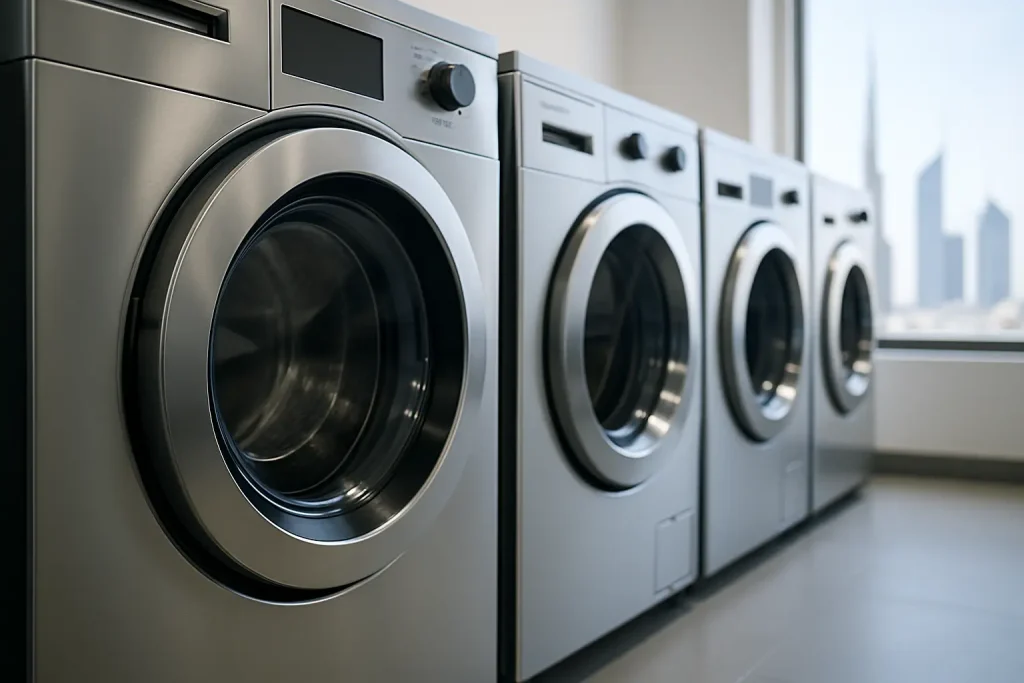
A commercial laundry in Dubai doesn’t get to “try again tomorrow.” When a washer-extractor is down, carts back up, shift schedules stretch, and customers feel it fast – especially in hotels, healthcare, and high-turn laundromats. That’s why selecting laundry equipment suppliers in Dubai is less about finding a brochure and more about building a supply line you can rely on: the right machine for your throughput, the right parts for your exact model, and a supplier who understands what downtime costs.
What buyers in Dubai actually need from a supplier
Most buyers don’t need more brands. They need fewer surprises.
A good supplier in this market should make three things easy: choosing correctly the first time, keeping equipment running after installation, and replenishing the small consumables that quietly keep production organized. If any of those are weak, the cheapest quote becomes the most expensive decision.
Uptime beats price – and Dubai is an uptime market
Dubai’s laundry demand is a throughput game. Hospitality and linen operations run tight turns. Laundromats compete on speed and consistency. OPL sites inside residential towers and staff accommodations often have limited machine counts, so one failure is instantly visible.
That changes how you should evaluate suppliers. The winning supplier is the one who can consistently support uptime – with availability, compatibility, and practical guidance – not the one with the most aggressive discount on day one.
One source for heavy equipment plus operating supplies
A supplier relationship gets easier when it consolidates the core categories you buy repeatedly. Commercial washers and dryers are the big ticket, but parts and consumables are what you scramble for when things get busy.
If your supplier can provide both infrastructure equipment (washers, washer-extractors, tumble dryers, stacked systems, heat-pump dryers) and the essentials that keep a plant organized (marking tapes, needles, fasteners, laundry pens, and spares), your purchasing becomes predictable. Your maintenance team also spends less time chasing compatible items across multiple vendors.
The shortlist criteria: how to evaluate laundry equipment suppliers in Dubai
Plenty of suppliers can sell you a machine. Fewer can support the full lifecycle. Here’s what to look for when you’re comparing options.
1) Brand and model continuity you can service
Commercial laundry isn’t a one-time purchase. It’s a 7- to 15-year operating decision.
Start by asking what the supplier supports consistently, not what they can “source once.” If you’re buying recognized commercial lines like Speed Queen, UniMac, Wascomat, and LaPauw, you want a supplier who regularly sells those platforms and understands the small differences between generations, control boards, door gaskets, drain valves, and stack configurations.
If the supplier’s catalog changes every few months, parts become a guessing game. That’s when downtime creeps in – not because the machine is bad, but because support is fragmented.
2) Parts readiness and the ability to confirm compatibility
A supplier’s parts capability is where the real test starts.
Ask direct questions: Do they stock common wear items? Can they identify the correct spare using your model and serial number? Do they provide the right consumables that match your workflow (identification tapes, marking tools, and fastening items) so your sorting and delivery doesn’t collapse into manual rework?
It depends on your operation, but most sites benefit from building a basic on-hand kit of predictable items. The supplier should be comfortable advising what belongs in that kit for your specific machines and usage level.
3) Practical sizing help – not just a spec sheet
Most procurement errors happen at sizing.
A washer-extractor that’s too small forces more cycles, higher labor per pound, and longer turnaround. A dryer bank that’s out of balance with your washer capacity creates a bottleneck you can’t fix with overtime. Stacked units can be the right move in tight footprints, but only if the loading pattern and venting plan are realistic.
A strong supplier asks about throughput goals, peak hours, linen types, and available utilities before they recommend a configuration. This is consultative, but it’s still procurement-friendly: you’re trying to prevent a mismatch that costs you every week.
4) Clear lead times and realistic logistics
Dubai projects move quickly, and many sites have immovable opening dates. Your supplier should give clear lead times on the exact models you’re quoting and be honest about what is in-stock versus what is inbound.
If your timeline is tight, consider whether an alternate configuration gets you running sooner without compromising long-term operating costs. Sometimes a slightly different capacity or control option is a smart trade when you account for revenue lost during delays.
5) Service coordination: who does what after delivery
Some suppliers also coordinate service support. Some sell equipment and leave installation and service fully to your side. Neither is automatically wrong – what matters is clarity.
Before you sign, confirm who handles commissioning, what documentation you’ll receive, and how parts requests are handled during the first critical months. If you already have technicians, you’ll value quick parts access and correct identification. If you don’t, you’ll value a supplier who can point you to dependable service pathways.
Equipment categories that matter most in Dubai operations
When buyers say “laundry equipment,” they often mean “washers and dryers.” In real operations, the right mix matters more than any single unit.
Washers vs washer-extractors: choose based on volume and extraction needs
Light commercial washers can fit certain low-to-mid volume sites. But for most professional operations handling linens, uniforms, or heavier goods, washer-extractors are the workhorse because extraction performance directly impacts dryer time, energy use, and throughput.
If you’re evaluating suppliers, look for those who can explain extraction speed, load factors, and how that translates into dryer requirements. A supplier who only talks capacity in kilograms isn’t finishing the job.
Tumble dryers and stacked systems: footprint vs flow
Tumble dryers are where bottlenecks show up first. A supplier should help you match dryer capacity to your wash side and your fabric mix.
Stacked washer/dryer systems can be a strong answer for limited space sites like multi-family housing, staff accommodations, and compact laundromats. The trade-off is that stacked layouts can be less flexible during peak loads, and maintenance access can be different than standalone units. You want a supplier who’s honest about those trade-offs rather than pushing stacks as a default.
Heat-pump dryers: where they fit and where they don’t
Industrial heat-pump dryers can make sense when energy strategy, ventilation limitations, or specific site constraints push you away from traditional setups. But they’re not a universal replacement.
The right supplier will qualify your use case: expected utilization, fabric types, required turnaround time, and whether your staff can support the operating discipline these systems may require. If your core KPI is fastest possible turn per hour, you may prioritize conventional capacity. If your KPI is energy profile and venting constraints, you may lean heat-pump.
The hidden category: consumables and identification supplies
High-output laundries don’t fail only on machines. They fail on mix-ups.
Marking tapes, laundry pens, needles, fasteners, and related accessories are small items that keep your plant organized, reduce lost-item disputes, and speed up sorting. In uniform programs and hospitality environments, identification isn’t optional – it’s how you avoid rework.
When you evaluate laundry equipment suppliers in Dubai, pay attention to whether they treat consumables as an afterthought or as part of a working system. A supplier who can keep these items available reduces your purchasing friction and helps your operation stay consistent week after week.
Questions to ask before you choose a supplier
You don’t need a long checklist. You need a few questions that force clarity.
Ask which brands and models they support continuously, what spare parts they stock locally versus order, and how they confirm compatibility. Ask how they recommend balancing washer capacity to dryer capacity for your target throughput. Ask what lead times look like for your specific configuration and what options exist if your deadline changes.
If the answers are vague, your after-sale experience will be vague too.
Where Abelco fits for buyers who want one dependable source
If your priority is a single specialized supplier relationship that covers commercial machines plus the recurring operating items that keep production moving, ABELCO EQUIPMENT TRADING LLC is built for that role. The focus stays on professional-grade laundry and dry-cleaning equipment and the practical supplies operators reorder constantly, with recognized commercial brands and the parts-and-consumables mindset that protects uptime. When it’s time to spec, replace, or stabilize your parts flow, you can start at https://Www.abelco.me.
A closing thought that helps on your next purchase
Treat your supplier decision like a production decision, not a purchasing task. The right partner is the one who can keep your exact machines running with the correct parts and the everyday supplies your staff reaches for without thinking – because that’s what keeps your customers from ever noticing there was a problem.