

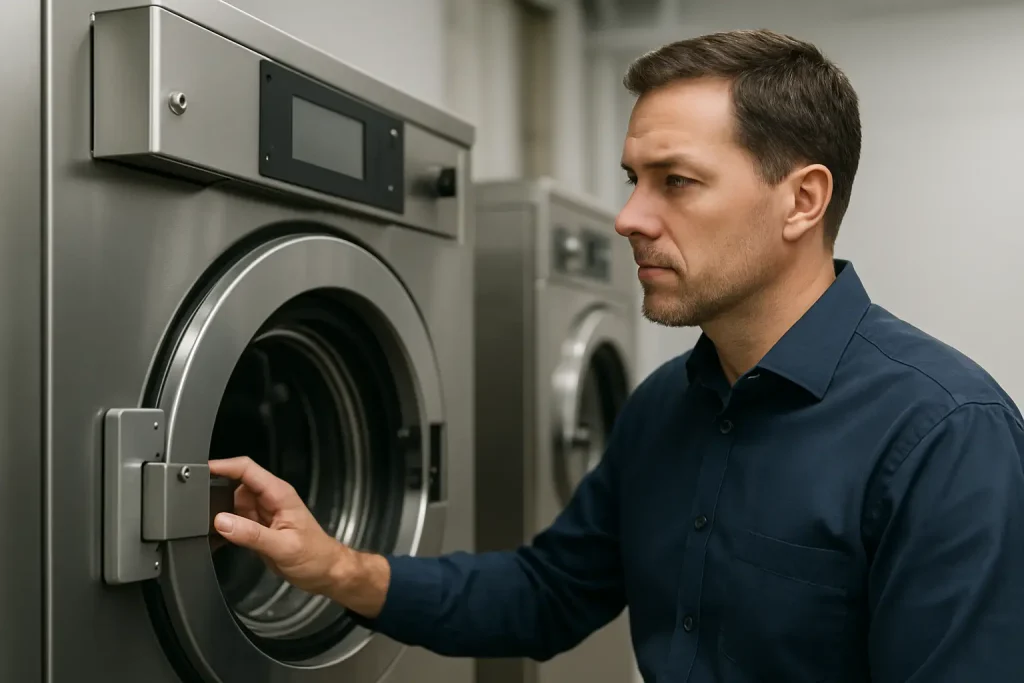
A good commercial washer doesn’t “do laundry.” It protects your uptime.
If you run a laundromat, OPL room, hotel laundry, healthcare plant, or a busy dry-cleaning back room, you already know the math: one down machine can turn into late deliveries, overtime, unhappy guests, or lost turns on the weekend. That’s why UniMac washers show up so often in serious facilities – they’re chosen less for marketing claims and more because operators want predictable cycles, durable build, and serviceability over years.
This article is written for buyers who are comparing options or planning a replacement and want fewer surprises after install.
Why UniMac washers are common in high-volume shops
Commercial laundry buyers usually care about three things first: throughput, reliability, and how quickly the machine can be returned to service when something goes wrong. UniMac has a long reputation in the commercial space because their machines are designed around that reality.
The practical advantage is not just “heavy-duty.” It’s that key wear points are engineered to take constant starts, stops, high-speed extraction, and daily chemical exposure. When the machine is also set up so techs can access components without a full teardown, downtime stays manageable.
There’s a trade-off: commercial-grade design typically carries higher upfront cost than light commercial or residential-style equipment. But if you’re running continuous loads, the replacement and downtime cost of cheaper machines usually shows up fast – especially when you factor in lost revenue per out-of-service day.
Picking the right UniMac washer type for your operation
Most buyers are choosing between a hard-mount washer-extractor and a soft-mount washer-extractor. Which one fits depends on your floor, your building constraints, and your workflow.
Hard-mount units anchor to a reinforced foundation. They’re a common fit in laundromats and plants that can plan for proper concrete and want long-term stability. They also tend to be straightforward in environments where vibration management is handled through the foundation design.
Soft-mount units use an internal suspension system. These are often the answer when you don’t want to build a heavy foundation or when you’re installing in a space where structural limits matter. Many on-premise laundry rooms in hospitality or multi-family housing lean this direction because it simplifies installation and reduces building modifications.
The “best” choice is situational. If you’re building new and can engineer the slab, hard-mount can be a solid long-term decision. If you’re retrofitting a laundry room and need flexibility, soft-mount can reduce friction and speed up the project.
Capacity planning: buy for peak reality, not average days
With UniMac washers, capacity planning is where operators either win or pay for it later.
If you undersize, you’ll run longer hours, stack work-in-process, and push labor costs up. If you oversize without the volume to keep the machine fed, you’ll waste water, energy, and chemistry – and your per-pound cost won’t look as good as it should.
For laundromats, your peak reality is weekends and evenings. A machine mix that looks fine on a Tuesday morning can fall apart Saturday afternoon. For hotels and healthcare, peak reality is linen changeover days, seasonal occupancy spikes, or delivery schedules.
A practical way to think about it is not just “pounds per load,” but “pounds per hour with your staffing.” A larger washer that sits waiting for sorting can be less productive than two right-sized machines that keep moving.
Controls and programmability: keep it simple, keep it consistent
Your control system choice affects more than convenience. It affects consistency across shifts and locations.
UniMac platforms typically give you options that range from simpler time-and-temp style operation to more programmable controls. The value of programmability shows up when you process varied goods: towels, sheets, uniforms, mats, and specialty items. When formulas are locked and repeatable, you reduce rewash and chemical overuse.
The trade-off is training and discipline. More control options can also mean more ways for staff to “experiment.” Many operators do best with a small set of approved programs, clearly named, with limited ability for end users to make on-the-fly changes.
If you’re a multi-site operator, standardizing control settings across all UniMac washers can simplify training, reduce mistakes, and make performance easier to compare.
Utilities: the hidden driver of operating cost
Most purchasing decisions focus on the machine price, but utilities drive lifetime cost.
Water use matters, but so does extraction speed. Better extraction reduces dryer time, which reduces gas or electric spend and increases dryer availability. In many operations, the washer-extractor’s ability to remove water efficiently is one of the biggest levers you have to reduce total processing time.
Your incoming water temperature strategy also matters. If you rely heavily on hot water, confirm your hot water capacity is realistic at peak hours. It’s common to install high-capacity equipment and then discover the building’s hot water system can’t keep up, forcing longer fills and inconsistent wash temperatures.
If you’re planning a new build or a major upgrade, it’s worth checking utilities early. The best washer in the world can’t compensate for undersized drains, weak water pressure, or a hot water system designed for a much smaller laundry.
Installation and footprint: what operators forget to measure
Most delays don’t come from the machine. They come from the room.
Before committing, confirm your doorways, turning clearance, ceiling height, and service access. Make sure you can open panels and reach critical components without moving the machine. Also confirm drain placement, chemical feed routing, and whether the floor needs reinforcement.
For OPL and institutional installs, noise and vibration can be a decision factor. A machine that performs well but disturbs adjacent rooms creates a different kind of operational problem. That’s where the hard-mount vs soft-mount decision can become more than a technical preference.
Serviceability and parts continuity: what “uptime” really means
Uptime is not just build quality. It’s also the speed of diagnosis, availability of parts, and whether you can maintain the machine without waiting weeks.
When you evaluate UniMac washers, think in terms of service events:
A normal operation should expect routine maintenance, periodic replacement of wear components, and the occasional unexpected issue. Your goal is to make those events short and predictable.
That’s where having a single supplier relationship for equipment and recurring operational items can help. If you’re sourcing machines from one place, consumables from another, and parts from whoever answers the phone, you’re adding procurement time to every maintenance event.
At ABELCO EQUIPMENT TRADING LLC, we’re specialized in the laundry and dry-cleaning equipment industry and supply commercial laundry equipment alongside the consumables and spare parts operators rely on to keep production moving. If you want a single-source procurement approach for UniMac and other recognized commercial brands, you can reach us at https://Www.abelco.me.
Where UniMac washers tend to fit best (and when to reconsider)
UniMac washers tend to be a strong fit when you need predictable daily throughput, strong extraction, and machines that are designed to be maintained.
They’re often a smart choice for:
- Laundromats with steady turns and weekend peaks
- Hotels that need consistent linen cycles and fast recovery after rush periods
- Healthcare and linen services where repeatable formulas and uptime are non-negotiable
- Multi-family and institutional OPL rooms where install constraints matter but durability still has to be commercial
When should you reconsider or at least slow down? If your operation is low-volume, highly variable, or constrained by utilities you can’t upgrade, you may not realize the full value of a heavier commercial platform. Also, if you can’t support the machine with a realistic maintenance plan, even the best equipment will get dragged down by neglect.
Buying approach: how to avoid the common procurement mistakes
Most problems happen when buyers select a washer on headline capacity alone.
Instead, align four things before you purchase: your goods mix (what you wash), your peak hours (when you wash), your utilities (what the building can support), and your maintenance plan (how you’ll keep it running). When those are clear, choosing between models and configurations becomes straightforward.
If you’re building a new site or planning a major refit, it’s also worth thinking about standardization. Running the same washer platform across locations simplifies training, parts stocking, and service procedures. That’s not a small advantage when you have staff turnover or multiple shifts.
A final point that experienced operators respect: faster isn’t always better. A cycle that’s too aggressive can increase linen wear, cause quality complaints, or drive rewash. Your best program is the one that meets quality standards consistently while protecting textiles and keeping the line moving.
A helpful closing thought: if you’re choosing UniMac washers, buy them with a plan for the room, the utilities, and the parts you’ll want on hand – because the easiest way to protect revenue is to make downtime boring and predictable.