

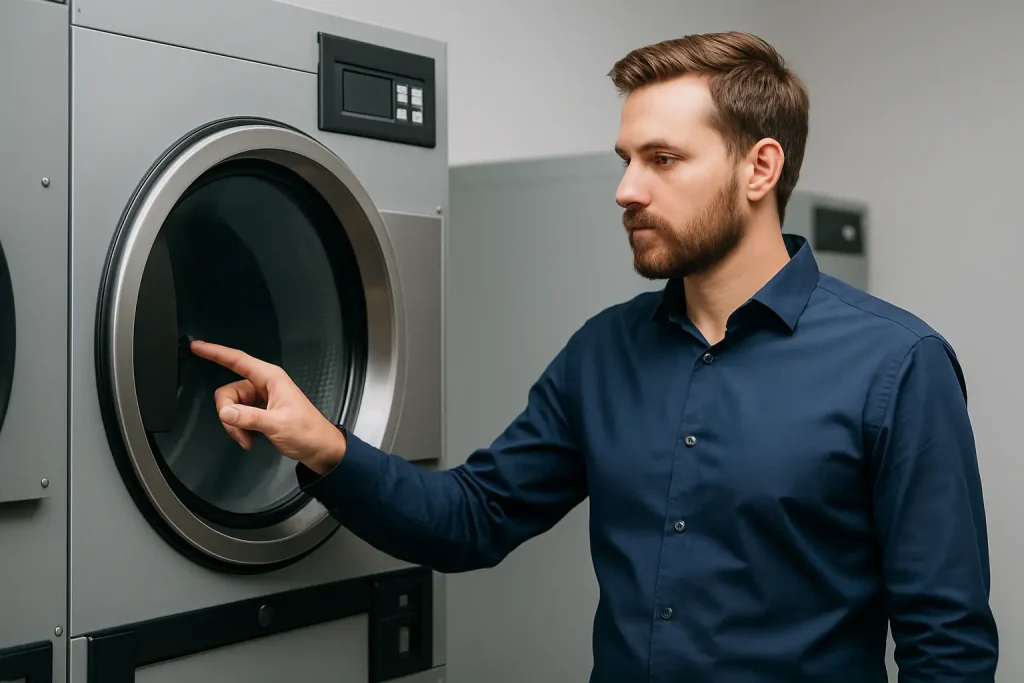
A dryer that runs hot but sits down for parts is not a “good dryer.” In a laundromat, hotel basement, healthcare linen room, or dry-cleaning plant, the only number that matters at 7:00 a.m. is how many loads you can finish before the rush hits. That is why UniMac dryers show up so often in serious commercial laundry builds – they’re bought for throughput, consistency, and serviceability, not because they look nice on a spec sheet.
This is a practical buying guide to unimac dryers with an operator’s lens: what to prioritize, what to trade off, and what to confirm before you place an order.
What operators mean when they ask for UniMac dryers
Most buyers asking for “UniMac dryers” are really asking for three outcomes: predictable dry times, high uptime, and straightforward maintenance. UniMac’s commercial heritage speaks to those needs, especially in settings where dryer performance is tied to customer satisfaction (coin laundries) or compliance and cost control (hospitality and healthcare).
You will still have decisions to make. A dryer line can include multiple capacities, pocket configurations, heat options, airflow packages, and control types. If you buy the wrong mix, you can end up with a room full of machines that technically work but never quite match your workflow.
Start with capacity and pocket strategy, not brand
Capacity is where ROI is won or lost. Too small and you create a bottleneck. Too large and you burn capital, floor space, and utility demand for capacity you rarely use.
In laundromats, the “right” approach is usually a blend: a core of mid-size pockets that stay busy all day and a smaller number of large pockets for comforters and bulk loads. In hotels and on-premise laundry rooms, the decision is more about matching washer-extractor output and linen mix. If your washers are producing consistent batch weights, dryers should be sized to finish those batches without overloading or excessive empty space.
Stacked configurations can be a smart fit when square footage is expensive or limited. They help you add pockets without expanding footprint, but they do concentrate maintenance and airflow management into a taller, tighter install. That is not a dealbreaker – it just means your venting plan and service access matter more.
Heat source: gas vs electric is a business decision
Most commercial operators prefer gas for cost-per-BTU and faster recovery, but the best choice depends on your site utilities and your downtime risk.
Gas drying typically provides strong heat output and can reduce cycle times, which matters in high-turn laundromats and production-focused OPL sites. The trade-off is that gas installs bring more variables: gas line sizing, regulator quality, combustion air, and venting discipline. When any of those are off, performance suffers and service calls go up.
Electric drying can be simpler when gas is not available or when project constraints make gas upgrades expensive. Electric can also be easier to standardize across certain facilities. The trade-off is operating cost and, in some markets, longer dry times depending on heater package and airflow.
If you are building or expanding, don’t decide based only on unit price. Decide based on installed cost, expected run hours, utility rates, and your tolerance for longer cycle times.
Airflow and venting: where “good dryers” quietly fail
Drying is not just heat – it’s heat plus airflow plus moisture removal. A high-quality dryer can still underperform if the venting is undersized, too long, or built with unnecessary elbows.
For unimac dryers, the practical rule is simple: treat venting like production equipment, not a construction afterthought. Poor venting shows up as longer dry times, higher energy use, more heat stress on components, and lint accumulation where you don’t want it.
If you are evaluating dryers for a new build, validate your vent plan early: duct diameter, run length, number of turns, make-up air, and whether each pocket has an appropriate exhaust path. If you’re replacing existing dryers, don’t assume the old venting is “good enough.” Older layouts often worked only because everyone tolerated slow cycles.
Controls: keep it simple unless you need accountability
UniMac dryers are available with different control styles, from straightforward timer-based setups to more programmable options.
In coin and vended environments, simplicity is often the best form of customer service. Clear cycle options reduce user confusion and reduce the “refund conversation.” In staff-operated OPL environments, programmability can be valuable if you need consistency across shifts or specific cycle profiles for linen types.
The trade-off is training and troubleshooting. More advanced controls can give you better visibility and fine-tuning, but they also introduce more points of configuration. If your facility has high staff turnover or limited maintenance coverage, choose the control package that your team will actually use correctly.
Matching dryer performance to your linen reality
Two sites can buy the same dryer and get completely different results.
- Hospitality towels and sheets generally reward consistent, repeatable cycles. The goal is fast turnaround without overdrying.
- Healthcare linens can bring higher moisture loads and stricter expectations around finish consistency.
- Laundromats see wide variability in customer behavior – chronic overloading is common.
That last point matters. If your business model includes the public, you are not just buying a dryer – you are buying tolerance for misuse. Plan capacity and cycle options with real customer behavior in mind, not ideal loading.
Maintenance and parts: the real reason buyers stick with commercial lines
Commercial laundry operators don’t fall in love with a machine. They stick with a platform because it’s serviceable.
With unimac dryers, your goal should be to set up a maintenance rhythm that protects airflow, keeps heat consistent, and avoids surprise shutdowns.
Lint management is the daily driver. A disciplined lint routine reduces dry times, reduces heat stress, and lowers fire risk. Beyond lint, plan for periodic checks on belts, bearings, igniters (for gas), sensors, and door switches. If you run high volume, those “small” components become uptime components.
The procurement side matters too. The fastest repair is the one you can do immediately because you have the right spares. If you are standardizing on a dryer line across multiple locations, consider keeping a small shelf of common wear items so you’re not waiting on shipments when a pocket goes down.
New build vs replacement: different priorities
If you’re opening a new facility or doing a full retrofit, you can design for dryer performance: correct venting, balanced electrical loads, proper gas sizing, and workable service clearances. That environment lets unimac dryers perform the way they were intended.
If you’re replacing existing dryers in a live operation, the priority shifts to minimizing disruption. Door swing, footprint, utility connections, and vent alignment start to matter as much as capacity. Sometimes the “best” dryer on paper creates too much install downtime. In those cases, it can be smarter to choose the model that integrates cleanly, then upgrade venting in phases.
Where UniMac dryers tend to fit best
You see UniMac dryers frequently in vended laundries, hotels, and institutional OPL rooms because those sites share a common demand: repeatable cycles and equipment that can take day-after-day use.
They also make sense in mixed portfolios where operators want to standardize training and parts across several equipment types. Standardization is not exciting, but it lowers operational friction. Fewer variations means fewer surprises, faster troubleshooting, and more predictable service.
What to confirm before you buy
Most dryer mistakes are preventable if you confirm a few practical details up front.
First, confirm your load weights and your real throughput target per day. If you guess, you will overspend or underbuild.
Second, confirm utilities at the machine location – not just “we have gas” or “we have electric,” but the actual capacity, line sizing, and constraints that affect performance.
Third, confirm venting feasibility. If your vent path is long or complicated, you may need to redesign it or choose equipment and placement that reduces restriction.
Finally, confirm your service plan. If you have in-house maintenance, choose the configuration that they can support confidently. If you rely on outside service, choose a platform and supplier relationship that can keep parts moving quickly.
If you want a single source for commercial laundry equipment plus the recurring consumables and spare parts that keep your operation running, ABELCO EQUIPMENT TRADING LLC is specialized in the laundry and dry-cleaning equipment industry and supports operators who prioritize uptime and continuity of supply. You can reach us at https://Www.abelco.me.
The buying mindset that protects ROI
A dryer is not a one-time purchase. It is a production asset that either protects your schedule or disrupts it.
When you evaluate unimac dryers, make your decision the way experienced operators do: size for real loads, design for airflow, choose the heat source that matches your utility reality, and prioritize serviceability over features you will never use. Then hold your install to the same standard as your equipment.
The best outcome is simple: customers get their laundry done on time, your staff stops fighting the machines, and your day runs the way it’s supposed to.