

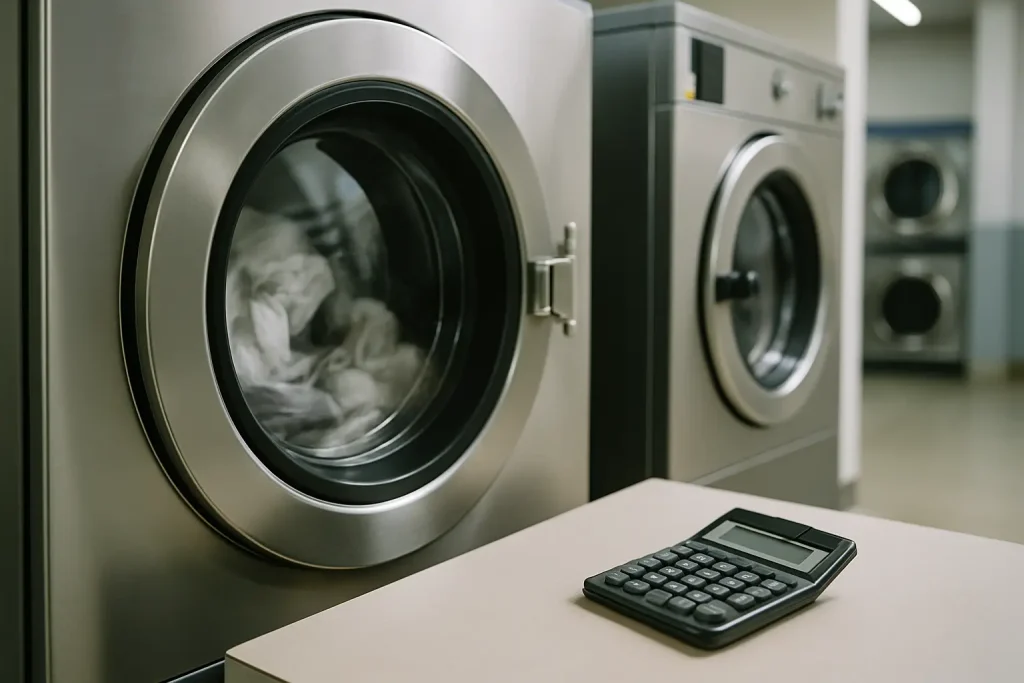
A laundromat rarely loses customers because of detergent. It loses them because machines are down, cycles take too long, or the store shakes like a jackhammer when a load goes out of balance. If you are evaluating a hard mount washer extractor for laundromat use, you are usually trying to solve one of three problems: improve throughput, reduce maintenance surprises, or get more predictable performance per square foot.
Hard-mount washer-extractors are not a universal “best.” They are a specific tool that performs extremely well when the building, installation plan, and usage pattern match the design. Below is the practical, operations-first way to decide.
What a hard-mount washer-extractor really is
A hard-mount washer-extractor is bolted to a reinforced concrete foundation. Unlike soft-mount machines that sit on springs and dampers, a hard-mount unit transfers more vibration to the slab, so the slab has to be built for it. The payoff is a simpler mechanical platform and a machine that can run for years with fewer suspension-related wear items.
For laundromats, hard-mount machines are most commonly used where owners want commercial-grade durability, straightforward serviceability, and consistent extraction performance. You will see them in higher-volume stores, mixed-use operations, and locations where operators prefer a “built for work” approach over maximum vibration isolation.
Why laundromat owners choose hard-mount
Hard-mount selection is usually driven by practical math, not marketing.
First, hard-mount units can be a strong fit for stores that want predictable uptime. With fewer suspension components than many soft-mount designs, there is less to drift out of spec over time. That does not eliminate maintenance, but it can simplify it.
Second, they can support a clean, repeatable install standard across multiple sites. If you are building new or doing a major remodel, pouring to spec once and installing the same platform repeatedly is easier to manage.
Third, they can make sense where floor stability is already excellent and you are not trying to “float” the machine to protect an older structure.
The trade-off is real: if your slab is not right, a hard-mount washer will remind you every day.
The biggest decision: your floor, not the machine
Before brands, before capacity, before price, the building decides whether a hard-mount washer extractor for laundromat use is a smart purchase.
A proper hard-mount install generally requires a reinforced concrete foundation designed to handle dynamic loads. That means thickness, rebar, concrete strength, and anchoring all matter. If you are in a retrofit location, you may be looking at saw-cutting, repouring pads, or adding structural reinforcement. On upper floors or suspended slabs, hard-mount often becomes impractical unless the structure was engineered for it.
If you are not sure, treat that uncertainty as a cost. A structural review up front is cheaper than cracked grout lines, walking machines, constant out-of-balance shutdowns, and customer complaints.
Extraction performance and the real cost: drying time
Operators sometimes focus on wash time and ignore what extraction does to their dryer lane. Higher extraction G-force pulls more water out before the load hits the dryer. That can reduce dry time, free up dryer capacity, and lower utility consumption.
Not every hard-mount model automatically means higher G-force than every soft-mount model. You have to check the spec. But in general, washer-extractors designed for commercial production work tend to prioritize strong, repeatable extraction.
If your dryers are your bottleneck, extraction becomes a profit lever. A few minutes saved per load shows up as shorter lines, faster turns, and fewer complaints about “the dryers don’t work.”
Capacity planning: buy for mix, not averages
Laundromat capacity planning goes wrong when owners buy only for average loads. Your peaks – weekends, evenings, seasonal spikes – are what drive customer satisfaction.
Hard-mount washer-extractors are commonly chosen in mid-to-large capacities where the machine is expected to run heavy all day. But the correct size is still about customer mix:
If you have a strong share of comforters and bulky items, you need larger cylinders and fewer “almost fits” loads that customers overload. If you serve a lot of weekly family laundry, mid-size machines with fast turns can outperform fewer large units.
Also pay attention to how capacity lines up with your dryer pockets. If you install large washers but your dryer bank cannot accept that same load comfortably, you create a new bottleneck.
Hard-mount vs soft-mount: where each wins
Soft-mount machines earn their place in many laundromats because they reduce transmitted vibration and can be more forgiving in older buildings. They are often easier to place without major concrete work, and that can shorten time to open.
Hard-mount machines win when you want a straightforward mechanical platform, your foundation is engineered correctly, and you are thinking long-term service cycles. For owners building a new store or doing a full slab upgrade, hard-mount can be an intentional “do it once” decision.
It depends on your building and your tolerance for installation work. If you are leasing a space with unknown slab details and a short lease horizon, soft-mount may be the safer operational bet.
Controls, programming, and vend flexibility
Laundromat operators live and die by cycle consistency and flexibility. When you compare hard-mount washer-extractors, look past the brochure language and focus on day-to-day operations:
Programming options should let you tune water levels, temperature steps, and extraction profiles for different vend prices. If you plan to offer premium cycles, make sure the control supports it cleanly.
Service access matters. A machine can have great specs and still be a headache if routine service requires excessive disassembly.
And if you run attendant-assisted services or plan to add wash-dry-fold, you will care about repeatability. You want the same result load after load, operator after operator.
Installation details that prevent expensive problems
Hard-mount installs are unforgiving. Small shortcuts become recurring issues.
Anchoring is not a minor step. Correct anchors, correct torque, and correct layout keep the machine stable under real-world imbalance. Leveling is equally important, not for appearance, but to reduce chronic vibration and premature component wear.
Drain and supply sizing also matter more than many expect. If your drain cannot keep up, you add minutes to every cycle and create intermittent faults that look like “machine issues” but are really plumbing constraints.
If you are planning a new build, coordinate machine selection with your contractor early. The cost of moving a drain trench on paper is nothing compared to jackhammering after the fact.
Brand considerations: prioritize parts continuity
In a laundromat, the best machine is the one you can keep running.
When you evaluate commercial lines such as Speed Queen, UniMac, Wascomat, and LaPauw, prioritize parts availability, commonality across your fleet, and how quickly you can get wear items. A store with ten machines from five different platforms can turn simple maintenance into a procurement problem.
This is where a specialized supplier helps. If you want to reduce downtime, you do not just buy the washer-extractor. You plan the parts shelf: door gaskets, drain valves, belts if applicable, key sensors, and common fasteners. If you are running route-style maintenance, you standardize.
ABELCO EQUIPMENT TRADING LLC is specialized in the laundry and dry-cleaning equipment industry and supports operators with professional-grade equipment plus the consumables and spare parts that keep uptime high – you can see the catalog at https://Www.abelco.me.
Operating costs: what to measure after the install
A hard-mount washer extractor for laundromat use should be evaluated like an asset, not a one-time purchase.
Water and energy consumption are obvious, but you should also track rewash rates and out-of-balance interruptions. If customers frequently overload and the machine cannot complete extraction smoothly, your “high capacity” turns into slower throughput and more refunds.
Pay attention to chemical compatibility and dispenser setup if you use automated dosing or vend chemicals. The wrong setup creates residue, odors, and customer complaints that look like “bad machines” but are really process issues.
Finally, measure dryer minutes per washer load. If extraction is doing its job, dryer usage should come down or throughput should go up. If it does not, revisit programming and load guidance signage.
A practical way to decide if hard-mount is right
If you are still on the fence, make the decision in this order.
Start with the building. If you cannot confidently build or verify the foundation, stop and price that work first. Then confirm your bottleneck: washers, dryers, or floor space. If dryers are tight, prioritize extraction performance and cycle programming that supports your vend strategy.
Next, choose a platform you can support. Standardize where possible, and make sure you have a clear path to routine parts. Then align capacity to your customer mix and your dryer bank, not just the biggest machine you can fit.
Hard-mount is the right answer when you want commercial durability, predictable service, and you can install it correctly. When those conditions are true, it is a very hard setup to beat.
A helpful closing thought: before you sign off on any machine quote, walk your store layout and picture a busy Saturday – the right choice is the one that keeps customers moving, keeps your tech visits predictable, and keeps your equipment plan simple enough to manage for years.